







Question: Plz also show the transition matrix Plz include the steps with transition matrix in the tennis scoring system, anca at dece, a player ses two


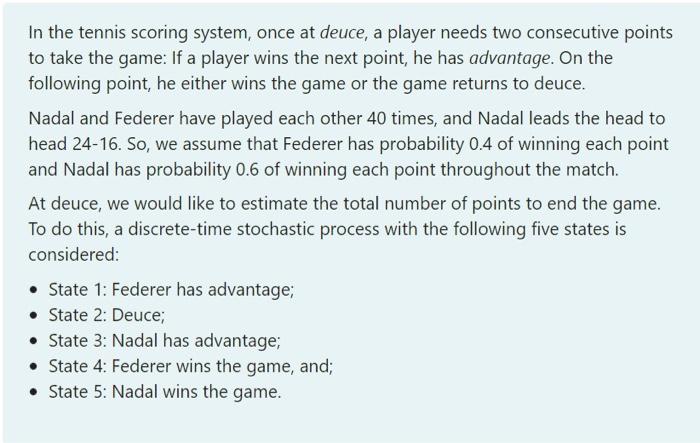
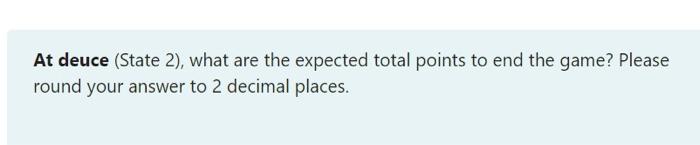
in the tennis scoring system, anca at dece, a player ses two consecutive points to take the game it a player wins the next point, he has antage. On the following point he either wins the game or the game returns to dece Nadal and Federer have played each other 40 times and Nadal leach the head to head 24-10. So we assume that Federer has probablity 0.4 of winning each point and Nadal has probability 0.6 of winning each point throughout the match At deuce we would like to estimate the total number of points to and the game to do this a discute-time stochastic process with the tutowing five states is considered State 1: Federer has advantage State Dece State 3: Nadal has advantage State & Federer wins the game and State 5 Nadal wies the game At deuce (State 2), what are the expected total points to end the game? Please round your answ In the tennis scoring system, once at deuce, a player needs two consecutive points to take the game: If a player wins the next point, he has advantage. On the following point, he either wins the game or the game returns to deuce. Nadal and Federer have played each other 40 times, and Nadal leads the head to head 24-16. So, we assume that Federer has probability 0.4 of winning each point and Nadal has probability 0.6 of winning each point throughout the match. At deuce, we would like to estimate the total number of points to end the game. To do this, a discrete-time stochastic process with the following five states is considered: State 1: Federer has advantage; State 2: Deuce; State 3: Nadal has advantage; State 4: Federer wins the game, and; State 5: Nadal wins the game. At deuce (State 2), what are the expected total points to end the game? Please round your answer to 2 decimal places. in the tennis scoring system, anca at dece, a player ses two consecutive points to take the game it a player wins the next point, he has antage. On the following point he either wins the game or the game returns to dece Nadal and Federer have played each other 40 times and Nadal leach the head to head 24-10. So we assume that Federer has probablity 0.4 of winning each point and Nadal has probability 0.6 of winning each point throughout the match At deuce we would like to estimate the total number of points to and the game to do this a discute-time stochastic process with the tutowing five states is considered State 1: Federer has advantage State Dece State 3: Nadal has advantage State & Federer wins the game and State 5 Nadal wies the game At deuce (State 2), what are the expected total points to end the game? Please round your answ In the tennis scoring system, once at deuce, a player needs two consecutive points to take the game: If a player wins the next point, he has advantage. On the following point, he either wins the game or the game returns to deuce. Nadal and Federer have played each other 40 times, and Nadal leads the head to head 24-16. So, we assume that Federer has probability 0.4 of winning each point and Nadal has probability 0.6 of winning each point throughout the match. At deuce, we would like to estimate the total number of points to end the game. To do this, a discrete-time stochastic process with the following five states is considered: State 1: Federer has advantage; State 2: Deuce; State 3: Nadal has advantage; State 4: Federer wins the game, and; State 5: Nadal wins the game. At deuce (State 2), what are the expected total points to end the game? Please round your answer to 2 decimal places
Step by Step Solution
There are 3 Steps involved in it

Get step-by-step solutions from verified subject matter experts
 Study Help