







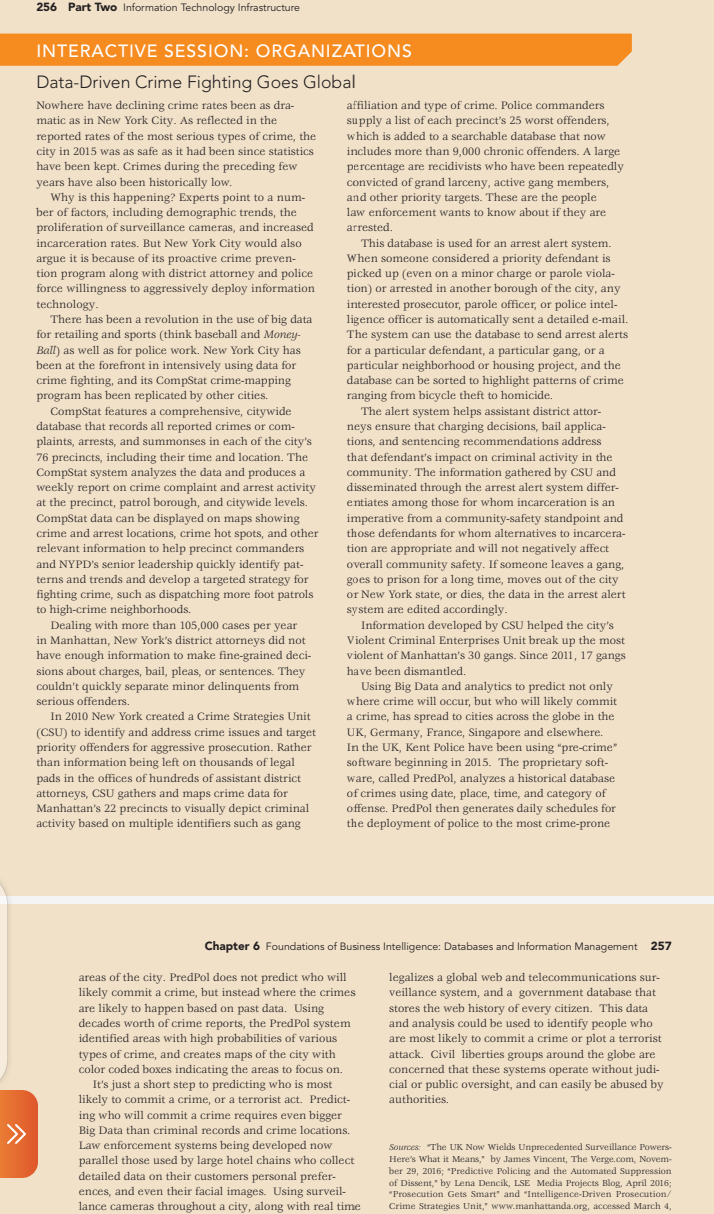
Question: plz answer quickly according to this 2. What problems does this approach to crime fight- ing pose? 256 Part Two Information Technology Infrastructure INTERACTIVE SESSION:

plz answer quickly according to this
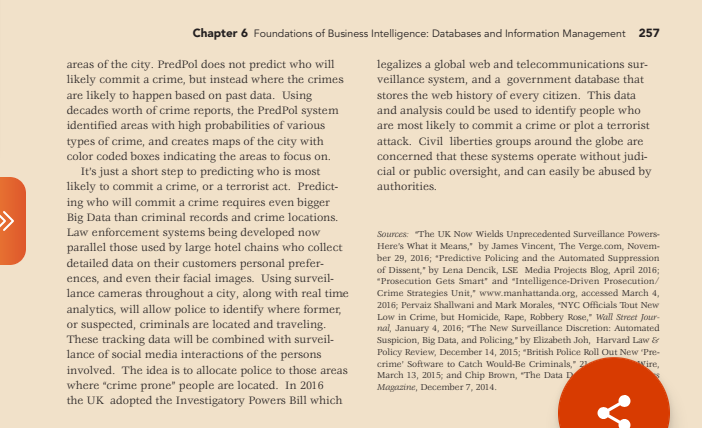
2. What problems does this approach to crime fight- ing pose? 256 Part Two Information Technology Infrastructure INTERACTIVE SESSION: ORGANIZATIONS Data-Driven Crime Fighting Goes Global Nowhere have declining crime rates been as dra- affiliation and type of crime. Police commanders matic as in New York City. As reflected in the supply a list of each precinct's 25 worst offenders, reported rates of the most serious types of crime, the which is added to a searchable database that now city in 2015 was as safe as it had been since statistics includes more than 9,000 chronic offenders. A large have been kept. Crimes during the preceding few percentage are recidivists who have been repeatedly years have also been historically low. convicted of grand larceny, active gang members, Why is this happening? Experts point to a num- and other priority targets. These are the people ber of factors, including demographic trends, the law enforcement wants to know about if they are proliferation of surveillance cameras, and increased arrested incarceration rates. But New York City would also This database is used for an arrest alert system. argue it is because of its proactive crime preven- When someone considered a priority defendant is tion program along with district attorney and police picked up (even on a minor charge or parole viola- force willingness to aggressively deploy information tion) or arrested in another borough of the city, any technology. interested prosecutor, parole officer, or police intel- There has been a revolution in the use of big data ligence officer is automatically sent a detailed e-mail. for retailing and sports (think baseball and Money- The system can use the database to send arrest alerts Ball) as well as for police work. New York City has for a particular defendant, a particular gang, or a been at the forefront in intensively using data for particular neighborhood or housing project, and the crime fighting, and its CompStat crime-mapping database can be sorted to highlight patterns of crime program has been replicated by other cities. ranging from bicycle theft to homicide. CompStat features a comprehensive, citywide The alert system helps assistant district attor- database that records all reported crimes or com- neys ensure that charging decisions, bail applica- plaints, arrests, and summonses in each of the city's tions, and sentencing recommendations address 76 precincts, including their time and location. The that defendant's impact on criminal activity in the CompStat system analyzes the data and produces a community. The information gathered by CSU and weekly report on crime complaint and arrest activity disseminated through the arrest alert system differ- at the precinct, patrol borough, and citywide levels. entiates among those for whom incarceration is an CompStat data can be displayed on maps showing imperative from a community-safety standpoint and crime and arrest locations, crime hot spots, and other those defendants for whom alternatives to incarcera- relevant information to help precinct commanders tion are appropriate and will not negatively affect and NYPD's senior leadership quickly identify pat- overall community safety. If someone leaves a gang, terns and trends and develop a targeted strategy for goes to prison for a long time, moves out of the city fighting crime, such as dispatching more foot patrols or New York state, or dies, the data in the arrest alert to high-crime neighborhoods. system are edited accordingly. Dealing with more than 105,000 cases per year Information developed by CSU helped the city's in Manhattan, New York's district attorneys did not Violent Criminal Enterprises Unit break up the most have enough information to make fine-grained deci- violent of Manhattan's 30 gangs. Since 2011, 17 gangs sions about charges, bail, pleas, or sentences. They have been dismantled. couldn't quickly separate minor delinquents from Using Big Data and analytics to predict not only serious offenders where crime will occur, but who will likely commit In 2010 New York created a Crime Strategies Unit a crime, has spread to cities across the globe in the (CSU) to identify and address crime issues and target UK, Germany, France, Singapore and elsewhere. priority offenders for aggressive prosecution. Rather In the UK, Kent Police have been using "pre-crime" than information being left on thousands of legal software beginning in 2015. The proprietary soft- pads in the offices of hundreds of assistant district ware, called PredPol, analyzes a historical database attorneys, CSU gathers and maps crime data for of crimes using date, place, time, and category of Manhattan's 22 precincts to visually depict criminal offense. PredPol then generates daily schedules for activity based on multiple identifiers such as gang the deployment of police to the most crime-prone m Chapter 6 Foundations of Business Intelligence: Databases and Information Management 257 areas of the city. PredPol does not predict who will likely commit a crime, but instead where the crimes are likely to happen based on past data. Using decades worth of crime reports, the Pred Pol system identified areas with high probabilities of various types of crime, and creates maps of the city with color coded boxes indicating the areas to focus on It's just a short step to predicting who is most likely to commit a crime, or a terrorist act. Predict- ing who will commit a crime requires even bigger Big Data than criminal records and crime locations. Law enforcement systems being developed now parallel those used by large hotel chains who collect detailed data on their customers personal prefer- ences, and even their facial images. Using surveil- lance cameras throughout a city, along with real time legalizes a global web and telecommunications sur- veillance system, and a government database that stores the web history of every citizen. This data and analysis could be used to identify people who are most likely to commit a crime or plot a terrorist attack. Civil liberties groups around the globe are concerned that these systems operate without judi- cial or public oversight, and can easily be abused by authorities. Sources: The UK Now Wields Unprecedented Surveillance Powers- Here's What it Means," by James Vincent, The Verge.com, Novem- ber 29, 2016; "Predictive Policing and the Automated Suppression of Dissent," by Lena Dencik, LSE Media Projects Blog, April 2016; "Prosecution Gets Smart" and "Intelligence-Driven Prosecution/ Crime Strategies Unit," www.manhattanda.org, accessed March 4, Chapter 6 Foundations of Business Intelligence: Databases and Information Management 257 legalizes a global web and telecommunications sur- veillance system, and a government database that stores the web history of every citizen. This data and analysis could be used to identify people who are most likely to commit a crime or plot a terrorist attack. Civil liberties groups around the globe are concerned that these systems operate without judi- cial or public oversight, and can easily be abused by authorities. areas of the city. PredPol does not predict who will likely commit a crime, but instead where the crimes are likely to happen based on past data. Using decades worth of crime reports, the Predpol system identified areas with high probabilities of various types of crime, and creates maps of the city with color coded boxes indicating the areas to focus on. It's just a short step to predicting who is most likely to commit a crime, or a terrorist act. Predict- ing who will commit a crime requires even bigger Big Data than criminal records and crime locations. Law enforcement systems being developed now parallel those used by large hotel chains who collect detailed data on their customers personal prefer- ences, and even their facial images. Using surveil- lance cameras throughout a city, along with real time analytics, will allow police to identify where former, or suspected, criminals are located and traveling. These tracking data will be combined with surveil- lance of social media interactions of the persons involved. The idea is to allocate police to those areas where "crime prone" people are located. In 2016 the UK adopted the Investigatory Powers Bill which Sources: The UK Now Wields Unprecedented Surveillance Powers- Here's What it Means," by James Vincent, The Verge.com, Novem- ber 29, 2016; "Predictive Policing and the Automated Suppression of Dissent," by Lena Dencik, LSE Media Projects Blog, April 2016; "Prosecution Gets Smart" and "Intelligence-Driven Prosecution/ Crime Strategies Unit," www.manhattanda.org, accessed March 4, 2016; Pervaiz Shallwani and Mark Morales, "NYC Officials Tout New Low in Crime, but Homicide, Rape, Robbery Rose," Wall Street Jour- nal, January 4, 2016; "The New Surveillance Discretion: Automated Suspicion, Big Data, and Policing," by Elizabeth Joh, Harvard Law & Policy Review, December 14, 2015; "British Police Roll Out New Pre- crime' Software to Catch Would-Be Criminals," Wire, March 13, 2015, and Chip Brown, "The Data D Magazine, December 7, 2014Step by Step Solution
There are 3 Steps involved in it
1 Expert Approved Answer
Step: 1 Unlock

Question Has Been Solved by an Expert!
Get step-by-step solutions from verified subject matter experts
Step: 2 Unlock
Step: 3 Unlock
 Study Help