



Question: Plz answer these questions Consider a three-person coalitional game in which .((O}) = ((1}) = ({2}) = ({3)) = 0, v({1, 2}) = 6, v({1,3})
Plz answer these questions
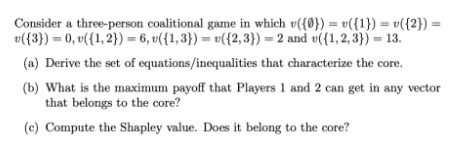
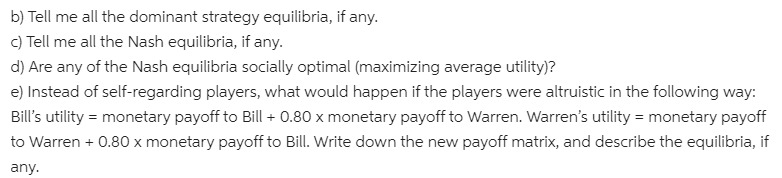
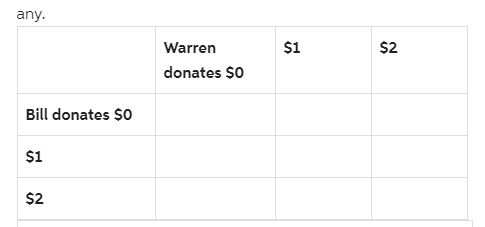
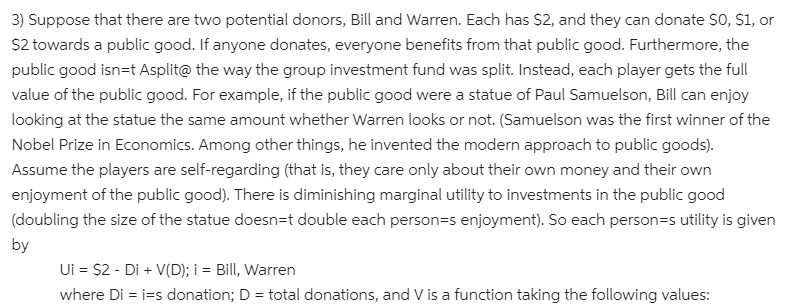
Consider a three-person coalitional game in which .((O}) = ((1}) = ({2}) = "({3)) = 0, v({1, 2}) = 6, v({1,3}) = v({2,3}) = 2 and v( {1, 2,3}) = 13. (a) Derive the set of equations/inequalities that characterize the core. (b) What is the maximum payoff that Players 1 and 2 can get in any vector that belongs to the core? (c) Compute the Shapley value. Does it belong to the core?b] Tell me all the dominant strategy equilibria, if any. (:1 Tell me all the Nash equilibn'a, if any. d] Are any of the Nash equilibn'a socially optimal [maximizing average utility}? e} Instead of selfregarding players, what would happen if the players were altruistic in the following way: Bill's utility = monetary payoff to Bill + 0.80 x monetary payoff to Warren. Warren's utility = monetary payoff to Warren + 0.80 x monetary payoff to Bill. Write down the new payoff matrix, and descn'be the equilibria. if any. \f3} Suppose that there are two potential donors, Bill and Warren. Each has 82, and they can donate $0, 51, or 52 towards a public good. if anyone donates, everyone benets from that public good. Furthermore, the public good isn=t Asplitll the way the group investment fund was split. Instead, each player gets the full value of the public good. For example, if the public good were a statue of Paul Samuelson, Bill can enjoy looking at the statue the same amount whether Warren looks or not. [Samuelson was the rst winner of the Nobel Prize in Economics. Among other things, he invented the modern approach to public goods}. Assume the players are self-regarding [that is, they care only about their own money and their own enjoyment of the public good}. There is diminishing marginal utility to investments in the public good [doubling the size of the statue doesn=t double each person=s enjoyment}. So each person=s utility is given by Ui = $2 - Di +V{D}; i= Bill, Warren where Di = i=s donation; D = total donations, and 'v' is a function taking the following values
Step by Step Solution
There are 3 Steps involved in it

Get step-by-step solutions from verified subject matter experts