







Question: plz clear calculation and it is numerical methods and optimization Medical laboratory wastewater (MLW) comes from laboratories which contains various chemicals, alcohols, solvents, and dyes.


 plz clear calculation and it is numerical methods and optimization
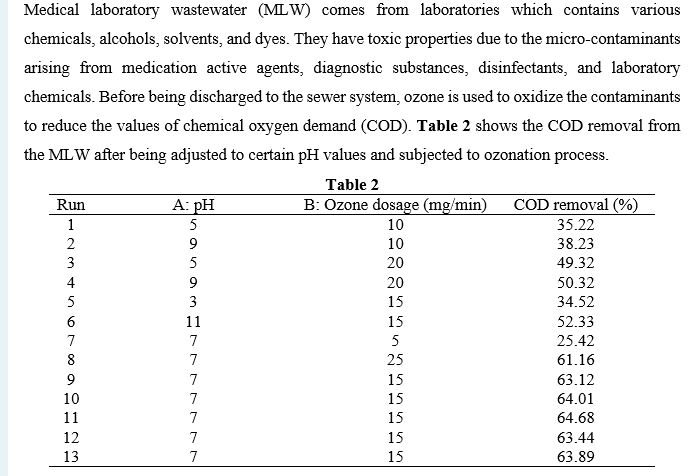
Medical laboratory wastewater (MLW) comes from laboratories which contains various chemicals, alcohols, solvents, and dyes. They have toxic properties due to the micro-contaminants arising from medication active agents, diagnostic substances, disinfectants, and laboratory chemicals. Before being discharged to the sewer system, ozone is used to oxidize the contaminants to reduce the values of chemical oxygen demand (COD). Table 2 shows the COD removal from the MLW after being adjusted to certain pH values and subjected to ozonation process. Table 2 Run A: pH B: Ozone dosage (mg/min) COD removal (%) 1 5 10 35.22 2 9 10 38.23 3 5 20 49.32 4 9 50.32 5 3 15 34.52 6 11 15 52.33 7 7 5 25.42 8 7 25 61.16 9 7 15 63.12 10 7 15 64.01 11 7 15 64.68 12 7 15 63.44 13 7 15 63.89 20 00aWN a) Provide a proper step-by-step guide to determine the optimum condition to achieve the maximum COD removal. b) Determine the mathematical model that describes the above results and its respective coefficient of determination. c) Predict the maximum COD removal and its respective experimental condition. Present the result using the corresponding 3-dimensional (3D) response surface plot. Medical laboratory wastewater (MLW) comes from laboratories which contains various chemicals, alcohols, solvents, and dyes. They have toxic properties due to the micro-contaminants arising from medication active agents, diagnostic substances, disinfectants, and laboratory chemicals. Before being discharged to the sewer system, ozone is used to oxidize the contaminants to reduce the values of chemical oxygen demand (COD). Table 2 shows the COD removal from the MLW after being adjusted to certain pH values and subjected to ozonation process. Table 2 Run A: pH B: Ozone dosage (mg/min) COD removal (%) 1 5 10 35.22 2 9 10 38.23 3 5 20 49.32 4 9 50.32 5 3 15 34.52 6 11 15 52.33 7 7 5 25.42 8 7 25 61.16 9 7 15 63.12 10 7 15 64.01 11 7 15 64.68 12 7 15 63.44 13 7 15 63.89 20 00aWN a) Provide a proper step-by-step guide to determine the optimum condition to achieve the maximum COD removal. b) Determine the mathematical model that describes the above results and its respective coefficient of determination. c) Predict the maximum COD removal and its respective experimental condition. Present the result using the corresponding 3-dimensional (3D) response surface plot
Step by Step Solution
There are 3 Steps involved in it

Get step-by-step solutions from verified subject matter experts
 Study Help