







Question: plz just answer G H I) 1. Consider this process for the manufacturing of clothes for Zara. Blanks stored in raw material inventory (RMI) are
plz just answer G H I)
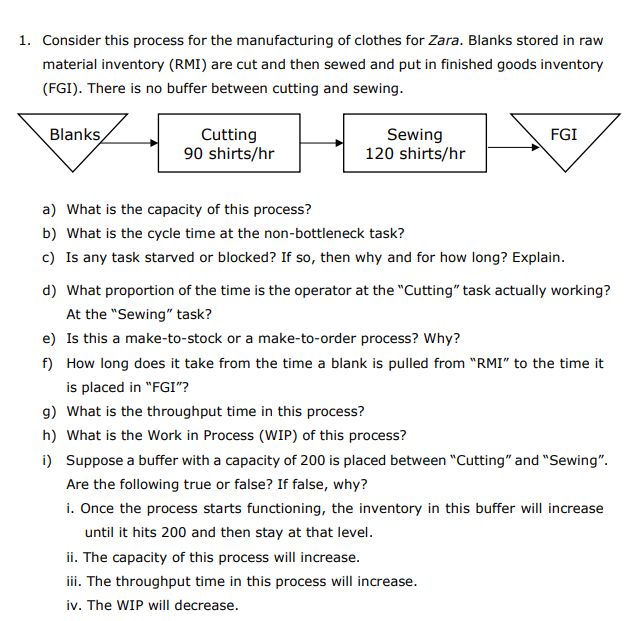
1. Consider this process for the manufacturing of clothes for Zara. Blanks stored in raw material inventory (RMI) are cut and then sewed and put in finished goods inventory (FGI). There is no buffer between cutting and sewing. Blanks FGI Cutting 90 shirts/hr Sewing 120 shirts/hr a) What is the capacity of this process? b) What is the cycle time at the non-bottleneck task? c) Is any task starved or blocked? If so, then why and for how long? Explain. d) What proportion of the time is the operator at the "Cutting" task actually working? At the "Sewing" task? e) Is this a make-to-stock or a make-to-order process? Why? f) How long does it take from the time a blank is pulled from "RMI" to the time it is placed in "FGI"? g) What is the throughput time in this process? h) What is the Work in Process (WIP) of this process? i) Suppose a buffer with a capacity of 200 is placed between "Cutting" and "Sewing". Are the following true or false? If false, why? i. Once the process starts functioning, the inventory in this buffer will increase until it hits 200 and then stay at that level. ii. The capacity of this process will increase. iii. The throughput time in this process will increase. iv. The WIP will decrease
Step by Step Solution
There are 3 Steps involved in it

Get step-by-step solutions from verified subject matter experts
 Study Help