Question: plz read the case study and answer the given questions. Below is the link pasted for the data of this assignment. also please zoom in
plz read the case study and answer the given questions. Below is the link pasted for the data of this assignment. also please zoom in the pictures it should be clear. an upvote will be given for sure.
https://courses.kpu.ca/pluginfile.php/145870782/mod_assign/introattachment/0/The1881CustomerInformation.xls?forcedownload=1
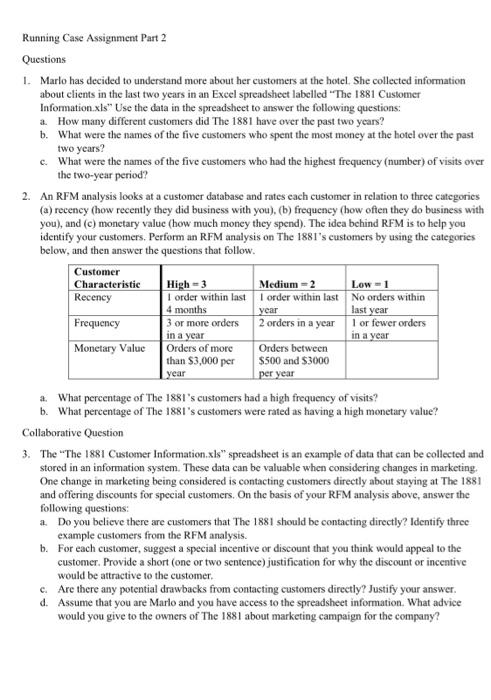
Running Case - The 1881 B&B Marlo Jenkins is a recent graduate with a joint major in Hospitality and Tourism, and Business. As an undergraduate, Marlo never really considered herself a "techie", but she decided to complete dual concentrations in marketing and MIS (an excellent combination) because she recognized how important cellphones, computers and social networks, such as Facebook, had become Following her convocation in 2014, Marlo attended a job fair. After a series of interviews, she was offered a position as a management trainee with the 1881, a medium sized B&B hotel in Lunenburg, Nova Scotia. Although Marlo was originally from central Canada, she had visited eastern Canada with her family many times, and these trips had sparked an interest in hospitality and tourism. As part of her degree, she had completed two co-op work terms. The first was with a large national hotel in Montreal, Quebec, and the second with a small motel in Niagara Falls, Ontario. Although Marlo had never stayed at a B&B, she was familiar with the concept. While there are many types of B&Bs, the majority tend to be medium to large family homes that have been converted to hotels in tourist areas. While some, such as the 1881, are large, many are quite small and have modest kitchens and dinning facilities. Most B&Bs offer breakfast or brunch and have limited amenities (no swimming pools or exercise rooms). Marlo was enthusiastic about starting her new job. Originally a private summer house built in 1881 (hence the name) for a wealthy family, The 1881 was converted to a B&B after the depression in 1939. Fully modernized to a five-star level in 2008, The 1881 included five basic rooms nine luxurious rooms and three full suites. It was definitely high end. The 1881 enjoyed an excellent reputation, and many guests returned year after year. Business included numerous corporate events, and the occupancy rate was very high. Off season rates ranged from $149 to $279 a night, although additional discounts were sometimes available. In 2014, The 1881 was purchased by a retired hedge fund manager and her spouse. Their vision for The 1881, which they shared with Marlo during the interview process, was to increase the number of high-end and affluent clients by offering more luxury and concierge-type services and to extend the season by catering to business needs for corporate executive retreats. Marlo believed that not only was this an excellent strategy but also that the new owners had the ability and resources to implement it. The owners were impressed by Marlo's positive attitude and willingness to learn. For them. The 1881 was a mix of a "hobby business" with an expectation of profit. They saw in Marlo an assistant manager they could trust, and someone who could one day run the entire operation when they were away or tied up with their other investments. We meet Marlo as she begins her new position and is tackling her first major project, the revitalization of the computing resources. We continue to follow her adventure in Chapter 5 after she has modernized the technology and has decided to investigate a system to collect and manage information about hotel's guests (a customer relationship management (CRM) system). In Chapter 6, Marlo deals with her first real crisis - a security breach of the hotel's computer information. While The 1881 and Marlo are fictitious, their experiences are based on facts, and these same experiences could happen to you! Running Case: The 1881 B&B It had been eight hectic weeks but Marlo was quickly coming up to speed. Arriving in Lunenburg in September 2014, she managed to find an apartment that was just a short walk from The 1881, as well as a great roommate by using her Facebook connections. Talking to her parents on Skype, Marlo said that she was really enjoying herself and that it felt every day was a great experience. Although the owners could be demanding and had very high standards, she found that they were also very supportive There were three other employees at the B&B-two cleaners who took care of laundry and housekeeping and a chef who came in every morning and worked from 6 a.m. to 2 p.m. Other services, Such as maintenance and repair, were outsourced. Most mornings, Marlo met briefly with the owners, Cathy and Andre, to discuss immediate priorities and upcoming events. Marlo found these morning meetings quite informal, and the owners had made it clear to her that she was expected to ask insightful questions as well as to suggest ideas As the last guest departed at the end of the Thanksgiving holiday. The 1881 was closed for a week to repaint some rooms and perform routine maintenance on the freezer. Over coffee in the main break fast room, the owners asked Marlo to investigate an upgrade of the computer technology and to recommend a strategy when they retumed the next weekend. Remembering her MIS courses, Marlo felt strongly that this strategy should begin with a hardware and software inventory. It was fairly obvious that computerization had not been important to the previous owners. The 1881 had only five computers, and the newest was close to five years old. Printing involved an inkjet printer that used hard-to-find cartridges, often jammed, and could not be connected to her new Ultrabook computer, which she had received as a graduation present. Hotel reservation and management used a popular and well-regarded software package that was fairly stable, but Marlo soon found out that the version that The 1881 used (2.0) was a far cry from the vendor's current offering of 12.0 and required new technology. Marlo knew that the owners were much more aware of new technology and although they were willing to invest, she also knew that they would want more than a shopping list of shiny new gadgets. She needed to demonstrate a vision that was grounded in the business. Knowing that the overall strategy was to attract more business clients, Marlo believed that The 1881 should portray the "right" image and appear to be on the leading edge. This would take investment that would have to be justified. Upgrading the computers made obvious sense and could be done for less than $7,500, but the details were important. Should they all be desktops like the old ones were, or should she recommend tablets for portability? Updating the hotel software was also an obvious task, but would cost about $5,000. Until now. The 1881 had been exclusively Microsoft but Marlo wondered if she should also include Apple technology. Mario wanted to be innovative. When guests arrived they were given paper information and photographs about The 1881 and Lunenburg history but what if there was an application instead that guests could load on their own devices or those loaned by The 1881. This would not only put The 1881 on the leading edge but could reduce overall costs. Marlo was not two worried about the hotel's tablets being lost or stolen. She thought that in many ways, they would be treated just like any other hotel asset. But how should she sell her ideas to the owners? She knew that $25,000 had been set aside for computer infrastructure improvements, but the owners would still need to be convinced. Where should she start? Running Case It had been more work than Marla thought, but she had finally finished upgrading the existing computers in The 1881 and initiated a tablet loaner program where guests could borrow an iPad to use during their stay. Fresh from this success, Marlo's next move was to get a better idea of the guests who were staying at The 1881. The old Hotel Reservation and Management System (version 2.0) was stable enough, but did not provide the ability to analyze guest information other than sorting the list by name, address, and telephone number. The updated version of the hotel reservation and management software had more advanced features, but the owners of The 1881 indicated that it was too expensive to purchase now. Marlo was stuck. How could she get better information about B&B hotel's clients? She decided to investigate and found that the current Hotel Reservation and management System was built on a relational database, something she had learned about in her introductory MIS course. She had learned that the database could export names, vacation dates, room numbers, and even services that the guests enjoyed. She needed to get administrative access to the database. She argued successfully that since she was exporting information that was already stored in the system, there was no impact on the current system and no chance for her to delete or modify the existing data. The exported data were provided in a format that could be read by a Microsoft Excel spreadsheet. She was thrilled the first time she opened the spreadsheet and was able to see the guests' names and other information. However, after a few minutes of exhilaration, she realized that there may be some challenges. She needed to learn more about how data were stored before she could do much with the data. After a few weeks of working on the data, Marlo had created an interesting set of spreadsheets. In one spreadsheet, she had carefully listed all of the rooms in the B&B hotel. In another spreadsheet, she had a list of the services provided by the hotel. In yet another spreadsheet, she had a list of all the activities that guests had been billed for over the past three years, by date, along with the names of the guests who purchased them. Another spreadsheet contained alphabetically listed names and the addresses of almost all of the guests who had stayed at The 1881. It was a lot of information spread over four different spreadsheets. Her problem now was finding a way to get all of this data to make sense. Luckily, she had kept her introductory MIS textbook, which included a chapter on database design- and even a tutorial on using Microsoft Access (a program that helps create relational databases). She read through the chapter on designing relational tables, and within a week she was able to combine four separate spreadsheets she had created into a single database. She now had the ability to consider such questions as "How many of our guests stay more than twice a year?" for which the database could provide answers within seconds. To prepare for her next meeting with the owners, Marlo used the database to prepare answers to such questions as the following: "Who are The 1881's most frequent guests?" "Which guests buy the most services?" "Which guests have stopped coming to The 1881?" She went into the meeting with a great feeling, knowing she was not only learning more about the B&B but also that she had developed valuable skills in analyzing information that would be used throughout her career. Running Case "This is definitely not good, but I guess it could be a lot worse" was just one of the things Marlo was thinking as she tried to stay calm and decide what to do next. The day had started off normally enough - she had checked in with the staff and been given a thumbs up that the biggest technical issue was a low toner light on one of the printers (her initial thought had been to take it out and give it a shake - something that she had learned could usually save money by yielding 50 more pages). But, then as she made herself a cappuccino, she ran into one of the guests, and her day darkened. The guest, head of human resources at a global fast food company, mentioned that when she was browsing the hotel's intranet page to reserve a couple of bicycles, she had noticed that she could access what looked like a complete list of The 1881 files! Marlo quickly assured the guest that this was definitely not normal and that she would immediately take action and get back to her. So many thoughts were running through her head. Marlo knew that this was a new problem because at the beginning of the season, a group of computer science students from the local university had audited the configuration as part of a class project, and everything had been set up correctly. Security was something that the owners took very seriously, likely because their backgrounds in investment banking. Marlo would have to quickly alert them, but first she wanted to size up the situation. She thought back to one of her MIS classes and wishes she had paid more attention to the lecture on security and that she had developed a checklist. Marlo was not the sort to panic - working at a hotel was definitely not a place to be if you could not handle any sort of change - and so she walked back to her desk she began to identify her next steps. She knew some of the questions that the owners would ask: What is the impact? How long has it been going on? How do we fix and prevent other similar problems? What do we tell our guests? First things first, she thought last year Running Case Assignment Part 2 Questions 1. Marlo has decided to understand more about her customers at the hotel. She collected information about clients in the last two years in an Excel spreadsheet labelled "The 1881 Customer Information.xls" Use the data in the spreadsheet to answer the following questions: & How many different customers did The 1881 have over the past two years? b. What were the names of the five customers who spent the most money at the hotel over the past two years? c. What were the names of the five customers who had the highest frequency (number) of visits over the two-year period? 2. An RFM analysis looks at a customer database and rates each customer in relation to three categories (a) recency (how recently they did business with you), (b) frequency (how often they do business with you), and (c) monetary value (how much money they spend). The idea behind RFM is to help you identify your customers. Perform an RFM analysis on The 188I's customers by using the categories below, and then answer the questions that follow. Customer Characteristic High-3 Medium=2 Low-1 Recency I order within last order within last No orders within 4 months year Frequency 3 or more orders 2 orders in a year I or fewer orders in a year in a year Monetary Valuc Orders of more Orders between than $3,000 per $500 and $3000 year per year a. What percentage of The 1881's customers had a high frequency of visits? b. What percentage of The 1881's customers were rated as having a high monetary value? Collaborative Question 3. The "The 1881 Customer Information.xls" spreadsheet is an example of data that can be collected and stored in an information system. These data can be valuable when considering changes in marketing, One change in marketing being considered is contacting customers directly about staying at The 1881 and offering discounts for special customers. On the basis of your RFM analysis above, answer the following questions: a. Do you believe there are customers that The 1881 should be contacting directly? Identify three example customers from the RFM analysis. b. For each customer, suggest a special incentive or discount that you think would appeal to the customer. Provide a short (one or two sentence) justification for why the discount or incentive would be attractive to the customer. c. Are there any potential drawbacks from contacting customers directly? Justify your answer. d. Assume that you are Marlo and you have access to the spreadsheet information. What advice would you give to the owners of The 1881 about marketing campaign for the company? Running Case - The 1881 B&B Marlo Jenkins is a recent graduate with a joint major in Hospitality and Tourism, and Business. As an undergraduate, Marlo never really considered herself a "techie", but she decided to complete dual concentrations in marketing and MIS (an excellent combination) because she recognized how important cellphones, computers and social networks, such as Facebook, had become Following her convocation in 2014, Marlo attended a job fair. After a series of interviews, she was offered a position as a management trainee with the 1881, a medium sized B&B hotel in Lunenburg, Nova Scotia. Although Marlo was originally from central Canada, she had visited eastern Canada with her family many times, and these trips had sparked an interest in hospitality and tourism. As part of her degree, she had completed two co-op work terms. The first was with a large national hotel in Montreal, Quebec, and the second with a small motel in Niagara Falls, Ontario. Although Marlo had never stayed at a B&B, she was familiar with the concept. While there are many types of B&Bs, the majority tend to be medium to large family homes that have been converted to hotels in tourist areas. While some, such as the 1881, are large, many are quite small and have modest kitchens and dinning facilities. Most B&Bs offer breakfast or brunch and have limited amenities (no swimming pools or exercise rooms). Marlo was enthusiastic about starting her new job. Originally a private summer house built in 1881 (hence the name) for a wealthy family, The 1881 was converted to a B&B after the depression in 1939. Fully modernized to a five-star level in 2008, The 1881 included five basic rooms nine luxurious rooms and three full suites. It was definitely high end. The 1881 enjoyed an excellent reputation, and many guests returned year after year. Business included numerous corporate events, and the occupancy rate was very high. Off season rates ranged from $149 to $279 a night, although additional discounts were sometimes available. In 2014, The 1881 was purchased by a retired hedge fund manager and her spouse. Their vision for The 1881, which they shared with Marlo during the interview process, was to increase the number of high-end and affluent clients by offering more luxury and concierge-type services and to extend the season by catering to business needs for corporate executive retreats. Marlo believed that not only was this an excellent strategy but also that the new owners had the ability and resources to implement it. The owners were impressed by Marlo's positive attitude and willingness to learn. For them. The 1881 was a mix of a "hobby business" with an expectation of profit. They saw in Marlo an assistant manager they could trust, and someone who could one day run the entire operation when they were away or tied up with their other investments. We meet Marlo as she begins her new position and is tackling her first major project, the revitalization of the computing resources. We continue to follow her adventure in Chapter 5 after she has modernized the technology and has decided to investigate a system to collect and manage information about hotel's guests (a customer relationship management (CRM) system). In Chapter 6, Marlo deals with her first real crisis - a security breach of the hotel's computer information. While The 1881 and Marlo are fictitious, their experiences are based on facts, and these same experiences could happen to you! Running Case: The 1881 B&B It had been eight hectic weeks but Marlo was quickly coming up to speed. Arriving in Lunenburg in September 2014, she managed to find an apartment that was just a short walk from The 1881, as well as a great roommate by using her Facebook connections. Talking to her parents on Skype, Marlo said that she was really enjoying herself and that it felt every day was a great experience. Although the owners could be demanding and had very high standards, she found that they were also very supportive There were three other employees at the B&B-two cleaners who took care of laundry and housekeeping and a chef who came in every morning and worked from 6 a.m. to 2 p.m. Other services, Such as maintenance and repair, were outsourced. Most mornings, Marlo met briefly with the owners, Cathy and Andre, to discuss immediate priorities and upcoming events. Marlo found these morning meetings quite informal, and the owners had made it clear to her that she was expected to ask insightful questions as well as to suggest ideas As the last guest departed at the end of the Thanksgiving holiday. The 1881 was closed for a week to repaint some rooms and perform routine maintenance on the freezer. Over coffee in the main break fast room, the owners asked Marlo to investigate an upgrade of the computer technology and to recommend a strategy when they retumed the next weekend. Remembering her MIS courses, Marlo felt strongly that this strategy should begin with a hardware and software inventory. It was fairly obvious that computerization had not been important to the previous owners. The 1881 had only five computers, and the newest was close to five years old. Printing involved an inkjet printer that used hard-to-find cartridges, often jammed, and could not be connected to her new Ultrabook computer, which she had received as a graduation present. Hotel reservation and management used a popular and well-regarded software package that was fairly stable, but Marlo soon found out that the version that The 1881 used (2.0) was a far cry from the vendor's current offering of 12.0 and required new technology. Marlo knew that the owners were much more aware of new technology and although they were willing to invest, she also knew that they would want more than a shopping list of shiny new gadgets. She needed to demonstrate a vision that was grounded in the business. Knowing that the overall strategy was to attract more business clients, Marlo believed that The 1881 should portray the "right" image and appear to be on the leading edge. This would take investment that would have to be justified. Upgrading the computers made obvious sense and could be done for less than $7,500, but the details were important. Should they all be desktops like the old ones were, or should she recommend tablets for portability? Updating the hotel software was also an obvious task, but would cost about $5,000. Until now. The 1881 had been exclusively Microsoft but Marlo wondered if she should also include Apple technology. Mario wanted to be innovative. When guests arrived they were given paper information and photographs about The 1881 and Lunenburg history but what if there was an application instead that guests could load on their own devices or those loaned by The 1881. This would not only put The 1881 on the leading edge but could reduce overall costs. Marlo was not two worried about the hotel's tablets being lost or stolen. She thought that in many ways, they would be treated just like any other hotel asset. But how should she sell her ideas to the owners? She knew that $25,000 had been set aside for computer infrastructure improvements, but the owners would still need to be convinced. Where should she start? Running Case It had been more work than Marla thought, but she had finally finished upgrading the existing computers in The 1881 and initiated a tablet loaner program where guests could borrow an iPad to use during their stay. Fresh from this success, Marlo's next move was to get a better idea of the guests who were staying at The 1881. The old Hotel Reservation and Management System (version 2.0) was stable enough, but did not provide the ability to analyze guest information other than sorting the list by name, address, and telephone number. The updated version of the hotel reservation and management software had more advanced features, but the owners of The 1881 indicated that it was too expensive to purchase now. Marlo was stuck. How could she get better information about B&B hotel's clients? She decided to investigate and found that the current Hotel Reservation and management System was built on a relational database, something she had learned about in her introductory MIS course. She had learned that the database could export names, vacation dates, room numbers, and even services that the guests enjoyed. She needed to get administrative access to the database. She argued successfully that since she was exporting information that was already stored in the system, there was no impact on the current system and no chance for her to delete or modify the existing data. The exported data were provided in a format that could be read by a Microsoft Excel spreadsheet. She was thrilled the first time she opened the spreadsheet and was able to see the guests' names and other information. However, after a few minutes of exhilaration, she realized that there may be some challenges. She needed to learn more about how data were stored before she could do much with the data. After a few weeks of working on the data, Marlo had created an interesting set of spreadsheets. In one spreadsheet, she had carefully listed all of the rooms in the B&B hotel. In another spreadsheet, she had a list of the services provided by the hotel. In yet another spreadsheet, she had a list of all the activities that guests had been billed for over the past three years, by date, along with the names of the guests who purchased them. Another spreadsheet contained alphabetically listed names and the addresses of almost all of the guests who had stayed at The 1881. It was a lot of information spread over four different spreadsheets. Her problem now was finding a way to get all of this data to make sense. Luckily, she had kept her introductory MIS textbook, which included a chapter on database design- and even a tutorial on using Microsoft Access (a program that helps create relational databases). She read through the chapter on designing relational tables, and within a week she was able to combine four separate spreadsheets she had created into a single database. She now had the ability to consider such questions as "How many of our guests stay more than twice a year?" for which the database could provide answers within seconds. To prepare for her next meeting with the owners, Marlo used the database to prepare answers to such questions as the following: "Who are The 1881's most frequent guests?" "Which guests buy the most services?" "Which guests have stopped coming to The 1881?" She went into the meeting with a great feeling, knowing she was not only learning more about the B&B but also that she had developed valuable skills in analyzing information that would be used throughout her career. Running Case "This is definitely not good, but I guess it could be a lot worse" was just one of the things Marlo was thinking as she tried to stay calm and decide what to do next. The day had started off normally enough - she had checked in with the staff and been given a thumbs up that the biggest technical issue was a low toner light on one of the printers (her initial thought had been to take it out and give it a shake - something that she had learned could usually save money by yielding 50 more pages). But, then as she made herself a cappuccino, she ran into one of the guests, and her day darkened. The guest, head of human resources at a global fast food company, mentioned that when she was browsing the hotel's intranet page to reserve a couple of bicycles, she had noticed that she could access what looked like a complete list of The 1881 files! Marlo quickly assured the guest that this was definitely not normal and that she would immediately take action and get back to her. So many thoughts were running through her head. Marlo knew that this was a new problem because at the beginning of the season, a group of computer science students from the local university had audited the configuration as part of a class project, and everything had been set up correctly. Security was something that the owners took very seriously, likely because their backgrounds in investment banking. Marlo would have to quickly alert them, but first she wanted to size up the situation. She thought back to one of her MIS classes and wishes she had paid more attention to the lecture on security and that she had developed a checklist. Marlo was not the sort to panic - working at a hotel was definitely not a place to be if you could not handle any sort of change - and so she walked back to her desk she began to identify her next steps. She knew some of the questions that the owners would ask: What is the impact? How long has it been going on? How do we fix and prevent other similar problems? What do we tell our guests? First things first, she thought last year Running Case Assignment Part 2 Questions 1. Marlo has decided to understand more about her customers at the hotel. She collected information about clients in the last two years in an Excel spreadsheet labelled "The 1881 Customer Information.xls" Use the data in the spreadsheet to answer the following questions: & How many different customers did The 1881 have over the past two years? b. What were the names of the five customers who spent the most money at the hotel over the past two years? c. What were the names of the five customers who had the highest frequency (number) of visits over the two-year period? 2. An RFM analysis looks at a customer database and rates each customer in relation to three categories (a) recency (how recently they did business with you), (b) frequency (how often they do business with you), and (c) monetary value (how much money they spend). The idea behind RFM is to help you identify your customers. Perform an RFM analysis on The 188I's customers by using the categories below, and then answer the questions that follow. Customer Characteristic High-3 Medium=2 Low-1 Recency I order within last order within last No orders within 4 months year Frequency 3 or more orders 2 orders in a year I or fewer orders in a year in a year Monetary Valuc Orders of more Orders between than $3,000 per $500 and $3000 year per year a. What percentage of The 1881's customers had a high frequency of visits? b. What percentage of The 1881's customers were rated as having a high monetary value? Collaborative Question 3. The "The 1881 Customer Information.xls" spreadsheet is an example of data that can be collected and stored in an information system. These data can be valuable when considering changes in marketing, One change in marketing being considered is contacting customers directly about staying at The 1881 and offering discounts for special customers. On the basis of your RFM analysis above, answer the following questions: a. Do you believe there are customers that The 1881 should be contacting directly? Identify three example customers from the RFM analysis. b. For each customer, suggest a special incentive or discount that you think would appeal to the customer. Provide a short (one or two sentence) justification for why the discount or incentive would be attractive to the customer. c. Are there any potential drawbacks from contacting customers directly? Justify your answer. d. Assume that you are Marlo and you have access to the spreadsheet information. What advice would you give to the owners of The 1881 about marketing campaign for the company









 Study Help