







Question: Polypeptides can be cleaved either chemically or enzymatically. Enzymes that catalyse the hydrolytic cleavage of peptide bonds are called proteases. Proteases fall into four main
"Polypeptides can be cleaved either chemically or enzymatically. Enzymes that catalyse
the hydrolytic cleavage of peptide bonds are called proteases. Proteases fall into four main
mechanistic classes: serine, cysteine, aspartyl and metalloproteases. In the active sites of
serine and cysteine proteases, the eponymous residue for which the enzyme is named is
usually paired with a protonwithdrawing group to promote nucleophilic attack on the
peptide bond. Aspartyl proteases and metalloproteases activate a water molecule to serve
as the nucleophile, rather than using a functional group of the enzyme itself. However, the
overall process of peptide bond scission is essentially the same for all protease classes."
Nature May
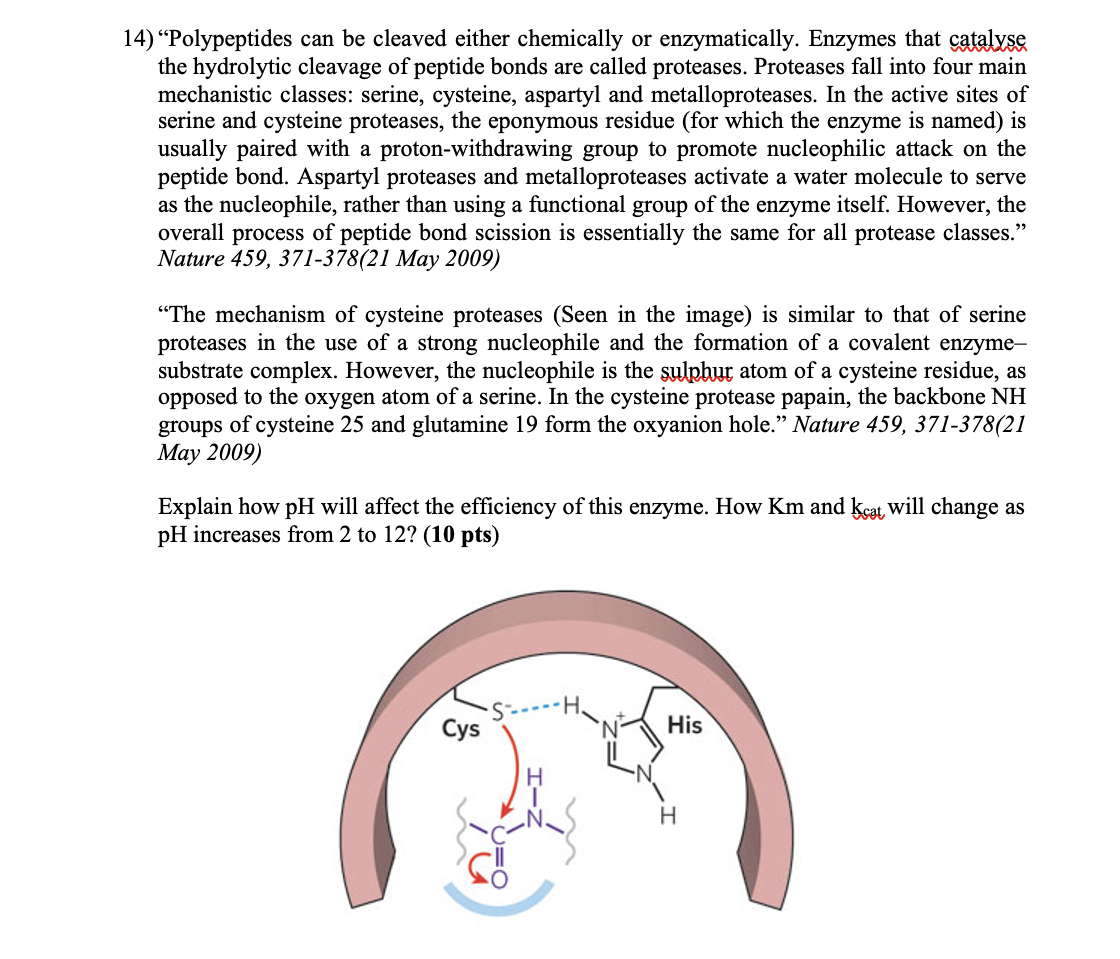
"The mechanism of cysteine proteases Seen in the image is similar to that of serine
proteases in the use of a strong nucleophile and the formation of a covalent enzyme
substrate complex. However, the nucleophile is the sulphur atom of a cysteine residue, as
opposed to the oxygen atom of a serine. In the cysteine protease papain, the backbone
groups of cysteine and glutamine form the oxyanion hole." Nature
May
Explain how will affect the efficiency of this enzyme. How and will change as
increases from to pts
Step by Step Solution
There are 3 Steps involved in it
1 Expert Approved Answer
Step: 1 Unlock

Question Has Been Solved by an Expert!
Get step-by-step solutions from verified subject matter experts
Step: 2 Unlock
Step: 3 Unlock
 Study Help