



Question: possibly defamatory, from litigation, rather than risk stifling them altogether. One such conditional, or qualified, privilege extends to a communication made by one person to
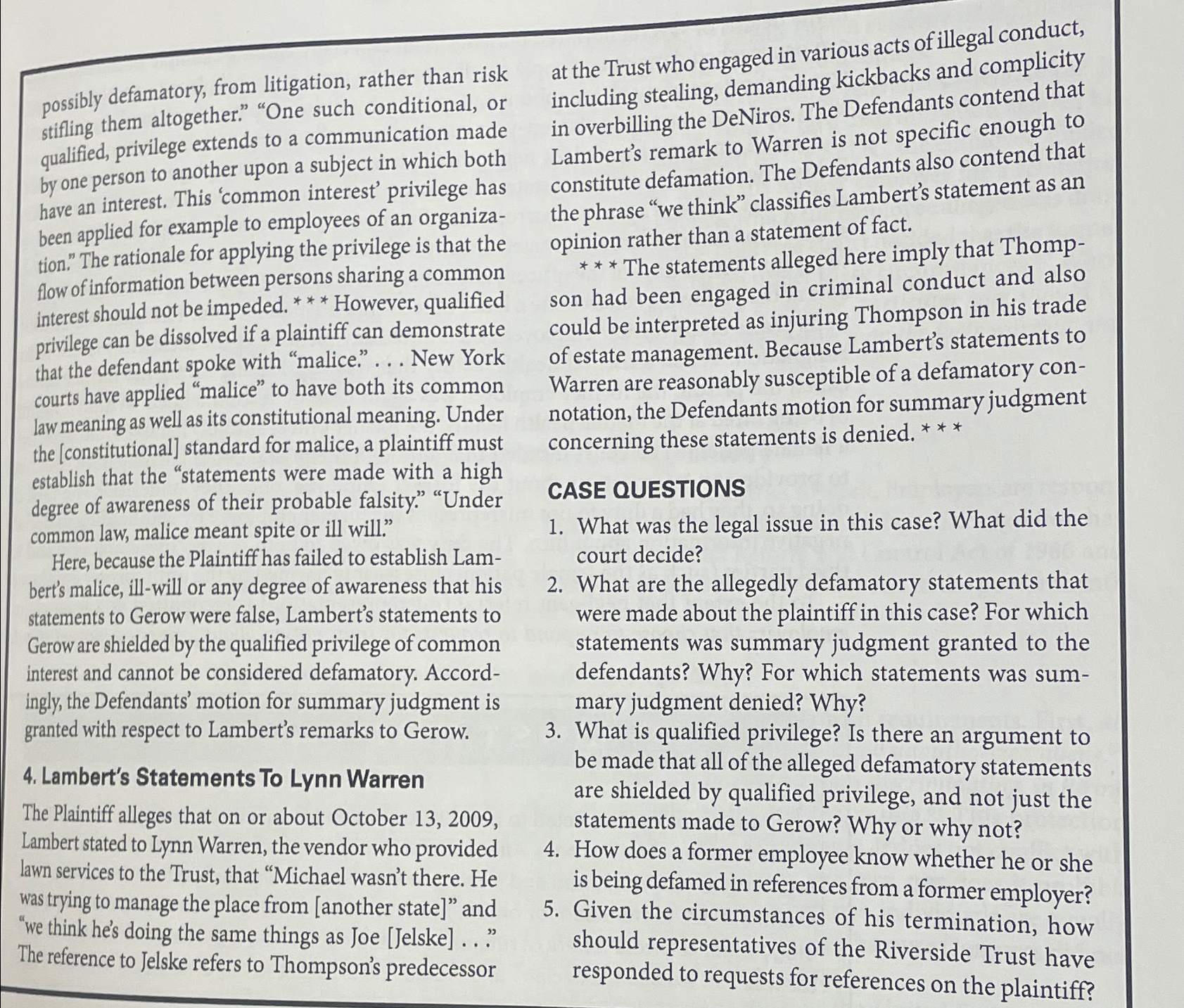
possibly defamatory, from litigation, rather than risk stifling them altogether." "One such conditional, or qualified, privilege extends to a communication made by one person to another upon a subject in which both have an interest. This 'common interest' privilege has been applied for example to employees of an organization." The rationale for applying the privilege is that the flow of information between persons sharing a common interest should not be impeded. However, qualified privilege can be dissolved if a plaintiff can demonstrate that the defendant spoke with "malice." New York courts have applied "malice" to have both its common law meaning as well as its constitutional meaning. Under the constitutional standard for malice, a plaintiff must establish that the "statements were made with a high degree of awareness of their probable falsity." "Under common law, malice meant spite or ill will."
Here, because the Plaintiff has failed to establish Lambert's malice, illwill or any degree of awareness that his statements to Gerow were false, Lambert's statements to Gerow are shielded by the qualified privilege of common interest and cannot be considered defamatory. Accordingly, the Defendants' motion for summary judgment is granted with respect to Lambert's remarks to Gerow.
Lambert's Statements To Lynn Warren
The Plaintiff alleges that on or about October Lambert stated to Lynn Warren, the vendor who provided lawn services to the Trust, that "Michael wasn't there. He was trying to manage the place from another state and we think he's doing the same things as Joe Jelske The reference to Jelske refers to Thompson's predecessor
at the Trust who engaged in various acts of illegal conduct, including stealing, demanding kickbacks and complicity in overbilling the DeNiros. The Defendants contend that Lambert's remark to Warren is not specific enough to constitute defamation. The Defendants also contend that the phrase we think" classifies Lambert's statement as an opinion rather than a statement of fact.
The statements alleged here imply that Thompson had been engaged in criminal conduct and also could be interpreted as injuring Thompson in his trade of estate management. Because Lambert's statements to Warren are reasonably susceptible of a defamatory connotation, the Defendants motion for summary judgment concerning these statements is denied.
CASE QUESTIONS
What was the legal issue in this case? What did the court decide?
What are the allegedly defamatory statements that were made about the plaintiff in this case? For which statements was summary judgment granted to the defendants? Why? For which statements was summary judgment denied? Why?
What is qualified privilege? Is there an argument to be made that all of the alleged defamatory statements are shielded by qualified privilege, and not just the statements made to Gerow? Why or why not?
How does a former employee know whether he or she is being defamed in references from a former employer?
Given the circumstances of his termination, how should representatives of the Riverside Trust have responded to requests for references on the plaintiff?
Step by Step Solution
There are 3 Steps involved in it
1 Expert Approved Answer
Step: 1 Unlock

Question Has Been Solved by an Expert!
Get step-by-step solutions from verified subject matter experts
Step: 2 Unlock
Step: 3 Unlock