



Question: PowerPoint presentation is based upon Video and Case Study (Effective Management Long-Term Care Facility ) 1.You will discuss Case (Conflict of Interest or Not?) 2.
PowerPoint presentation is based upon Video and Case Study (Effective Management Long-Term Care Facility ) 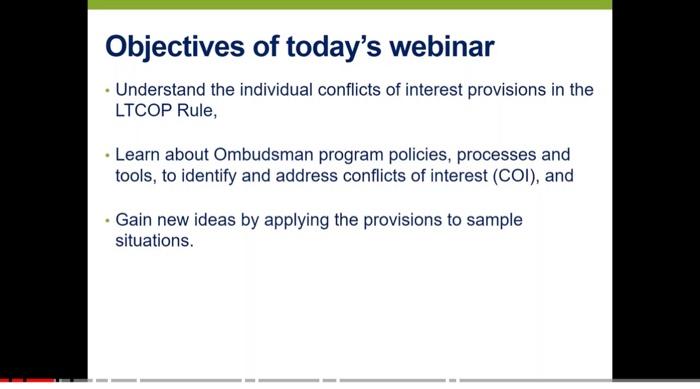
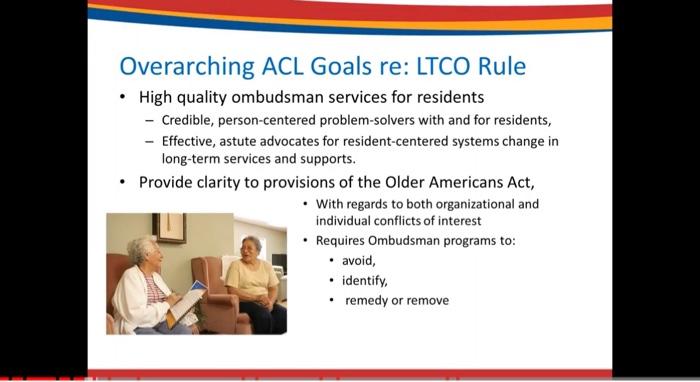
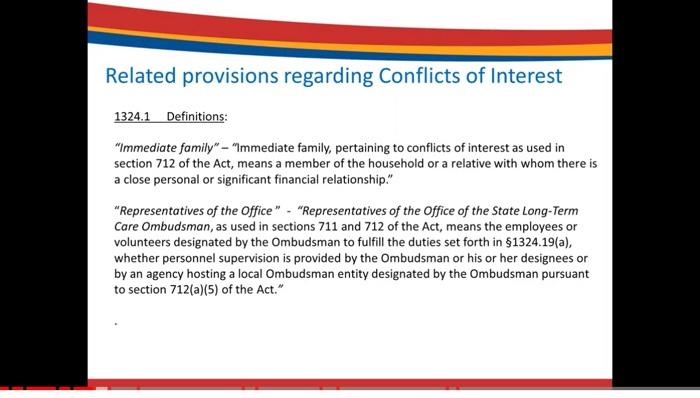
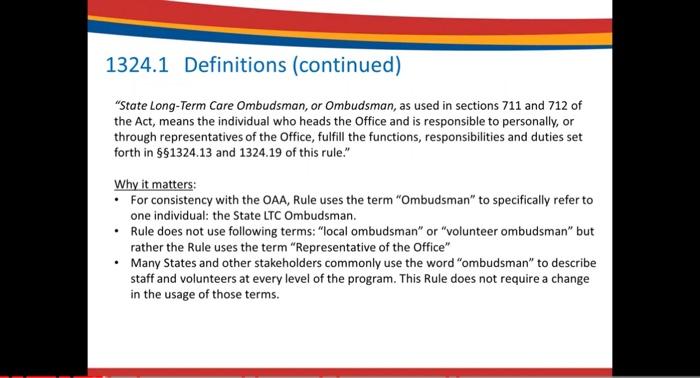
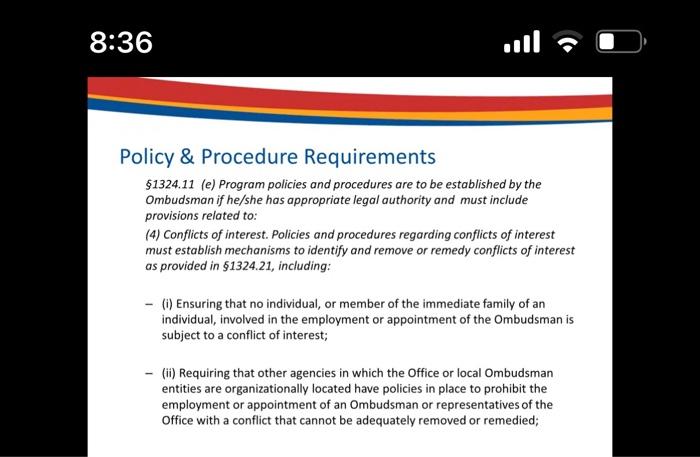
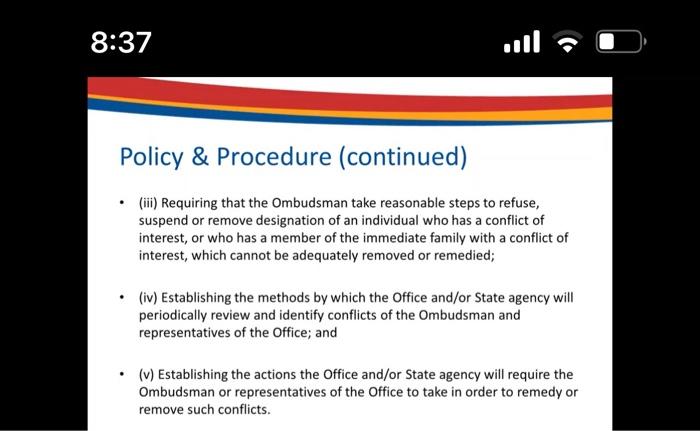
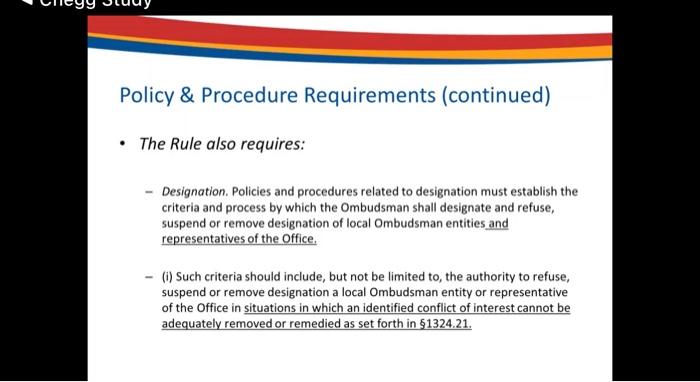
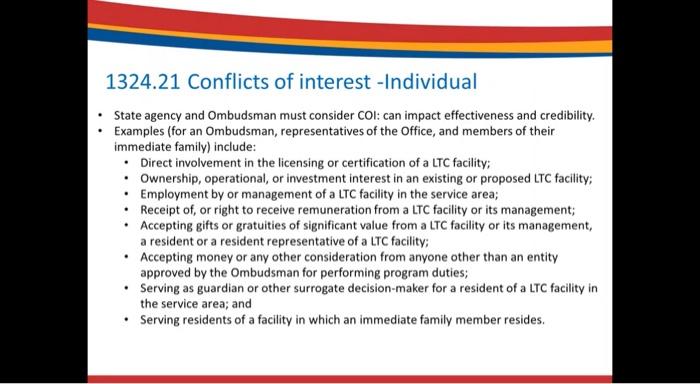
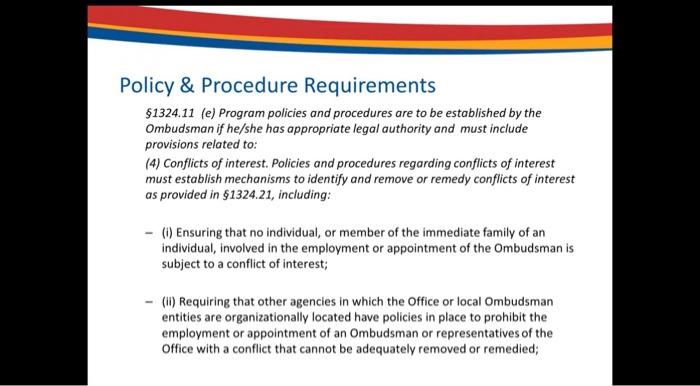
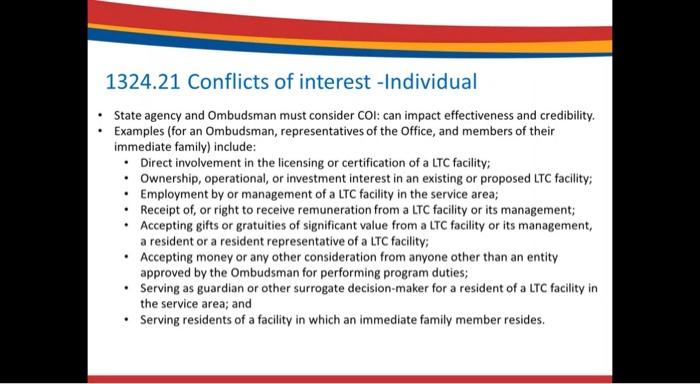
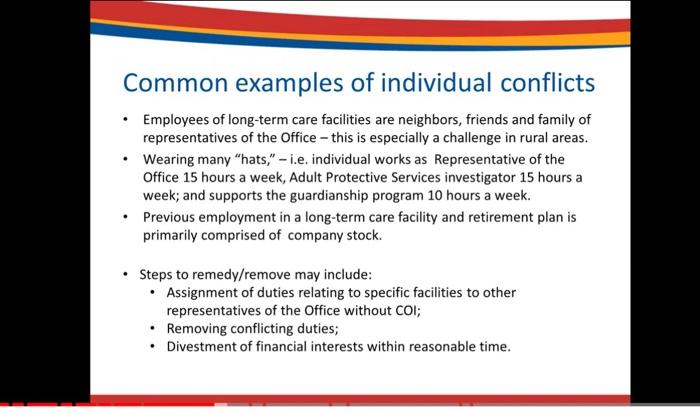
Objectives of today's webinar - Understand the individual conflicts of interest provisions in the LTCOP Rule, - Learn about Ombudsman program policies, processes and tools, to identify and address conflicts of interest (COI), and - Gain new ideas by applying the provisions to sample situations. Louise Ryan, MPA Ombudsman Program Specialist Office of Long-Term Care Ombudsman Programs April 25, 2017 Overarching ACL Goals re: LTCO Rule - High quality ombudsman services for residents - Credible, person-centered problem-solvers with and for residents, - Effective, astute advocates for resident-centered systems change in long-term services and supports. - Provide clarity to provisions of the Older Americans Act, - With regards to both organizational and individual conflicts of interest - Requires Ombudsman programs to: - avoid, - identify, - remedy or remove Related provisions regarding Conflicts of Interest 1324.1 Definitions: "Immediate family" - "Immediate family, pertaining to conflicts of interest as used in section 712 of the Act, means a member of the household or a relative with whom there is a close personal or significant financial relationship." "Representatives of the Office" - "Representatives of the Office of the State Long-Term Care Ombudsman, as used in sections 711 and 712 of the Act, means the employees or volunteers designated by the Ombudsman to fulfill the duties set forth in $1324.19(a), whether personnel supervision is provided by the Ombudsman or his or her designees or by an agency hosting a local Ombudsman entity designated by the Ombudsman pursuant to section 712(a)(5) of the Act." "State Long-Term Care Ombudsman, or Ombudsman, as used in sections 711 and 712 of the Act, means the individual who heads the Office and is responsible to personally, or through representatives of the Office, fulfill the functions, responsibilities and duties set forth in $1324.13 and 1324.19 of this rule." Why it matters: - For consistency with the OAA, Rule uses the term "Ombudsman" to specifically refer to one individual: the State LTC Ombudsman. - Rule does not use following terms: "local ombudsman" or "volunteer ombudsman" but rather the Rule uses the term "Representative of the Office" - Many States and other stakeholders commonly use the word "ombudsman" to describe staff and volunteers at every level of the program. This Rule does not require a change in the usage of those terms. olicy \& Procedure Requirements \$1324.11 (e) Program policies and procedures are to be established by the Ombudsman if he/she has appropriate legal authority and must include provisions related to: (4) Conflicts of interest. Policies and procedures regarding conflicts of interest must establish mechanisms to identify and remove or remedy conflicts of interest as provided in $1324.21, including: - (i) Ensuring that no individual, or member of the immediate family of an individual, involved in the employment or appointment of the Ombudsman is subject to a conflict of interest; - (ii) Requiring that other agencies in which the Office or local Ombudsman entities are organizationally located have policies in place to prohibit the employment or appointment of an Ombudsman or representatives of the Office with a conflict that cannot be adequately removed or remedied; Policy \& Procedure (continued) - (iii) Requiring that the Ombudsman take reasonable steps to refuse, suspend or remove designation of an individual who has a conflict of interest, or who has a member of the immediate family with a conflict of interest, which cannot be adequately removed or remedied; - (iv) Establishing the methods by which the Office and/or State agency will periodically review and identify conflicts of the Ombudsman and representatives of the Office; and - (v) Establishing the actions the Office and/or State agency will require the Ombudsman or representatives of the Office to take in order to remedy or remove such conflicts. Policy \& Procedure Requirements (continued) - The Rule also requires: - Designation. Policies and procedures related to designation must establish the criteria and process by which the Ombudsman shall designate and refuse, suspend or remove designation of local Ombudsman entities and representatives of the Office, - (i) Such criteria should include, but not be limited to, the authority to refuse, suspend or remove designation a local Ombudsman entity or representative of the Office in situations in which an identified conflict of interest cannot be adequately removed or remedied as set forth in 1324.21. - State agency and Ombudsman must consider COI: can impact effectiveness and credibility. - Examples (for an Ombudsman, representatives of the Office, and members of their immediate family) include: - Direct involvement in the licensing or certification of a LTC facility; - Ownership, operational, or investment interest in an existing or proposed LTC facility; - Employment by or management of a LTC facility in the service area; - Receipt of, or right to receive remuneration from a LTC facility or its management; - Accepting gifts or gratuities of significant value from a LTC facility or its management, a resident or a resident representative of a LTC facility; - Accepting money or any other consideration from anyone other than an entity approved by the Ombudsman for performing program duties; - Serving as guardian or other surrogate decision-maker for a resident of a LTC facility in the service area; and - Serving residents of a facility in which an immediate family member resides. Oolicy \& Procedure Requirements \$1324.11 (e) Program policies and procedures are to be established by the Ombudsman if he/she has appropriate legal authority and must include provisions related to: (4) Conflicts of interest. Policies and procedures regarding conflicts of interest must establish mechanisms to identify and remove or remedy conflicts of interest as provided in $1324.21, including: - (i) Ensuring that no individual, or member of the immediate family of an individual, involved in the employment or appointment of the Ombudsman is subject to a conflict of interest; - (ii) Requiring that other agencies in which the Office or local Ombudsman entities are organizationally located have policies in place to prohibit the employment or appointment of an Ombudsman or representatives of the Office with a conflict that cannot be adequately removed or remedied; - State agency and Ombudsman must consider COI: can impact effectiveness and credibility. - Examples (for an Ombudsman, representatives of the Office, and members of their immediate family) include: - Direct involvement in the licensing or certification of a LTC facility; - Ownership, operational, or investment interest in an existing or proposed LTC facility; - Employment by or management of a LTC facility in the service area; - Receipt of, or right to receive remuneration from a LTC facility or its management; - Accepting gifts or gratuities of significant value from a LTC facility or its management, a resident or a resident representative of a LTC facility; - Accepting money or any other consideration from anyone other than an entity approved by the Ombudsman for performing program duties; - Serving as guardian or other surrogate decision-maker for a resident of a LTC facility in the service area; and - Serving residents of a facility in which an immediate family member resides. Common examples of individual conflicts - Employees of long-term care facilities are neighbors, friends and family of representatives of the Office this is especially a challenge in rural areas. - Wearing many "hats," - i.e. individual works as Representative of the Office 15 hours a week, Adult Protective Services investigator 15 hours a week; and supports the guardianship program 10 hours a week. - Previous employment in a long-term care facility and retirement plan is primarily comprised of company stock. - Steps to remedy/remove may include: - Assignment of duties relating to specific facilities to other representatives of the Office without COI; - Removing conflicting duties; - Divestment of financial interests within reasonable time 1.You will discuss Case (Conflict of Interest or Not?)
2.you will discuss and explain why or why not there is a conflict.
3.you will discuss and explain the role of the Ombudsman. 4. What attitudes do you think nursing home administrators ought to have towards regulations that are often regarded as onerous? and explain and discuss as a Nursing Facility Administrator, what would you do to ensure that your organization is in compliance with various regulations-list 5 important factors that will ensure appropriate care for your residents/patients also, this is your facility identify Federal Regulations that were violated and what corrective action would your facility put in place as preventive measures Use Video & textbook with other resources--ie: journals, textbooks, videos to build your presentation. Video- https://youtu.be/0IsYWAs8N1U
These are what is discussed in the video
Step by Step Solution
There are 3 Steps involved in it
1 Expert Approved Answer
Step: 1 Unlock

Question Has Been Solved by an Expert!
Get step-by-step solutions from verified subject matter experts
Step: 2 Unlock
Step: 3 Unlock