







Question: Practice the Math: Comparing the Efficiencies of Two Systems Read Do the Math: Comparing the Efficiencies of Two Systems on page 52. Try Your
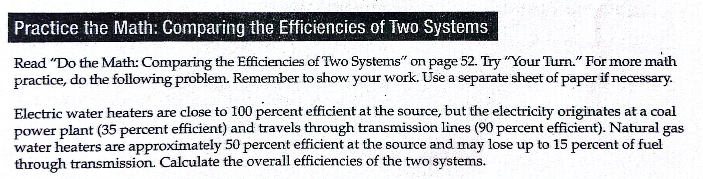
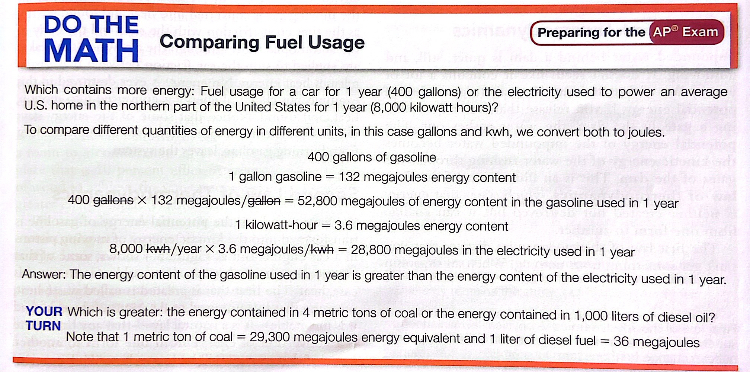
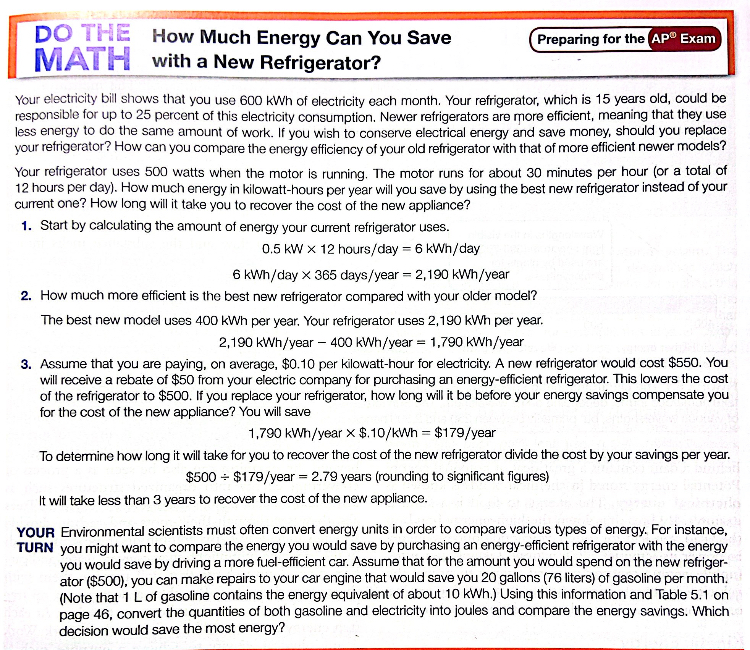
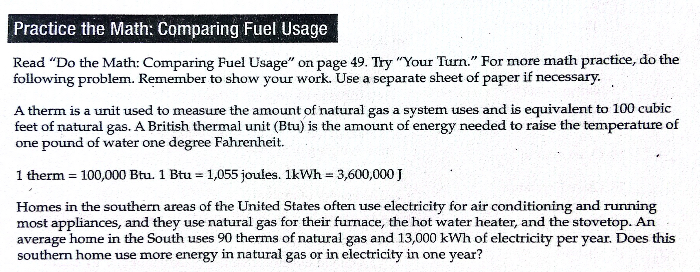
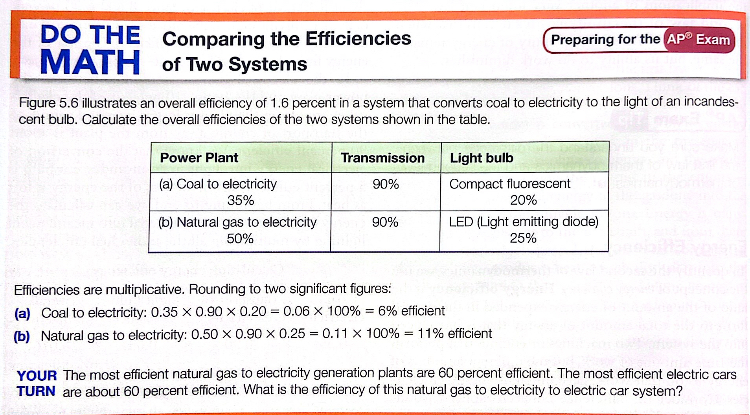
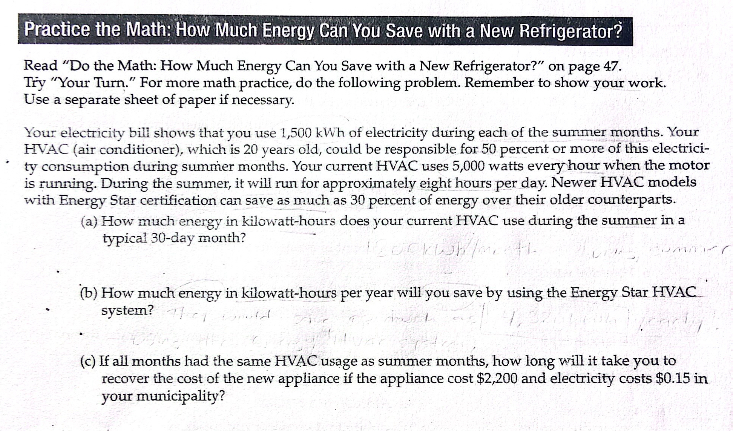
Practice the Math: Comparing the Efficiencies of Two Systems Read "Do the Math: Comparing the Efficiencies of Two Systems" on page 52. Try "Your Turn." For more math practice, do the following problem. Remember to show your work. Use a separate sheet of paper if necessary. Electric water heaters are close to 100 percent efficient at the source, but the electricity originates at a coal power plant (35 percent efficient) and travels through transmission lines (90 percent efficient). Natural gas water heaters are approximately 50 percent efficient at the source and may lose up to 15 percent of fuel through transmission. Calculate the overall efficiencies of the two systems. DO THE MATH Comparing Fuel Usage animan Preparing for the AP Exam Which contains more energy: Fuel usage for a car for 1 year (400 gallons) or the electricity used to power an average U.S. home in the northern part of the United States for 1 year (8,000 kilowatt hours)? To compare different quantities of energy in different units, in this case gallons and kwh, we convert both to joules. 400 gallons of gasoline 1 gallon gasoline 132 megajoules energy content = 400 gallons X 132 megajoules/gallon 52,800 megajoules of energy content in the gasoline used in 1 year. 1 kilowatt-hour 3.6 megajoules energy content = = 8,000 kwh/year X 3.6 megajoules/kwh 28,800 megajoules in the electricity used in 1 year Answer: The energy content of the gasoline used in 1 year is greater than the energy content of the electricity used in 1 year. YOUR Which is greater: the energy contained in 4 metric tons of coal or the energy contained in 1,000 liters of diesel oil? Note that 1 metric ton of coal 29,300 megajoules energy equivalent and 1 liter of diesel fuel = 36 megajoules TURN = DO THE How Much Energy Can You Save MATH with a New Refrigerator? Preparing for the AP Exam Your electricity bill shows that you use 600 kWh of electricity each month. Your refrigerator, which is 15 years old, could be responsible for up to 25 percent of this electricity consumption. Newer refrigerators are more efficient, meaning that they use less energy to do the same amount of work. If you wish to conserve electrical energy and save money, should you replace your refrigerator? How can you compare the energy efficiency of your old refrigerator with that of more efficient newer models? Your refrigerator uses 500 watts when the motor is running. The motor runs for about 30 minutes per hour (or a total of 12 hours per day). How much energy in kilowatt-hours per year will you save by using the best new refrigerator instead of your current one? How long will it take you to recover the cost of the new appliance? 1. Start by calculating the amount of energy your current refrigerator uses. 0.5 kW x 12 hours/day = 6 kWh/day 6 kWh/day X 365 days/year = 2,190 kWh/year 2. How much more efficient is the best new refrigerator compared with your older model? The best new model uses 400 kWh per year. Your refrigerator uses 2,190 kWh per year. 2,190 kWh/year - 400 kWh/year = 1,790 kWh/year 3. Assume that you are paying, on average, $0.10 per kilowatt-hour for electricity. A new refrigerator would cost $550. You will receive a rebate of $50 from your electric company for purchasing an energy-efficient refrigerator. This lowers the cost of the refrigerator to $500. If you replace your refrigerator, how long will it be before your energy savings compensate you for the cost of the new appliance? You will save 1,790 kWh/year x $.10/kWh = $179/year To determine how long it will take for you to recover the cost of the new refrigerator divide the cost by your savings per year. $500 $179/year = 2.79 years (rounding to significant figures) It will take less than 3 years to recover the cost of the new appliance. YOUR Environmental scientists must often convert energy units in order to compare various types of energy. For instance, TURN you might want to compare the energy you would save by purchasing an energy-efficient refrigerator with the energy you would save by driving a more fuel-efficient car. Assume that for the amount you would spend on the new refriger- ator ($500), you can make repairs to your car engine that would save you 20 gallons (76 liters) of gasoline per month. (Note that 1 L of gasoline contains the energy equivalent of about 10 kWh.) Using this information and Table 5.1 on page 46, convert the quantities of both gasoline and electricity into joules and compare the energy savings. Which decision would save the most energy? Practice the Math: Comparing Fuel Usage Read "Do the Math: Comparing Fuel Usage" on page 49. Try "Your Turn." For more math practice, do the following problem. Remember to show your work. Use a separate sheet of paper if necessary. A therm is a unit used to measure the amount of natural gas a system uses and is equivalent to 100 cubic feet of natural gas. A British thermal unit (Btu) is the amount of energy needed to raise the temperature of one pound of water one degree Fahrenheit. 1 therm = 100,000 Btu. 1 Btu = 1,055 joules. 1kWh = 3,600,000 J Homes in the southern areas of the United States often use electricity for air conditioning and running most appliances, and they use natural gas for their furnace, the hot water heater, and the stovetop. An average home in the South uses 90 therms of natural gas and 13,000 kWh of electricity per year. Does this southern home use more energy in natural gas or in electricity in one year? DO THE Comparing the Efficiencies MATH of Two Systems Preparing for the AP Exam Figure 5.6 illustrates an overall efficiency of 1.6 percent in a system that converts coal to electricity to the light of an incandes- cent bulb. Calculate the overall efficiencies of the two systems shown in the table. Power Plant (a) Coal to electricity 35% Transmission 90% Light bulb Compact fluorescent 20% (b) Natural gas to electricity 50% 90% LED (Light emitting diode) 25% Efficiencies are multiplicative. Rounding to two significant figures: (a) Coal to electricity: 0.35 x 0.90 x 0.20 = 0.06 x 100% = 6% efficient (b) Natural gas to electricity: 0.50 x 0.90 x 0.25 0.11 x 100% 11% efficient YOUR The most efficient natural gas to electricity generation plants are 60 percent efficient. The most efficient electric cars TURN are about 60 percent efficient. What is the efficiency of this natural gas to electricity to electric car system? Practice the Math: How Much Energy Can You Save with a New Refrigerator? Read "Do the Math: How Much Energy Can You Save with a New Refrigerator?" on page 47. Try "Your Turn." For more math practice, do the following problem. Remember to show your work. Use a separate sheet of paper if necessary. Your electricity bill shows that you use 1,500 kWh of electricity during each of the summer months. Your HVAC (air conditioner), which is 20 years old, could be responsible for 50 percent or more of this electrici- ty consumption during summer months. Your current HVAC uses 5,000 watts every hour when the motor is running. During the summer, it will run for approximately eight hours per day. Newer HVAC models with Energy Star certification can save as much as 30 percent of energy over their older counterparts. (a) How much energy in kilowatt-hours does your current HVAC use during the summer in a typical 30-day month? (b) How much energy in kilowatt-hours per year will you save by using the Energy Star HVAC system? would (c) If all months had the same HVAC usage as summer months, how long will it take you to recover the cost of the new appliance if the appliance cost $2,200 and electricity costs $0.15 in your municipality?
Step by Step Solution
There are 3 Steps involved in it

Get step-by-step solutions from verified subject matter experts
 Study Help