



Question: Pre-Lab 7 Rotational Kinematics In Lab 7, we will study the kinematics of rotational motion. We will be using the cellphone app thghox to take
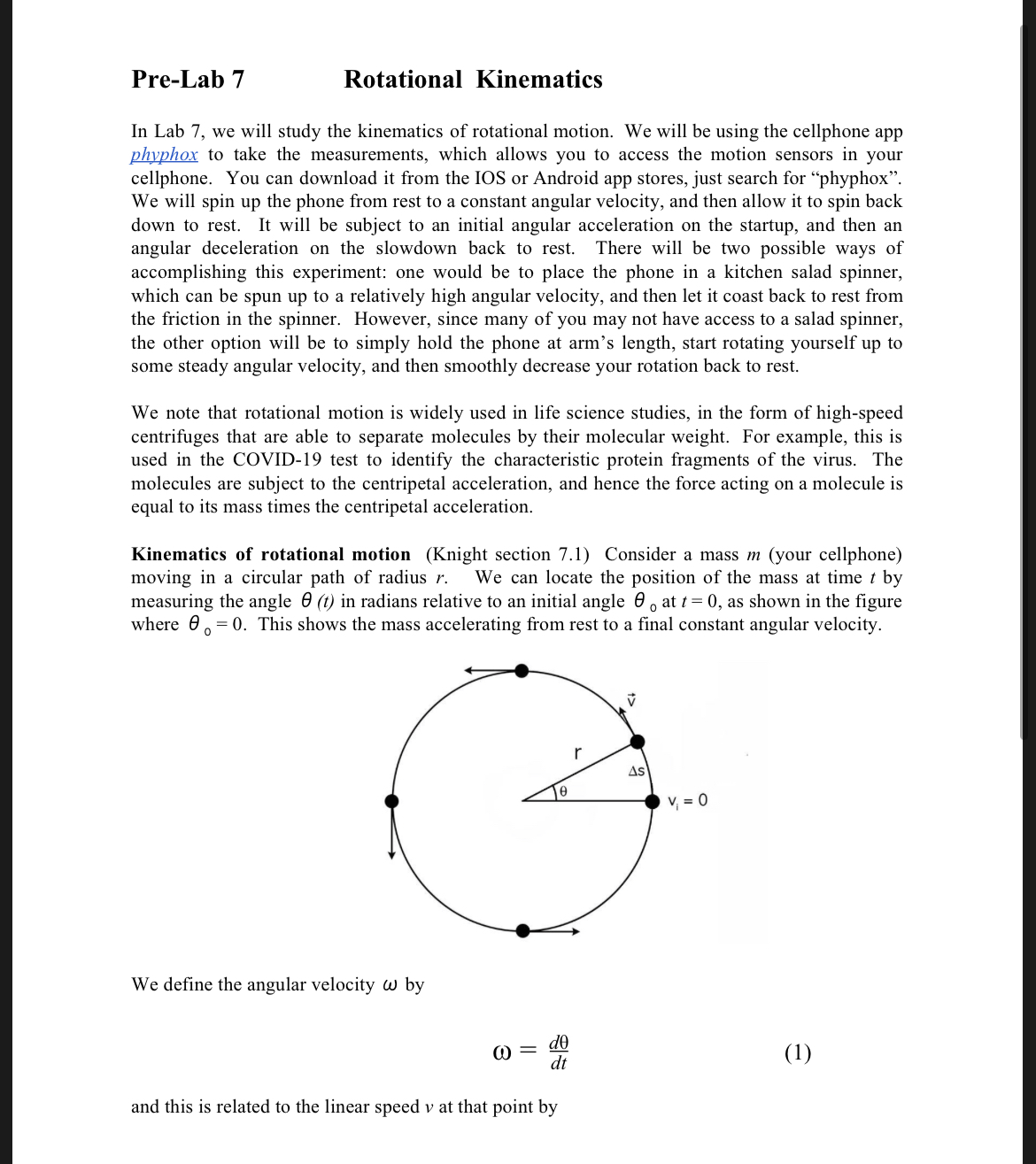
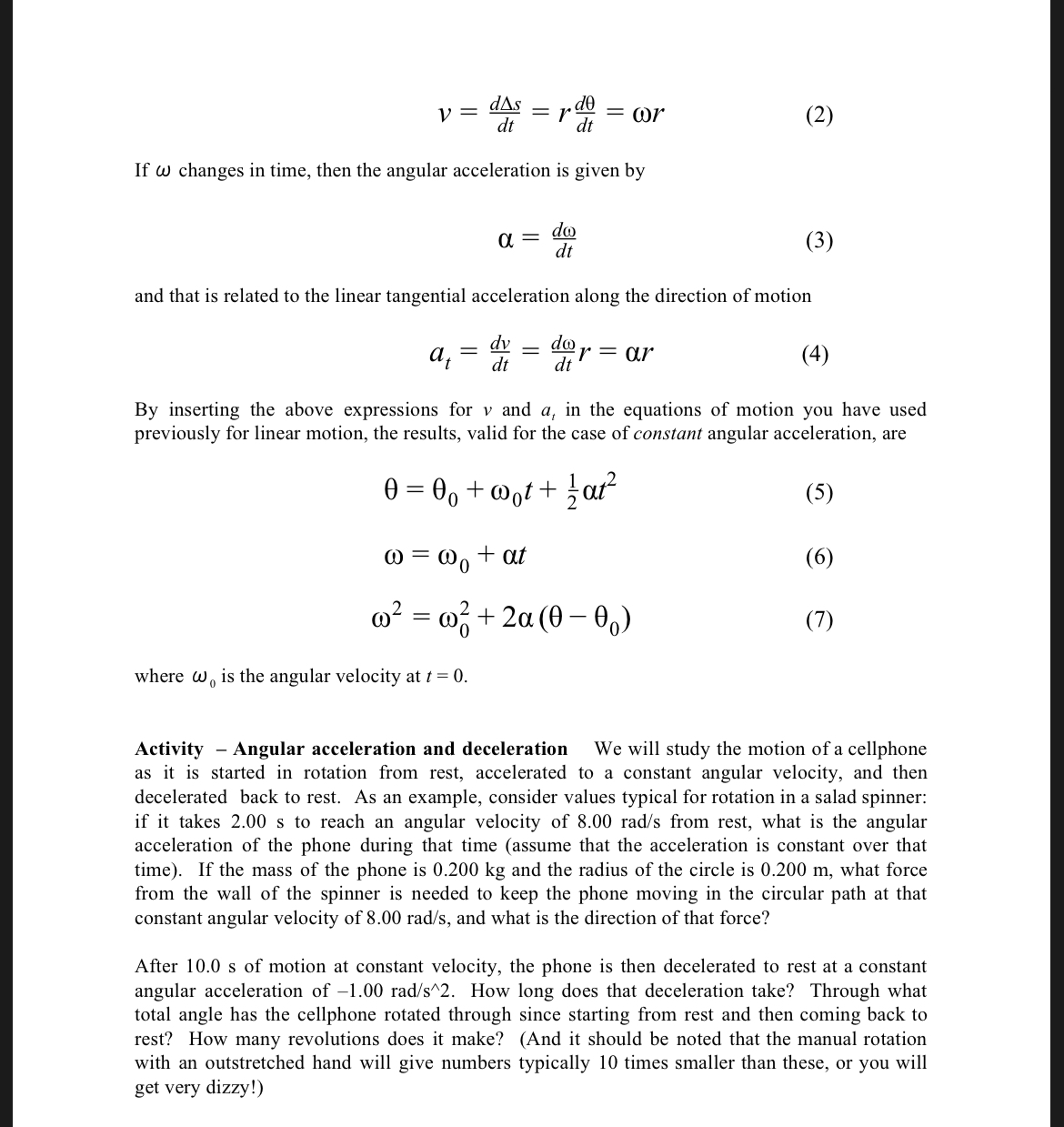
Pre-Lab 7 Rotational Kinematics In Lab 7, we will study the kinematics of rotational motion. We will be using the cellphone app thghox to take the measurements, which allows you to access the motion sensors in your cellphone. You can download it from the [OS or Android app stores, just search for \"phyphox\". We will spin up the phone from rest to a constant angular velocity, and then allow it to spin back down to rest. It will be subject to an initial angular acceleration on the startup, and then an angular deceleration on the slowdown back to rest. There will be two possible ways of accomplishing this experiment: one would be to place the phone in a kitchen salad spinner, which can be spun up to a relatively high angular velocity, and then let it coast back to rest from the friction in the spinner. However, since many of you may not have access to a salad spinner, the other option will be to simply hold the phone at arm's length, start rotating yourself up to some steady angular velocity, and then smoothly decrease your rotation back to rest. We note that rotational motion is widely used in life science studies, in the form of high-speed centrifuges that are able to separate molecules by their molecular weight. For example, this is used in the COVID-19 test to identify the characteristic protein fragments of the virus. The molecules are subject to the centripetal acceleration, and hence the force acting on a molecule is equal to its mass times the centripetal acceleration. Kinematics of rotational motion (Knight section 7.1) Consider a mass m (your cellphone) moving in a circular path of radius r. We can locate the position of the mass at time I by measuring the angle 9 (t) in radians relative to an initial angle 9 O at I = 0, as shown in the gure where 9 o = 0. This shows the mass accelerating from rest to a nal constant angular velocity. We dene the angular velocity to by oa= a (1) and this is related to the linear speed v at that point by _@=@= v , rm or a) If to changes in time, then the angular acceleration is given by a= '% (3) and that is related to the linear tangential acceleration along the direction of motion a,=E=Er=ar (4) By inserting the above expressions for v and a, in the equations of motion you have used previously for linear motion, the results, valid for the case of constant angular acceleration, are 9=90+w0t+ zz (5) m=w0+at (6) 032 = mg + 2a(9 90) (7) where w, is the angular velocity at I = 0. Activity Angular acceleration and deceleration We will study the motion of a cellphone as it is started in rotation from rest, accelerated to a constant angular velocity, and then decelerated back to rest. As an example, consider values typical for rotation in a salad spinner: if it takes 2.00 s to reach an angular velocity of 8.00 rad/\"s from rest, what is the angular acceleration of the phone during that time (assume that the acceleration is constant over that time). If the mass of the phone is 0.200 kg and the radius of the circle is 0.200 In, what force from the wall of the spinner is needed to keep the phone moving in the circular path at that constant angular velocity of 8.00 radfs, and what is the direction of that force? After 10.0 s of motion at constant velocity, the phone is then decelerated to rest at a constant angular acceleration of 1.00 radfs\"2. How long does that deceleration take? Through what total angle has the cellphone rotated through since starting from rest and then coming back to rest? How many revolutions does it make? (And it should be noted that the manual rotation with an outstretched hand will give numbers typically 10 times smaller than these, or you will get very dizzy!)
Step by Step Solution
There are 3 Steps involved in it

Get step-by-step solutions from verified subject matter experts