







Question: Pre-Lab Work: 1. Give a full balanced equation for the synthesis of 1-Bromobutane from 1-Butanol a per this experiment. Why is NaBr used here instead
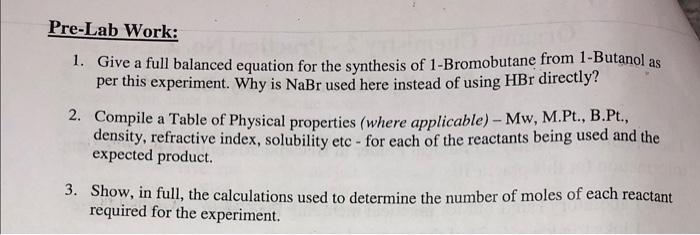
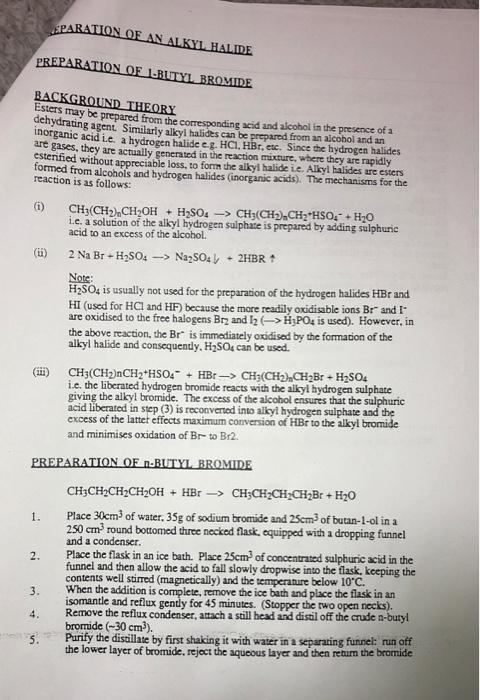
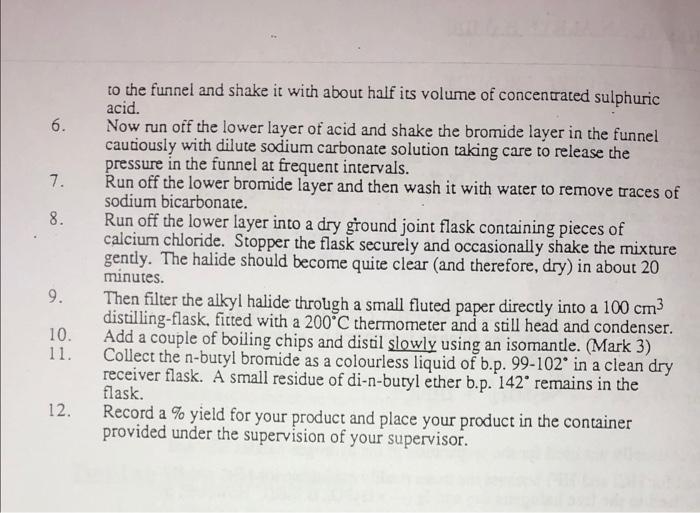
Pre-Lab Work: 1. Give a full balanced equation for the synthesis of 1-Bromobutane from 1-Butanol a per this experiment. Why is NaBr used here instead of using HBr directly? 2. Compile a Table of Physical properties (where applicable) Mw, M.Pt., B.Pt., density, refractive index, solubility etc - for each of the reactants being used and the expected product. 3. Show, in full, the calculations used to determine the number of moles of each reactant required for the experiment. JEPARATION OF AN ALKYL HALIE PREPARATION OF I-BUTYL BROMIDE BACKGROUND THEORY Esters may be prepared from the corresponding acid and alcohol in the presence of a dehydrating agent. Similarly alkyi halides can be prepared from an alcohol and an inorganic acid i.e. a hydrogen halide eg. HC1, HBr.es. Since the hydrogen halides are gases, they are actually generated in the reaction mixture, where they are rapidly estenfied without appreciable loss, to form the alkyi halide ie Alkyl balides are esters formed from alcohols and hydrogen halides (inorganic acids). The mechanisms for the reaction is as follows: (i) (u) CH3(CH2).CH2OH + H2SO4 -> CH3(CH). CH2 HSO:+ H20 i.e. a solution of the alkyl hydrogen sulphate is prepared by adding sulphurie acid to an excess of the alcohol. 2 Na Br + H2SO4 -> Na2SO4 + 2HBR Note: H2SO4 is usually not used for the preparation of the hydrogen halides HBr and HI (used for HCl and HF) because the more readily oxidisable ions Brand I are oxidised to the free halogens Bry and lz (H3PO4 is used). However, in the above reaction, the Br is immediately oxidised by the formation of the alkyl halide and consequently, H2SOs can be used. CH(CH2)CH2+HSO4- + HBr -> CH3(CH2).CH2Br + H2SO4 i.e. the liberated hydrogen bromide reacts with the alkyl hydrogen sulphate giving the alkyl bromide. The excess of the alcohol ensures that the sulphuric acid liberated in step (3) is reconverted into alkyl hydrogen sulphate and the excess of the latter effects maximum conversion of HBr to the alkyl bromide and minimises oxidation of Br- to Br2. ( PREPARATION OF N-BUTYL BROMIDE 1. 2. CH3CH2CH2CH2OH + HBr -> CH3CH2CH2CH2Br + H20 Place 30cm3 of water. 35g of sodium bromide and 25cm3 of butan-l-ol in a 250 cm round bottomed three necked flask, equipped with a dropping funnel and a condenser. Place the flask in an ice bath. Place 25cm of concentrated sulphuric acid in the funnel and then allow the acid to fall slowly dropwise into the flask. keeping the contents well stirred (magnetically) and the temperature below 10C. When the addition is complete, remove the ice bath and place the flask in an isomantle and reflux gendy for 45 minutes. (Stopper the two open necks). Remove the reflux condenser, attach a still head and distil off the crude n-butyl bromide (-30 cm). Purify the distillate by first shaking it with water in a separating funnel: run off the lower layer of bromide, reject the aqueous layer and then return the bromide 3. 4. 6. 7. 8. to the funnel and shake it with about half its volume of concentrated sulphuric acid. Now run off the lower layer of acid and shake the bromide layer in the funnel cautiously with dilute sodium carbonate solution taking care to release the pressure in the funnel at frequent intervals. Run off the lower bromide layer and then wash it with water to remove traces of sodium bicarbonate. Run off the lower layer into a dry ground joint flask containing pieces of calcium chloride. Stopper the flask securely and occasionally shake the mixture gently. The halide should become quite clear (and therefore, dry) in about 20 minutes. Then filter the alkyl halide through a small fluted paper directly into a 100 cm3 distilling-flask, fitted with a 200C thermometer and a still head and condenser. Add a couple of boiling chips and distil slowly using an isomantle. (Mark 3) Collect the n-butyl bromide as a colourless liquid of b.p. 99-102 in a clean dry receiver flask. A small residue of di-n-butyl ether b.p. 142 remains in the flask. Record a % yield for your product and place your product in the container provided under the supervision of your supervisor. 9. 10. 11. 12
Step by Step Solution
There are 3 Steps involved in it

Get step-by-step solutions from verified subject matter experts
 Study Help