







Question: present performance metrics for the chip-dips lines 1. computing FL's present market shares in the chip-dips lines 2. evaluating FL's opportunity factors for marketing veggies-dips
present performance metrics for the chip-dips lines
1. computing FL's present market shares in the chip-dips lines
2. evaluating FL's opportunity factors for marketing veggies-dips
3. gauging the optimization of their distribution & sales functions for veggies-dips
4. configuring the implementation of their integrated advertising-&-promotions campaign
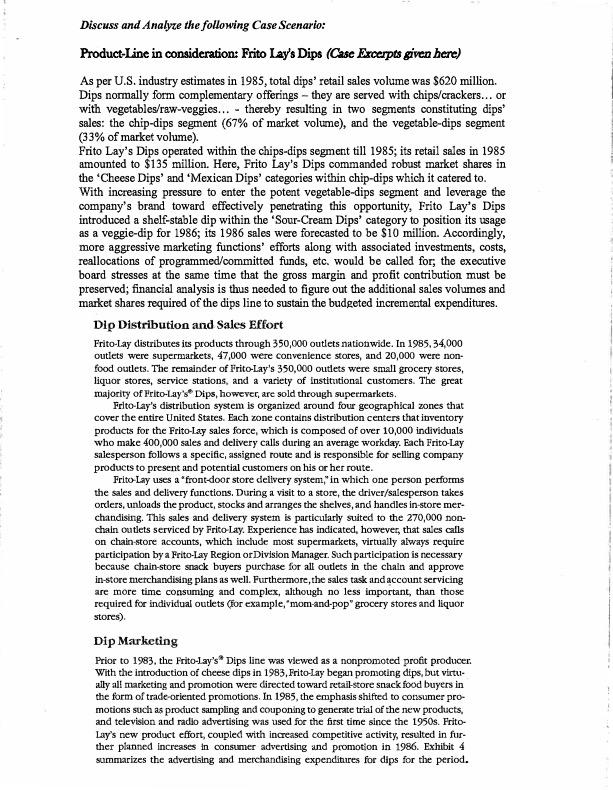
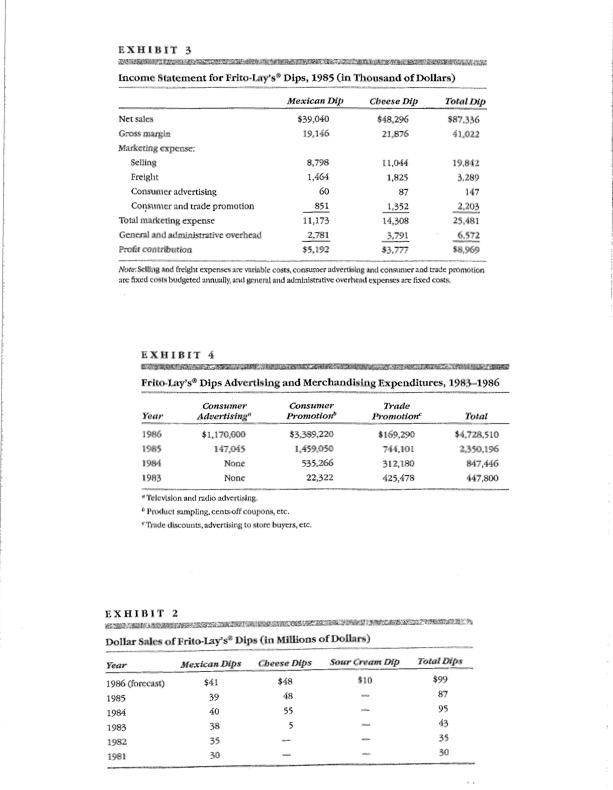
Discuss and Analyze the following Case Scenario: Product-Line in consideration: Frito Lay's Dips (Case Excerpts given bere) As per U.S. industry estimates in 1985, total dips' retail sales volume was $620 million. Dips normally form complementary offerings - they are served with chips/crackers... or with vegetables/raw-veggies... - thereby resulting in two segments constituting dips' sales: the chip-dips segment ( 67% of market volume), and the vegetable-dips segment ( 33% of market volume). Frito Lay's Dips operated within the chips-dips segment till 1985; its retail sales in 1985 amounted to $135 million. Here, Frito Lay's Dips commanded robust market shares in the 'Cheese Dips' and 'Mexican Dips' categories within chip-dips which it catered to. With increasing pressure to enter the potent vegetable-dips segment and leverage the company's brand toward effectively penetrating this opportunity, Frito Lay's Dips introduced a shelf-stable dip within the 'Sour-Cream Dips' category to position its usage as a veggie-dip for 1986 ; its 1986 sales were forecasted to be $10 million. Accordingly, more aggressive marketing functions' efforts along with associated investments, costs, reallocations of programmed/committed funds, etc. would be called for; the executive board stresses at the same time that the gross margin and profit contribution must be preserved; financial analysis is thus needed to figure out the additional sales volumes and market shares required of the dips line to sustain the budgeted incremental expenditures. Dip Distribution and Sales Effort Frito-Lay distributes its products through 350,000 outlets nationwide. In 1985, 34,000 outlets were supermarkets, 47,000 were convenience stares, and 20,000 were nonfood outlets. The remainder of Frito-Lay's 350,000 outlets were small grocery stores, liquor stores, service stations, and a variety of institutional customers. The great majority of Hrito-Lay 's" Dips, however, are sold through supermarkets. Frlto-Lay's distribution system is organized around four geographical zones that cover the entire United States. Each zone contains distribution centers that ibventory products for the Frito-Lay sales force, which is composed of over 10,000 indivicuals who make 400,000 sales and delivery calls during an avernge workday. Each Frito-Lay salesperson follows a specific, assigned route and is responsible for selling company products to present and potential customers on his or her route. Frito-Lay uses a "front-door store dellvery system, "in which one person performs the sales and dellvery functions. During a visit to a store, the driver/salesperson takes orders, unloads the product, stocks and arranges the shelves, and handles in-store merchandising. This sales and delivery system is particularly suited to the 270,000 nonchain outlets serviced by Frito-Lay. Experience has indicated, however, that sales calls on chain-store accounts, which include most supermarkets, virtually always require participation by a Frito-Lay Region orDivision Manager. Such participation is necessary because chain-store snack buyers purchase for all outlets in the chaln and approve in-store merchandising plans as well. Furthermore, the sales task and account servicing are more time consuming and complex, although no less important, than those required for individual outlets (for example, "mom-and-pop" grocery stores and liquor stores). Dip Marketing Frior to 1983, the Frito-lay's" Dips line was viewed as a nonpromoted profit producer. With the introduction of cheese dips in 1983, Frito-Lay began promoting dips, but virtually all marketing and promotion were directed toward retail-store snack food buyers in the form of trade-oriented promotions. In 1985, the emphasis shifted to consumer promotions such as protuct sampling and couponing to generate trial of the new products, and television and radio advertising was used for the first time since the 1950s. FritoLay's new product effort, coupled with increased competitive activity, resulted in further planned increases in consumer advertising and promotion in 1986. Exhibit 4 sammarizes the advertising and merchandising expenditures for dips for the period. EXHIHIT 3 Income Statement for Frito-Lay's Dips, 1985 (in Thousand of Dollars) Note Seliag and treight expenses are variable costs, consumer advertibing and consunier and trade poomoticn are fixed coss boulyeted anusilly and genenal and ad anlanisgritive overtead expenses ar fixed cosk. EXHIBIT I Frito-Lay's" Dips Advertising and Merchandising Expenditures, 1983-1986 "Television and redio advertiding. ' Proiluct sampling centsoff coupons, etc. "Thale discoubts, advertisirs to stare bayers, etc. EX H I I T 2 Dollar Sales of Frito-Lay's Dips (in Millions of Dollars)
Step by Step Solution
There are 3 Steps involved in it

Get step-by-step solutions from verified subject matter experts
 Study Help