Question: Presenting Research about Eco-Friendly Practices Creating Charts to Emphasize Key Messages BUSIN Topics Analyzing survey results Creating tables, charts, and other data graphics Developing survey
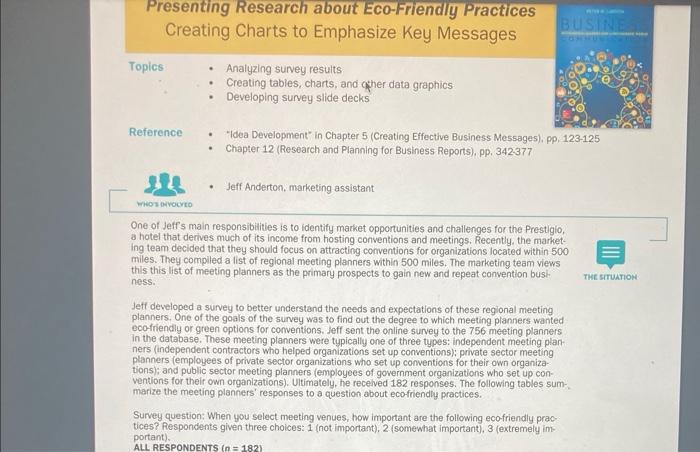
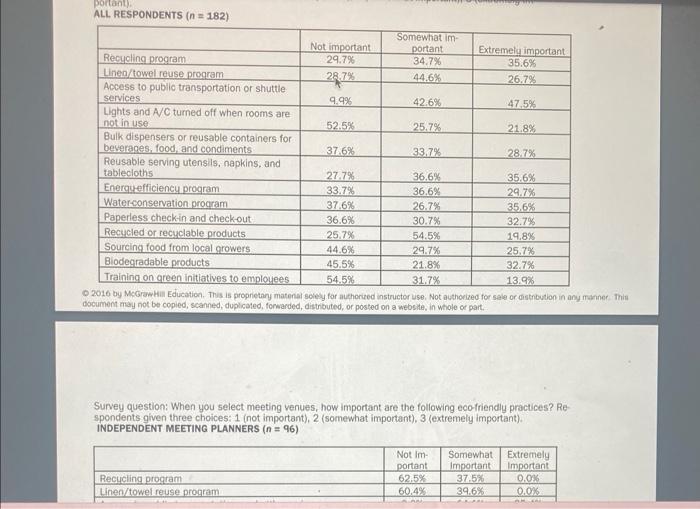
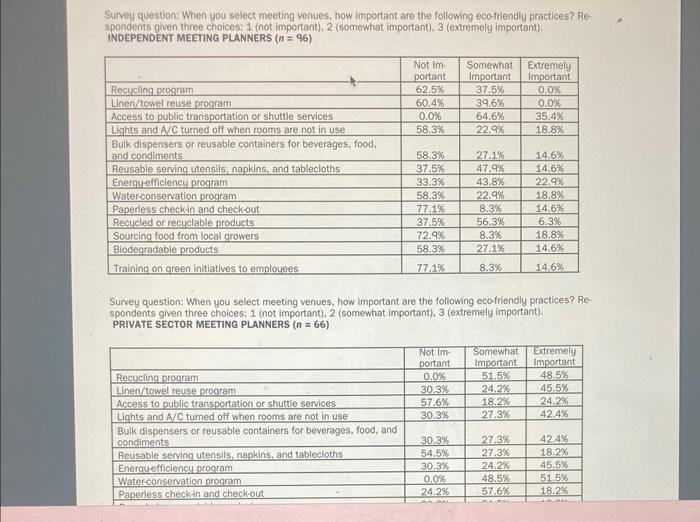
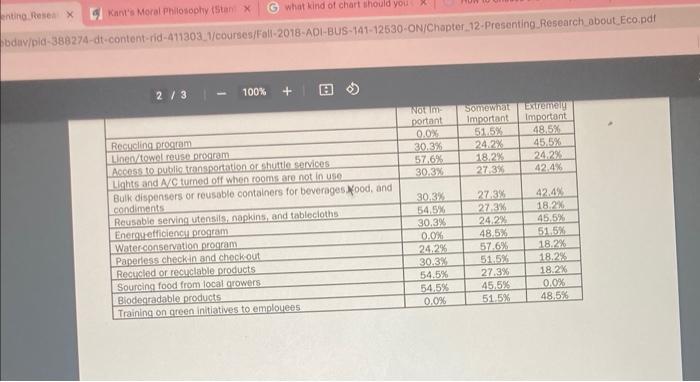
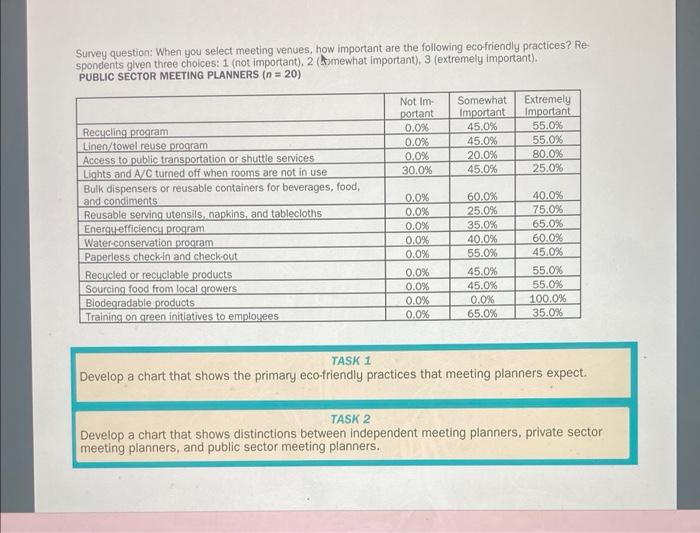
Presenting Research about Eco-Friendly Practices Creating Charts to Emphasize Key Messages BUSIN Topics Analyzing survey results Creating tables, charts, and other data graphics Developing survey slide decks Reference Idea Development" in Chapter 5 (Creating Effective Business Messages), pp. 123-125 Chapter 12 (Research and Planning for Business Reports), pp. 342377 . Jeff Anderton, marketing assistant WHO'S INVOLVED One of Jeff's main responsibilities is to identify market opportunities and challenges for the Prestigio, a hotel that derives much of its income from hosting conventions and meetings. Recently, the market Ing team decided that they should focus on attracting conventions for organizations located within 500 miles. They compiled a list of regional meeting planners within 500 miles. The marketing team views this this list of meeting planners as the primary prospects to gain new and repeat convention busi: ness THE SITUATION Jeff developed a survey to better understand the needs and expectations of these regional meeting planners. One of the goals of the survey was to find out the degree to which meeting planners wanted eco-friendly or green options for conventions, Jeff sent the online survey to the 756 meeting planners in the database. These meeting planners were typically one of three types: Independent meeting plan ners (independent contractors who helped organizations set up conventions): private sector meeting planners (employees of private sector organizations who set up conventions for their own organiza tions): and public sector meeting planners (employees of government organizations who set up con ventions for their own organizations). Ultimately, he received 182 responses. The following tables sum- marize the meeting planners' responses to a question about eco-friendly practices. Survey question: When you select meeting venues, how important are the following eco-friendly prao tices? Respondents given three choices: i (not important), 2 (somewhat important), 3 (extremely im- portant) ALL RESPONDENTS (n = 1821 28.7% portant) ALL RESPONDENTS (n = 182) Somewhat im Not important portant Extremely important Recycling program 29.7% 34.7% 35.6% Linea towel reuse program 44.6% 26.7% Access to public transportation or shuttle Services 4.9% 42.6% 47.5% Lights and NC turned off when rooms are not in use 52.5% 25.7% 21.8% Bulk dispensers or reusable containers for beverages, food, and condiments 37.6% 33.7% 28.7% Reusable serving utensils, napkins, and tablecloths 27.7% 36.6% 35.6% Energiefficiency program 33.7% 36.6% 29.7% Water conservation program 37.6% 26.7% 35,6% Paperless check-in and check out 36.6% 30.7% 32.7% Recycled or recyclable products 25.7% 54.5% 19.8% Sourcing food from local growers 44.6% 29.7% 25.7 Biodegradable products 45.5% 21.8% 32.7% Training on green initiatives to employees 54.5% 31.7% 13.9% 2016 by McGraw Hill Education. This is proprietary material solely for authorized instructor use. Not authorized for sale or distribution in any manner. This document may not be copied, scanned, duplicated, forwarded, distributed, or posted on a website, in whole or part. Survey question: When you select meeting venues, how important are the following eco-friendly practices? Re spondents given three choices: 1 (not important), 2 (somewhat important), 3(extremely important), INDEPENDENT MEETING PLANNERS (n = 96) Recycling program Linen/towel reuse program Not im portant 62.5% 60.4% Somewhat Important 37.5% 39.6% Extremely Important 0.0% 0.0% Survey question: When you select meeting venues, how important are the following eco-friendly practices? Re- spondents given three choices: 1 (not important), 2 (somewhat important), 3 (extremely important). INDEPENDENT MEETING PLANNERS (n = 96) Not Im portant 62.5% 60.4% 0.0% 58.3% Somewhat Important 37.5% 39.6% 64.6% 22.9% Extremely Important 0.0% 0.0% 35.4% 18.8% Recycling program Linen/towel reuse program Access to public transportation or shuttle services Lights and A/C turned off when rooms are not in use Bulk dispensers or reusable containers for beverages, food, and condiments Reusable serving utensils, napkins, and tablecloths Energy efficiency program Water conservation program Paperless check-in and check out Recycled or recyclable products Sourcing food from local growers Biodegradable products Training on green initiatives to employees 58.3% 37.5% 33.3% 58.3% 77.1% 37.5% 72.9% 58.3% 27.1% 47.9% 43.8% 22.9% 8.3% 56.3% 8.3% 27.1% 14.6% 14.6% 22.9% 18.8% 14.6% 6.3% 18.8% 14.6% 14.6% 77.1% 8.3% Survey question: When you select meeting venues, how important are the following eco-friendly practices? Re- spondents given three choices: 1 (not important), 2 (somewhat Important), 3 (extremely important). PRIVATE SECTOR MEETING PLANNERS (n = 66) Not im portant 0.0% 30.3% 57.6% 30.3% Somewhat Extremely Important Important 51.5% 48.5% 24.2% 45.5% 18.2% 24.2% 27.3% 42.4% Recucling program Linen/towel reuse program Access to public transportation or shuttle services Lights and A/C turned off when rooms are not in use Bulk dispensers or reusable containers for beverages, food, and condiments Reusable serving utensils, napkins, and tablecloths Energy efficiency program Water conservation program Paperless check-in and check-out 30.3% 54.5% 30,3% 0.0% 24.2% 27.3% 27.3% 24.2% 48.52 57.6% 42.4% 18.2% 45,5% 51.5% 18.2% antino Resen Kant's Moral Philosophy (San X Gwhat kind of chart should you bduv/pid-388274-dt-content-rid-4113031/courses/Fall-2018-ADI-BUS-141-12530 ON/Chapter 12-Presenting Research about Eco.pdf 2 / 3 100% + NOM portant 0.0% 30.3% 57.6% 30.3% Somewhat Important 51.5% 24,2% 18.2% 273% Extremo Important 48.5% 45.5% 2429 42.4% Recucling program Linentowel reuse program Access to public transportation or shuttle services Lehts and AC turned off when rooms are not in use Bulk dispensers or reusable containers for beverages Mood, and condiments Reusable serving utensils napkins, and tablecloths Energieefficiencia program Water conservation program Paperless check in and check out Recucled or recuciable products Sourcing food from local growers Blodegradable products Training on green initiatives to emplouens 30,3% 54. 30.3% 0.0% 24,2% 30.3% 54.5% 54.5% 0.0% 273 27.3% 24,2% 48.5% 57.6% 5159 27.3% 45.5 51.5% 42.43 18.2% 45,5% 51.5% 18.2% 18.2% 18.2% 0.0% 48.5% Survey question: When you select meeting venues, how important are the following eco-friendly practices? Re. spondents given three choices: 1 (not important), 2(Romewhat important), 3 (extremely important), PUBLIC SECTOR MEETING PLANNERS (n = 20) Not Im- portant 0.0% 0.0% 0.0% 30.0% Somewhat Important 45.0% 45.0% 20.0% 45.0% Extremely Important 55.0% 55.0% 80.0% 25.0% Recycling program Linen/towel reuse program Access to public transportation or shuttle services Lights and A/C turned off when rooms are not in use Bulk dispensers or reusable containers for beverages, food, and condiments Reusable serving utensils, napkins, and tablecloths Energy efficiency program Water conservation program Paperless check-in and check-out Recycled or recyclable products Sourcing food from local growers Biodegradable products Training on green initiatives to employees 0.0% 0.0% 0.0% 0.0% 0.0% 0.0% 0.0% 0.0% 0.0% 60.0% 25.0% 35.0% 40.0% 55.0% 45.0% 45.0% 0.0% 65.0% 40.0% 75.0% 65.0% 60.0% 45.0% 55.0% 55.0% 100.0% 35.0% TASK 1 Develop a chart that shows the primary eco-friendly practices that meeting planners expect. TASK 2 Develop a chart that shows distinctions between independent meeting planners, private sector meeting planners, and public sector meeting planners









 Study Help