







Question: (PRESS CTrl + TO SEE CLEARLY!) (PRESS CTrl + TO SEE CLEARLY!) (PRESS CTrl + TO SEE CLEARLY!) (PRESS CTrl + TO SEE CLEARLY!) Question
(PRESS CTrl + TO SEE CLEARLY!) (PRESS CTrl + TO SEE CLEARLY!) (PRESS CTrl + TO SEE CLEARLY!) (PRESS CTrl + TO SEE CLEARLY!)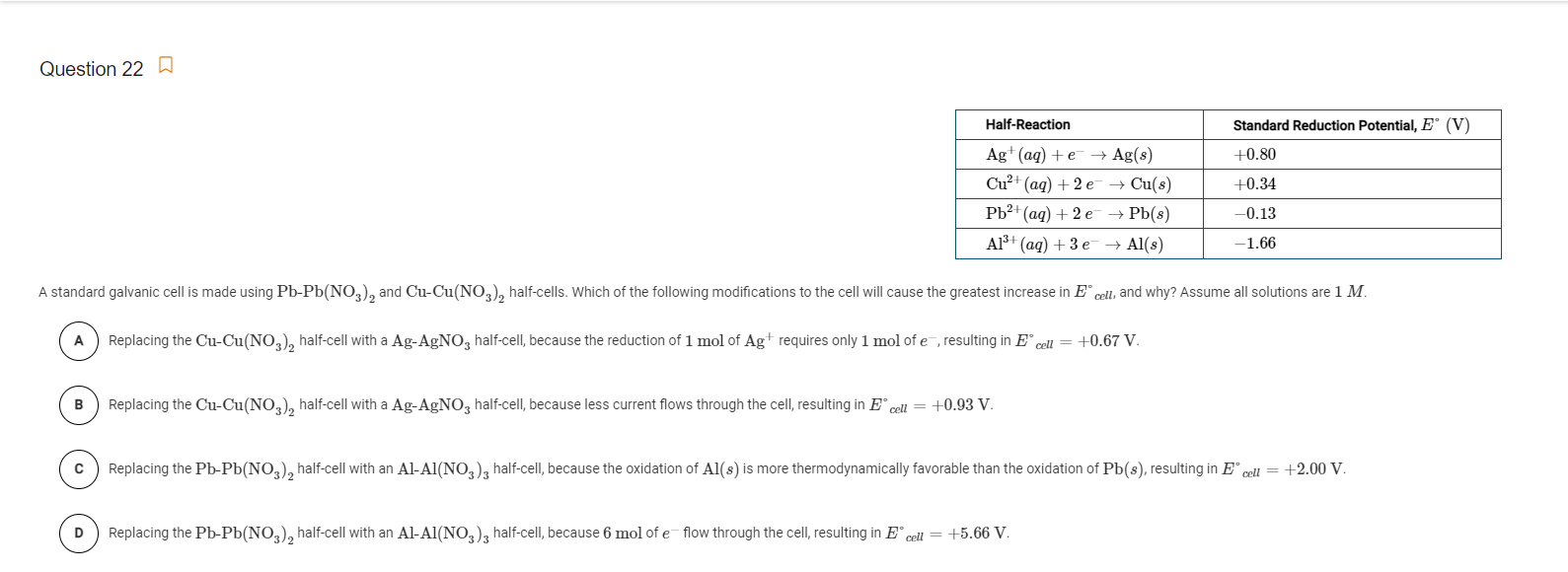
Question 22a Half-Reaction Standard Reduction Potential, E (V) +0.80 +0.34 Ag+ (aq) + e + Ag(s) Cu+ (aq) + 2 e + Cu(s) Pb2+ (aq) + 2 e + Pb(3) Al3+ (aq) + 3 e + Al(8) -0.13 -1.66 A standard galvanic cell is made using Pb-Pb(NO3), and Cu-Cu(NO3), half-cells. Which of the following modifications to the cell will cause the greatest increase in Ecell, and why? Assume all solutions are 1 M. A Replacing the Cu-Cu(NO3), half-cell with a Ag-AgNO3 half-cell, because the reduction of 1 mol of Agt requires only 1 mol of e, resulting in E cell = +0.67 V. B Replacing the Cu-Cu(NO3), half-cell with a Ag-AgNO3 half-cell, because less current flows through the cell, resulting in Ecell = +0.93 V. Replacing the Pb-Pb(NO3), half-cell with an Al-A1(NO3)3 half-cell, because the oxidation of Al(s) is more thermodynamically favorable than the oxidation of Pb(s), resulting in Ecell = +2.00 V. D Replacing the Pb-Pb(NO3), half-cell with an Al-A1(NO3)3 half-cell, because 6 mol of e flow through the cell, resulting in Ecell = +5.66 V
Step by Step Solution
There are 3 Steps involved in it

Get step-by-step solutions from verified subject matter experts
 Study Help