







Question: Pricing with Network Effects This problem set explores what happens to pricing when we add network effects, which are a specific form of positive externality.
Pricing with Network Effects
This problem set explores what happens to pricing when we add network effects, which are a specific form of positive externality.
Youve invented a 3D fax machine. This cool technology is almost like a Star Trek teleporter. You can scan an object at one machine, which creates an exact copy at another 3D fax machine. It is so valuable that as more people use it, it becomes more valuable, and the price any given user is willing to pay increases in turn.
Consider a scenario in which there are 12 possible users, who each value the fax machine at i*n, where i is the index of that user (from 1 to 12), and n is the number of other purchasing users. So, if no one buys the 3D fax machine, everyone values it at 0. However, as soon as one person buys the device, then the 12 possible users begin to value the product at 1, 2, 12, respectively. If 2 people purchase, the 12 possible users valuations increase to 2, 4, 24, and so on. Because youve just invented the machine, the initial number of users is zero, but you want to price it so as to encourage purchase and ultimately maximize your profits. As you look to maximize your profits, it is important to keep in mind that it costs you $2 to make each machine.
Clarifying assumptions. Three points will help you think about the problem:
- Assume that only one user can adopt a particular machine, i.e., users cannot share a machine.
- Assume that the marginal buyer does purchase, meaning that if the price is $3, then someone who values the machine at $3 will purchase.
- Consider how a cascade must start. From the perspective of a single buyer, this has two parts:
- Part A: If I purchase, given the price, will the next person have surplus >=0? AND
- Part B: If part A is true, and the next person purchases, then afterward, will I have surplus >= 0, given the price?
If both Part A and Part B are true, then a single person can cause a market to tip. That person might experience a loss for a moment but will recover as soon as the next person buys. No coordination is needed to start this cascade; one person can trigger it.
Question: What are your profits when you first invent the 3D fax if you offer it at a fixed price of $12?
Question: What are your profits if you offer the machine at a fixed price of $11?
Suppose that you can choose a fixed price for everyone, but you can offer a discount to the first few buyers. For example, you could set a price of $15 but offer a $5 discount to the first buyer.
Note: Under a publicly posted pricing policy (here, the discount), people with the highest willingness to pay (WTP) will buy first.
Hint: To set up the discount strategy, make sure that the price you charge net of the discount is no more than the WTP of the first several people who buy.
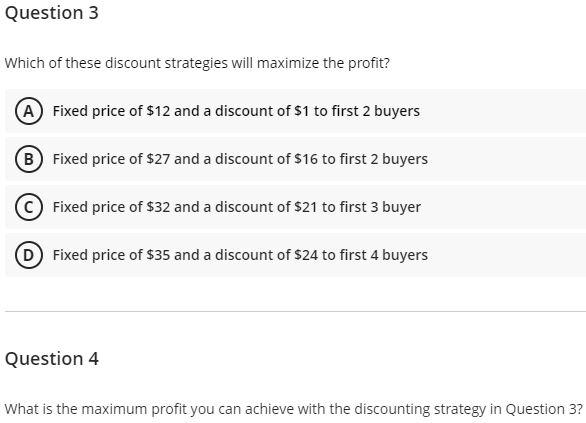
Question 3 Which of these discount strategies will maximize the profit? A Fixed price of $12 and a discount of $1 to first 2 buyers B Fixed price of $27 and a discount of $16 to first 2 buyers Fixed price of $32 and a discount of $21 to first 3 buyer Fixed price of $35 and a discount of $24 to first 4 buyers Question 4 What is the maximum profit you can achieve with the discounting strategy in Question 3? Question 3 Which of these discount strategies will maximize the profit? A Fixed price of $12 and a discount of $1 to first 2 buyers B Fixed price of $27 and a discount of $16 to first 2 buyers Fixed price of $32 and a discount of $21 to first 3 buyer Fixed price of $35 and a discount of $24 to first 4 buyers Question 4 What is the maximum profit you can achieve with the discounting strategy in Question 3
Step by Step Solution
There are 3 Steps involved in it

Get step-by-step solutions from verified subject matter experts
 Study Help