







Question: Primal-dual path following algorithm for convex quadratic programming Consider the optimization problem minimize c'x + 1/2 x' Qx subject to Ax = b x greaterthanorequalto
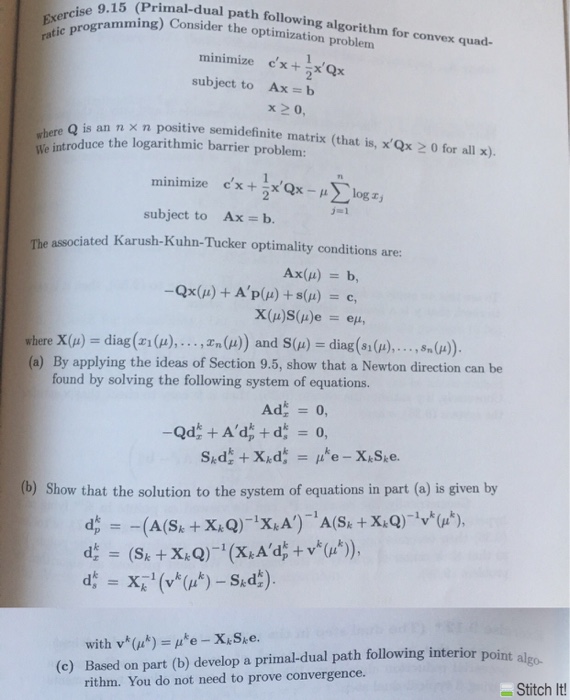
Consider the optimization problem minimize c'x + 1/2 x' Qx subject to Ax = b x greaterthanorequalto 0, where Q is an n times n positive semidefinite matrix (that is x'Qx greaterthanorequalto 0 for all x). We introduce the logarithmic barrier problem: minimize c'x + 1/2 x'Qx - mu sigma^n_j = 1 log x_j subject to Ax = b. The associated Karush-Kuhn-Tucker optimality conditions are: Ax(mu) = b, -Qx(mu) + A'p(mu) + s(mu) = c, X(mu)S(mu)e = e mu, where X(mu) = diag(x_1(mu), ..., x_n(mu)) and S(mu) = diag(s_1(mu), ..., s_n(mu)). (a) By applying the ideas of section 9.5, show that a Newton direction can be found by solving the following system of equations. A d^k_x = 0, -Q d^k_x + A'd^k_p + d^k_s = 0, S_k d^k_x + X_k d^k_s = mu^k e - X_k S_k e. b) Show that the solution to the system of equations in part (a) is given by d^k_p = -(A(S_k + X_k Q)^-1 X_k A')^-1 A(S_k + X_k Q)^-1 v^k (mu^k), d^k_x = (S_k + X_k Q)^-1 (X_k A' d^k_p + v^k (mu^k)), d^k_s = X^-1_k (v^k (mu^k) - S_k d^k_x). with v^k (mu^k) = mu^k e - X_k S_k e. (c) Based on part (b) develop a primal-dual path following interior point algorithm. You do not need to prove convergence
Step by Step Solution
There are 3 Steps involved in it

Get step-by-step solutions from verified subject matter experts
 Study Help