







Question: Principle 1: A value not in the confidence interval can be rejected as a possible value of the population parameter. A value in the confidence


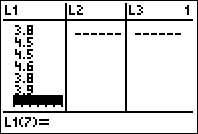


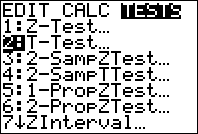
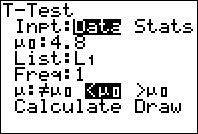
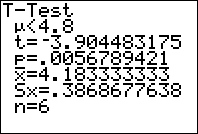

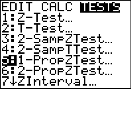

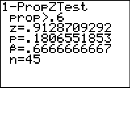

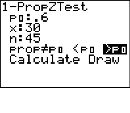
Principle 1: A value not in the confidence interval can be rejected as a possible value of the population parameter. A value in the confidence interval is an "acceptable" possibility for the value of a population parameter.
Principle 2: When the confidence intervals in two different populations do not overlap, it is reasonable to conclude that the two populations are different.
- Exercise Gear. A company sells exercise clothing and equipment on the Internet. To design clothing, data on physical characteristics of different types of customers is collected. The weight, in kilograms, of 24 female randomly selected runners are recorded:
62.8 | 56.9 | 58 | 48.1 | 57.3 | 54.7 | 50.4 | 53.9 |
55.9 | 64.2 | 58.7 | 63.3 | 59.7 | 60.6 | 51 | 52.8 |
61 | 57.9 | 48.6 | 60 | 50.8 | 55.4 | 64.3 | 56.7 |
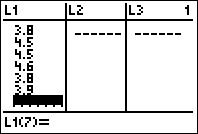
a. Give the 95% confidence interval for the mean weight of the population of all female runners.
b. Based on this confidence interval, does a test of
H0:




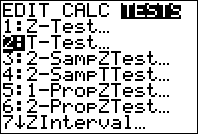
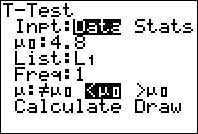
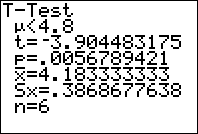


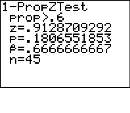

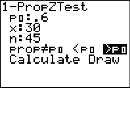
T-Test IntoDate Stats :4, List:L Frey: 1 alculate DrawT-Test = 04483 75 = 4.1\fEDIT CALC TESTS 7-Test.. T -Test - SampZTest... amPTTest. HNI -PropzTest... PropZTest... Interve\f1-Prop2Test PROP TON 1=45\f1-Prop2Test PO PROP*PO Calculate ME JO
Step by Step Solution
There are 3 Steps involved in it

Get step-by-step solutions from verified subject matter experts
 Study Help