Question: Priority value 6 3 Process P1 P2 P3 P4 P5 Burst time (ms) 8 6 10 7 9 4 7 8 (b) Assume the arrival
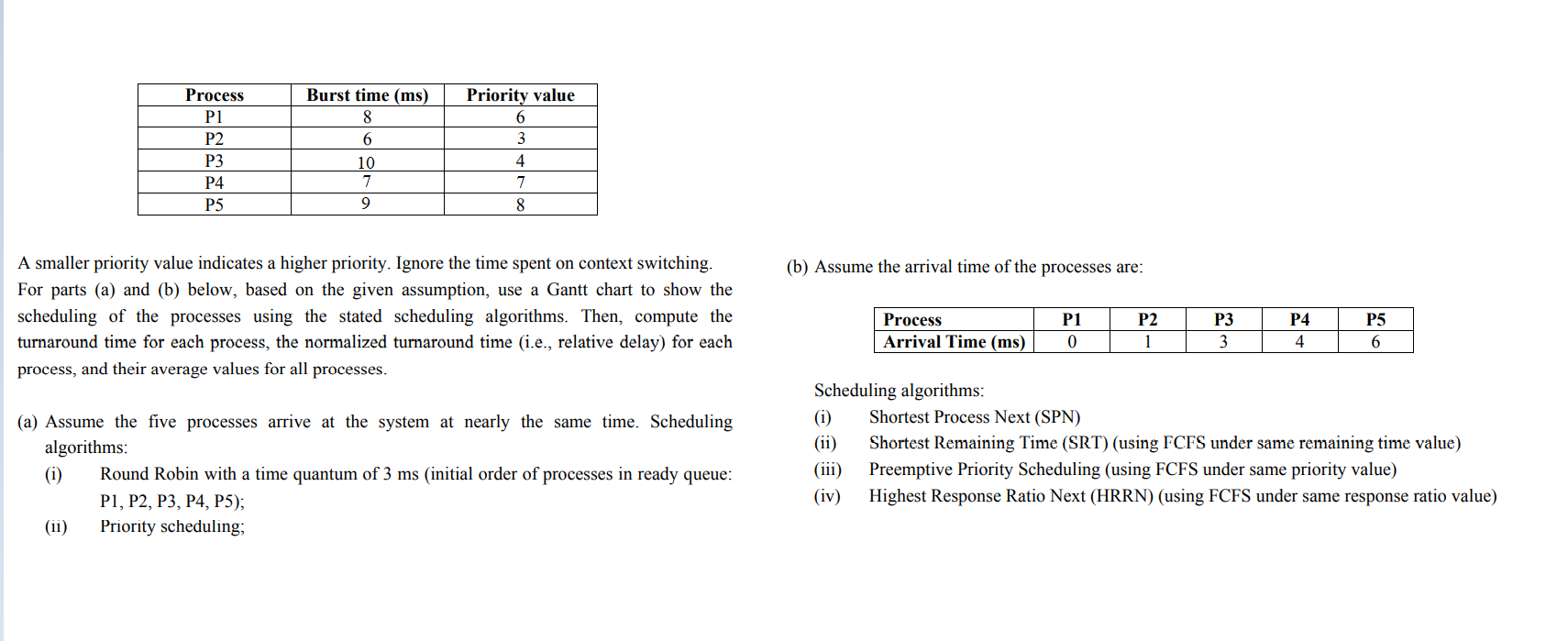
Priority value 6 3 Process P1 P2 P3 P4 P5 Burst time (ms) 8 6 10 7 9 4 7 8 (b) Assume the arrival time of the processes are: A smaller priority value indicates a higher priority. Ignore the time spent on context switching. For parts (a) and (b) below, based on the given assumption, use a Gantt chart to show the scheduling of the processes using the stated scheduling algorithms. Then, compute the turnaround time for each process, the normalized turnaround time (i.e., relative delay) for each process, and their average values for all processes. P1 Process Arrival Time (ms) P2 1 P3 3 P4 4 P5 6 0 (a) Assume the five processes arrive at the system at nearly the same time. Scheduling algorithms: Round Robin with a time quantum of 3 ms (initial order of processes in ready queue: P1, P2, P3, P4, P5); (11) Priority scheduling; Scheduling algorithms: (1) Shortest Process Next (SPN) Shortest Remaining Time (SRT) (using FCFS under same remaining time value) (iii) Preemptive Priority Scheduling (using FCFS under same priority value) (iv) Highest Response Ratio Next (HRRN) (using FCFS under same response ratio value) Priority value 6 3 Process P1 P2 P3 P4 P5 Burst time (ms) 8 6 10 7 9 4 7 8 (b) Assume the arrival time of the processes are: A smaller priority value indicates a higher priority. Ignore the time spent on context switching. For parts (a) and (b) below, based on the given assumption, use a Gantt chart to show the scheduling of the processes using the stated scheduling algorithms. Then, compute the turnaround time for each process, the normalized turnaround time (i.e., relative delay) for each process, and their average values for all processes. P1 Process Arrival Time (ms) P2 1 P3 3 P4 4 P5 6 0 (a) Assume the five processes arrive at the system at nearly the same time. Scheduling algorithms: Round Robin with a time quantum of 3 ms (initial order of processes in ready queue: P1, P2, P3, P4, P5); (11) Priority scheduling; Scheduling algorithms: (1) Shortest Process Next (SPN) Shortest Remaining Time (SRT) (using FCFS under same remaining time value) (iii) Preemptive Priority Scheduling (using FCFS under same priority value) (iv) Highest Response Ratio Next (HRRN) (using FCFS under same response ratio value)









 Study Help