







Question: Probability Theorem: Let E and F be two events in a sample space. (a) The probability of event E or F occurring p(EUF) =
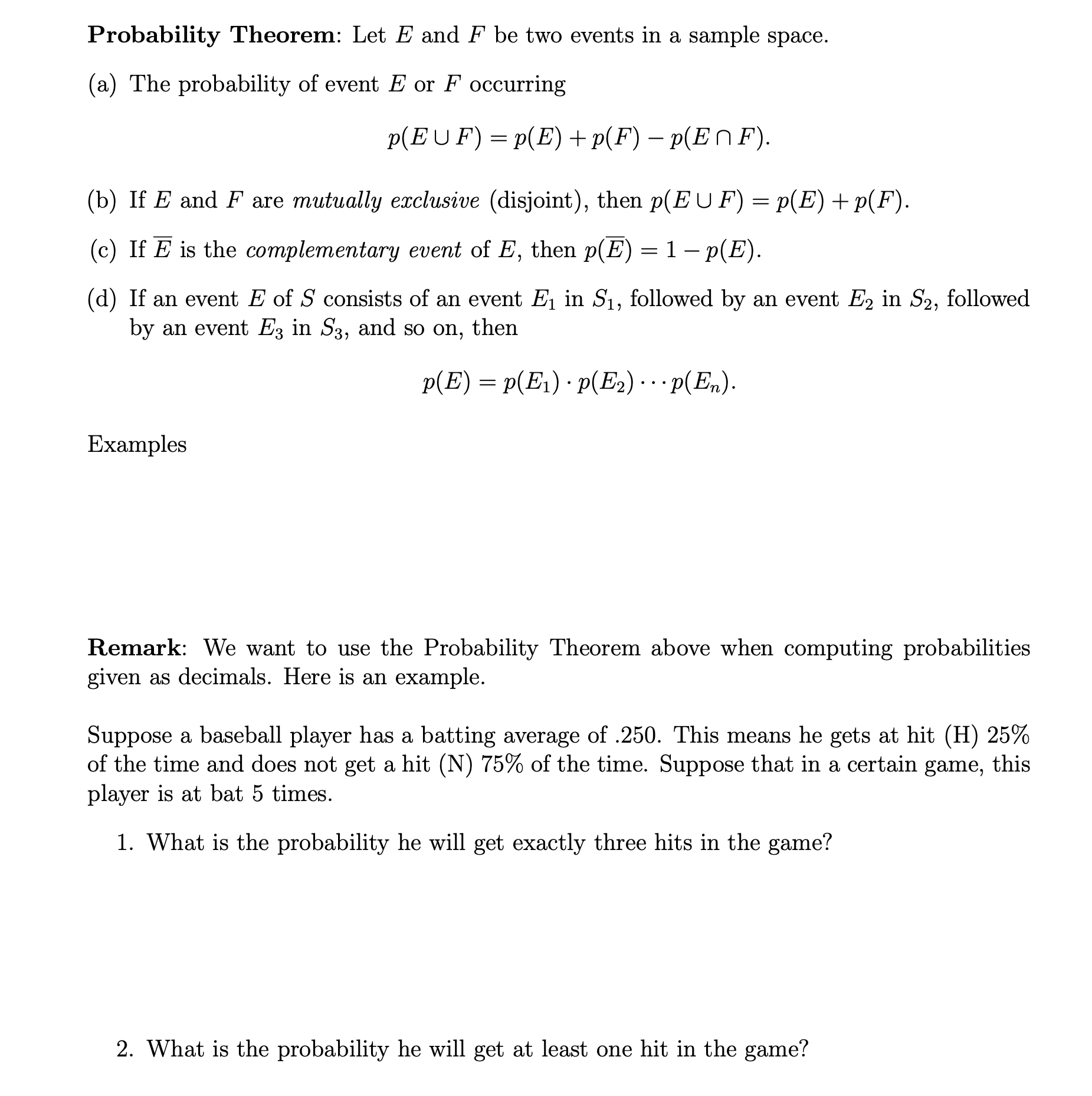
Probability Theorem: Let E and F be two events in a sample space. (a) The probability of event E or F occurring p(EUF) = p(E) +p(F) p(E^F). (b) If E and F are mutually exclusive (disjoint), then p(EU F) = p(E) +p(F). (c) If E is the complementary event of E, then p(E) = 1 p(E). (d) If an event E of S consists of an event E in S, followed by an event E2 in S2, followed by an event E3 in S3, and so on, then p(E) = p(E) p(E2) p(En). Examples Remark: We want to use the Probability Theorem above when computing probabilities given as decimals. Here is an example. Suppose a baseball player has a batting average of .250. This means he gets at hit (H) 25% of the time and does not get a hit (N) 75% of the time. Suppose that in a certain game, this player is at bat 5 times. 1. What is the probability he will get exactly three hits in the game? 2. What is the probability he will get at least one hit in the game?
Step by Step Solution
3.35 Rating (155 Votes )
There are 3 Steps involved in it
1 P Hit 25 1 4 P net Hit 75 3 4 out of 5 ... View full answer

Get step-by-step solutions from verified subject matter experts
 Study Help