







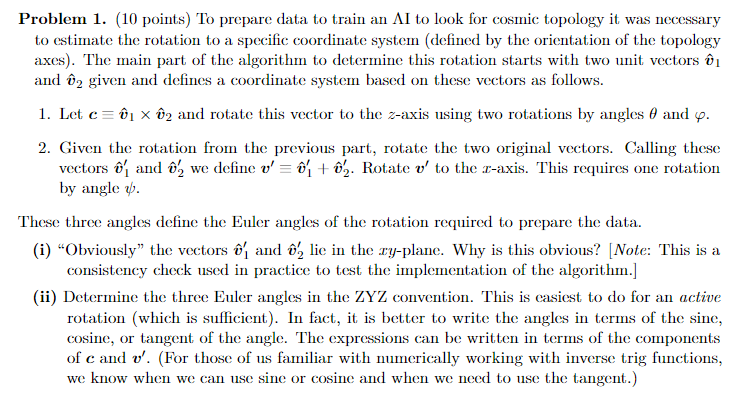
Question: Problem 1 . ( 1 0 points ) To prepare data to train an I to look for cosmic topology it was necessary to estimate
Problem points To prepare data to train an to look for cosmic topology it was necessary
to estimate the rotation to a specific coordinate system defined by the orientation of the topology
axes The main part of the algorithm to determine this rotation starts with two unit vectors hat
and hat given and defines a coordinate system based on these vectors as follows.
Let hathat and rotate this vector to the axis using two rotations by angles and
Given the rotation from the previous part, rotate the two original vectors. Calling these
vectors hat and hat we define hathat Rotate to the axis. This requires one rotation
by angle
These three angles define the Euler angles of the rotation required to prepare the data.
i "Obviously" the vectors hat and hat lie in the plane. Why is this obvious? Note: This is a
consistency check used in practice to test the implementation of the algorithm.
ii Determine the three Euler angles in the ZYZ convention. This is casiest to do for an active
rotation which is sufficient In fact, it is better to write the angles in terms of the sine
cosine, or tangent of the angle. The expressions can be written in terms of the components
of and For those of us familiar with numerically working with inverse trig functions,
we know when we can use sine or cosine and when we need to use the tangent.
Step by Step Solution
There are 3 Steps involved in it
1 Expert Approved Answer
Step: 1 Unlock

Question Has Been Solved by an Expert!
Get step-by-step solutions from verified subject matter experts
Step: 2 Unlock
Step: 3 Unlock
 Study Help