







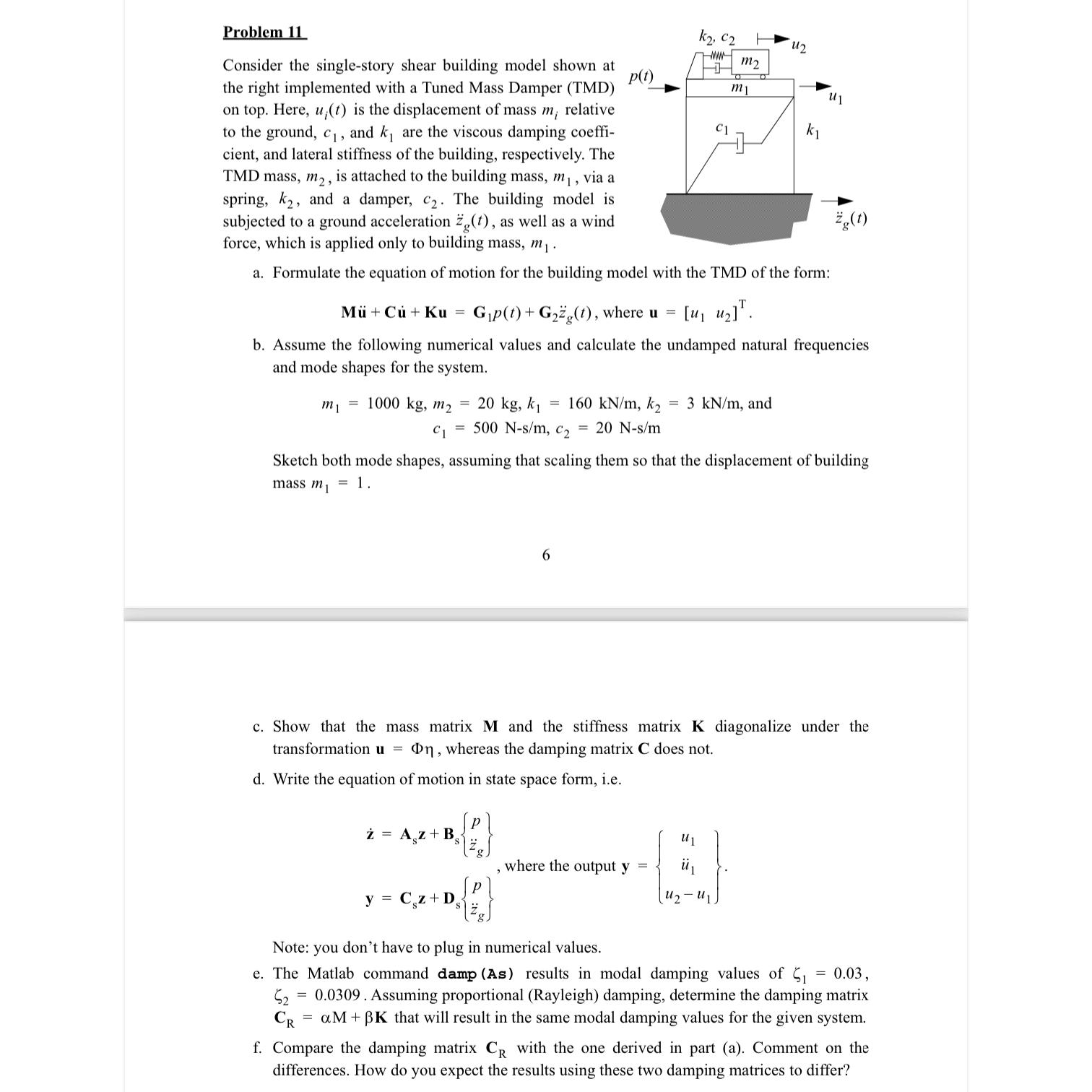
Question: Problem 1 1 Consider the single - story shear building model shown at the right implemented with a Tuned Mass Damper ( TMD ) on
Problem
Consider the singlestory shear building model shown at the right implemented with a Tuned Mass Damper TMD on top. Here, is the displacement of mass relative to the ground, and are the viscous damping coefficient, and lateral stiffness of the building, respectively. The TMD mass, is attached to the building mass, via a spring, and a damper, The building model is subjected to a ground acceleration as well as a wind force, which is applied only to building mass,
a Formulate the equation of motion for the building model with the TMD of the form:
where
b Assume the following numerical values and calculate the undamped natural frequencies and mode shapes for the system.
and
Sketch both mode shapes, assuming that scaling them so that the displacement of building mass
c Show that the mass matrix and the stiffness matrix diagonalize under the transformation whereas the damping matrix does not.
d Write the equation of motion in state space form, ie
Note: you don't have to plug in numerical values.
e The Matlab command dampAs results in modal damping values of Assuming proportional Rayleigh damping, determine the damping matrix that will result in the same modal damping values for the given system.
f Compare the damping matrix with the one derived in part a Comment on the differences. How do you expect the results using these two damping matrices to differ?
Step by Step Solution
There are 3 Steps involved in it
1 Expert Approved Answer
Step: 1 Unlock

Question Has Been Solved by an Expert!
Get step-by-step solutions from verified subject matter experts
Step: 2 Unlock
Step: 3 Unlock
 Study Help