







Question: Problem 1. (10 POINTS) DATA SUMMARIES AND LINEAR TRANSFORMATIONS. In this problem, you will explore how data summaries change under liner transformation of the
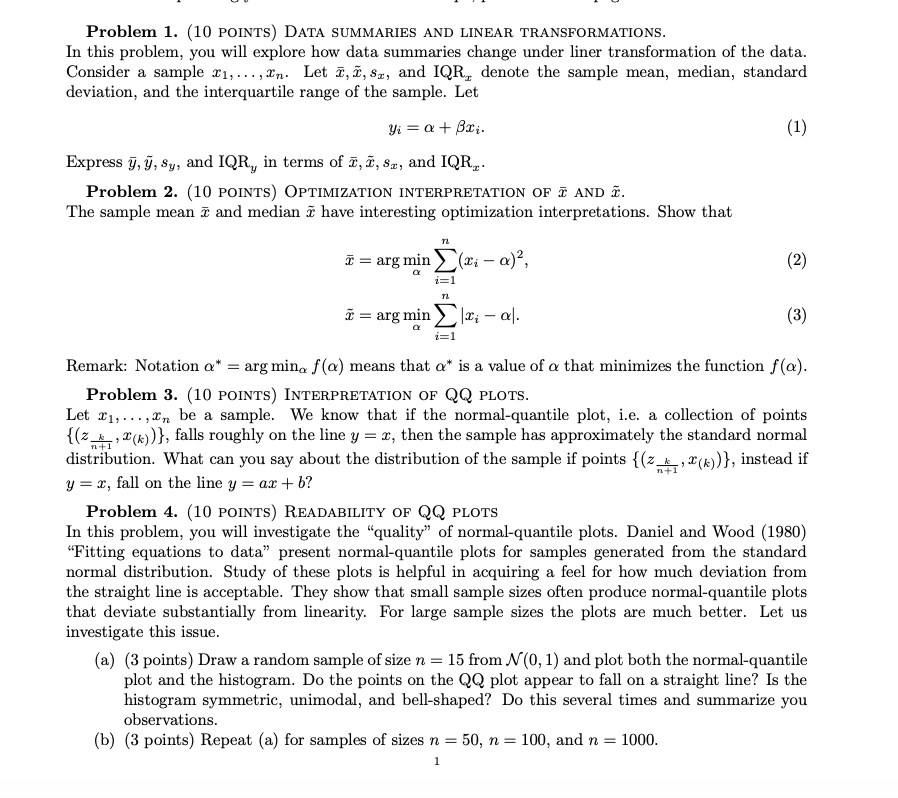

Problem 1. (10 POINTS) DATA SUMMARIES AND LINEAR TRANSFORMATIONS. In this problem, you will explore how data summaries change under liner transformation of the data. Consider a sample x1,...,xn. Let I, I, 82, and IQR, denote the sample mean, median, standard deviation, and the interquartile range of the sample. Let Yi = a + xi. Express , , sy, and IQR, in terms of , , sr, and IQR. Problem 2. (10 POINTS) OPTIMIZATION INTERPRETATION OF I AND . The sample mean and median have interesting optimization interpretations. Show that n = arg min (x; a), i=1 n I = arg min xa. - i=1 (1) (2) (3) Remark: Notation a* = arg mina f(a) means that a* is a value of a that minimizes the function f(a). Problem 3. (10 POINTS) INTERPRETATION OF QQ PLOTS. Let x1,...,x be a sample. We know that if the normal-quantile plot, i.e. a collection of points {(z (k))}, falls roughly on the line y = x, then the sample has approximately the standard normal distribution. What can you say about the distribution of the sample if points {(__, (^))}, instead if y=x, fall on the line y = ax + b? Problem 4. (10 POINTS) READABILITY OF QQ PLOTS In this problem, you will investigate the "quality" of normal-quantile plots. Daniel and Wood (1980) "Fitting equations to data" present normal-quantile plots for samples generated from the standard normal distribution. Study of these plots is helpful in acquiring a feel for how much deviation from the straight line is acceptable. They show that small sample sizes often produce normal-quantile plots that deviate substantially from linearity. For large sample sizes the plots are much better. Let us investigate this issue. (a) (3 points) Draw a random sample of size n = 15 from N(0, 1) and plot both the normal-quantile plot and the histogram. Do the points on the QQ plot appear to fall on a straight line? Is the histogram symmetric, unimodal, and bell-shaped? Do this several times and summarize you observations. (b) (3 points) Repeat (a) for samples of sizes n = 50, n = 100, and n 1000. 1 = (c) (4 points) After experimenting with normal samples in (a) and (b), what would be your estimate for the "critical" sample size n*, such that for samples of size larger than n*, the normal-quantile plots are stable enough to be easily interpreted (i.e. do not deviate substantially from linearity)? Write a script that implements this task. Write you results and conclusions as comments in the script.
Step by Step Solution
There are 3 Steps involved in it
Solutions Step 1 In Machine learing the non linear transformation changes the linear relationship be... View full answer

Get step-by-step solutions from verified subject matter experts
 Study Help