







Question: Problem 1 (20 points): With the ECB mode, if there is a one-bit error in a block of the transmitted ciphertext, only the corresponding plaintext
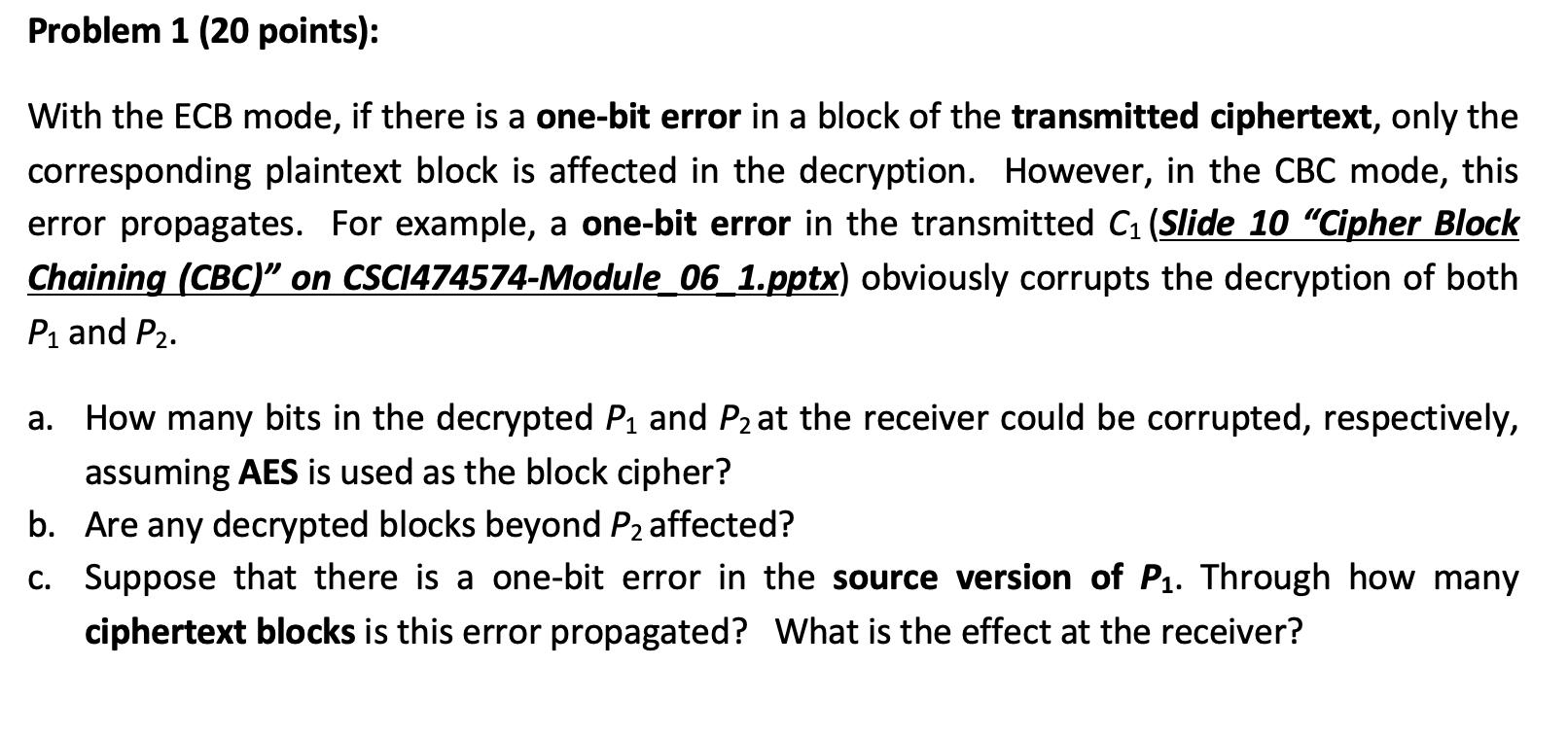
Problem 1 (20 points): With the ECB mode, if there is a one-bit error in a block of the transmitted ciphertext, only the corresponding plaintext block is affected in the decryption. However, in the CBC mode, this error propagates. For example, a one-bit error in the transmitted C1 (Slide 10 Cipher Block Chaining (CBC)" on CSC1474574-Module_06_1.pptx) obviously corrupts the decryption of both P1 and P2. a. How many bits in the decrypted P1 and P2 at the receiver could be corrupted, respectively, assuming AES is used as the block cipher? b. Are any decrypted blocks beyond P2 affected? C. Suppose that there is a one-bit error in the source version of P2. Through how many ciphertext blocks is this error propagated? What is the effect at the receiver? Problem 1 (20 points): With the ECB mode, if there is a one-bit error in a block of the transmitted ciphertext, only the corresponding plaintext block is affected in the decryption. However, in the CBC mode, this error propagates. For example, a one-bit error in the transmitted C1 (Slide 10 Cipher Block Chaining (CBC)" on CSC1474574-Module_06_1.pptx) obviously corrupts the decryption of both P1 and P2. a. How many bits in the decrypted P1 and P2 at the receiver could be corrupted, respectively, assuming AES is used as the block cipher? b. Are any decrypted blocks beyond P2 affected? C. Suppose that there is a one-bit error in the source version of P2. Through how many ciphertext blocks is this error propagated? What is the effect at the receiver
Step by Step Solution
There are 3 Steps involved in it

Get step-by-step solutions from verified subject matter experts
 Study Help