





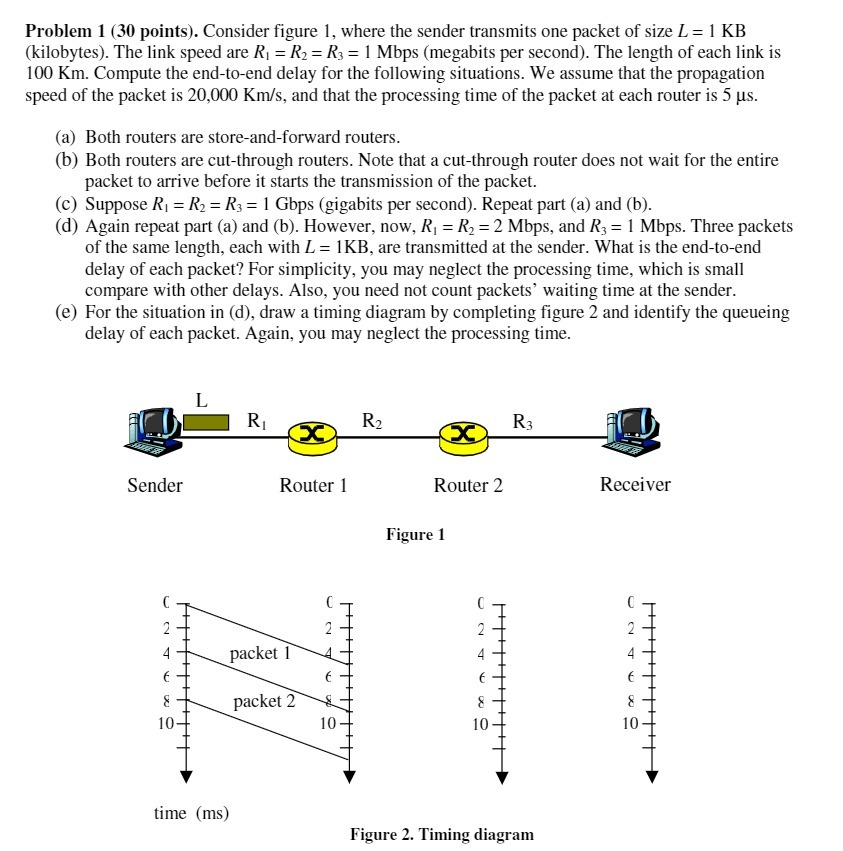
Question: Problem 1 (30 points}. Consider gure 1, where the sender transmits one packet of size L = 1 KB (kilobytes). The link speed are R;
Problem 1 (30 points}. Consider gure 1, where the
Problem 1 (30 points}. Consider gure 1, where the sender transmits one packet of size L = 1 KB (kilobytes). The link speed are R; : R2 : R3 : 1 Mbps (megabits per second}. The length of each link is 100 Km. Compute the endtoend delay for the following situations. We assume that the propagation speed of the packet is 20,000 KENS, and that the processing time of the packet at each router is 5 its. (a) Both routers are storeandforward routers. ([1) Both routers are cutthrough routers. Note that a cutthrough router does not wait for the entire packet to arrive before it starts the transmission of the packet. (6) Suppose R1 = R2 = R3 = l Gbps {gigabits per second). Repeat part (a) and (b). (d) Again repeat part (a) and (b). However, now, R. = R2 = 2 Mbps, and R3 = 1 Mbps. Three packets of the same length, each with L : \"(13, are transmitted at the sender. What is the endtoend delay of each packet? For simplicity, you may neglect the processing time, which is small compare with other delays. Also, you need not count packets\" waiting time at the sender. (e) For the situation in (d), draw a timing diagram by completing gure 2 and identify the queueing delay of each packet. Again, you may neglect the processing time. Sender Router 1 Router 2 Receiver packet 2 SmithBM?! time (ms) Figure 2. Timing diagram

Step by Step Solution

There are 3 Steps involved in it

1 Expert Approved Answer
Step: 1 Unlock blur-text-image

Question Has Been Solved by an Expert!

Get step-by-step solutions from verified subject matter experts

Step: 2 Unlock
Step: 3 Unlock

Students Have Also Explored These Related Mathematics Questions!