







Question: Problem 1 ( 6 points ) A watershed is a land area bounded peripherally by a divide and draining into a stream or other body
Problem points
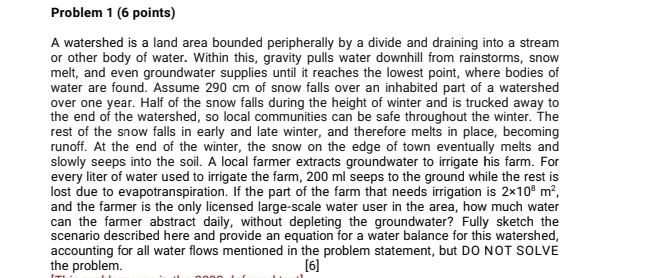
A watershed is a land area bounded peripherally by a divide and draining into a stream or other body of water. Within this, gravity pulls water downhill from rainstorms, snow melt, and even groundwater supplies until it reaches the lowest point, where bodies of water are found. Assume cm of snow falls over an inhabited part of a watershed over one year. Half of the snow falls during the height of winter and is trucked away to the end of the watershed, so local communities can be safe throughout the winter. The rest of the snow falls in early and late winter, and therefore melts in place, becoming runoff. At the end of the winter, the snow on the edge of town eventually melts and slowly seeps into the soil. A local farmer extracts groundwater to irrigate his farm. For every liter of water used to irrigate the farm, ml seeps to the ground while the rest is lost due to evapotranspiration. If the part of the farm that needs irrigation is and the farmer is the only licensed largescale water user in the area, how much water can the farmer abstract daily, without depleting the groundwater? Fully sketch the scenario described here and provide an equation for a water balance for this watershed, accounting for all water flows mentioned in the problem statement, but DO NOT SOLVE the problem just sketch the senario
Im
Step by Step Solution
There are 3 Steps involved in it
1 Expert Approved Answer
Step: 1 Unlock

Question Has Been Solved by an Expert!
Get step-by-step solutions from verified subject matter experts
Step: 2 Unlock
Step: 3 Unlock
 Study Help