







Question: Problem # 1 : ( 7 0 points ) The beam ( A B C ) of length ( 2 L
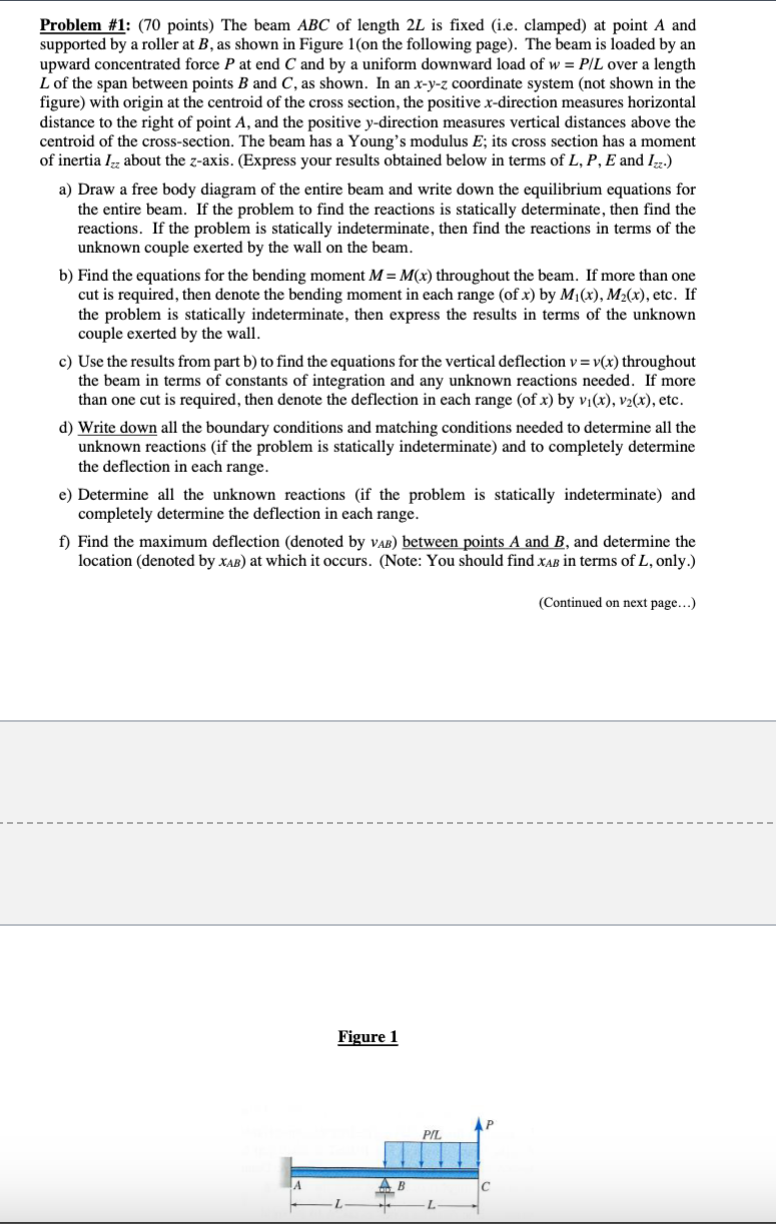
Problem #: points The beam A B C of length L is fixed ie clamped at point A and supported by a roller at B as shown in Figure on the following page The beam is loaded by an upward concentrated force P at end C and by a uniform downward load of wP L over a length L of the span between points B and C as shown. In an xyz coordinate system not shown in the figure with origin at the centroid of the cross section, the positive x direction measures horizontal distance to the right of point A and the positive y direction measures vertical distances above the centroid of the crosssection. The beam has a Young's modulus E ; its cross section has a moment of inertia Iz z about the z axis. Express your results obtained below in terms of L P E and Iz z
a Draw a free body diagram of the entire beam and write down the equilibrium equations for the entire beam. If the problem to find the reactions is statically determinate, then find the reactions. If the problem is statically indeterminate, then find the reactions in terms of the unknown couple exerted by the wall on the beam.
b Find the equations for the bending moment MMx throughout the beam. If more than one cut is required, then denote the bending moment in each range of x by Mx Mx etc. If the problem is statically indeterminate, then express the results in terms of the unknown couple exerted by the wall.
c Use the results from part b to find the equations for the vertical deflection vvx throughout the beam in terms of constants of integration and any unknown reactions needed. If more than one cut is required, then denote the deflection in each range of x by vx vx etc.
d Write down all the boundary conditions and matching conditions needed to determine all the unknown reactions if the problem is statically indeterminate and to completely determine the deflection in each range.
e Determine all the unknown reactions if the problem is statically indeterminate and completely determine the deflection in each range.
f Find the maximum deflection denoted by vA B between points A and B and determine the location denoted by xA B at which it occurs. Note: You should find xA B in terms of L only.
Step by Step Solution
There are 3 Steps involved in it
1 Expert Approved Answer
Step: 1 Unlock

Question Has Been Solved by an Expert!
Get step-by-step solutions from verified subject matter experts
Step: 2 Unlock
Step: 3 Unlock
 Study Help