







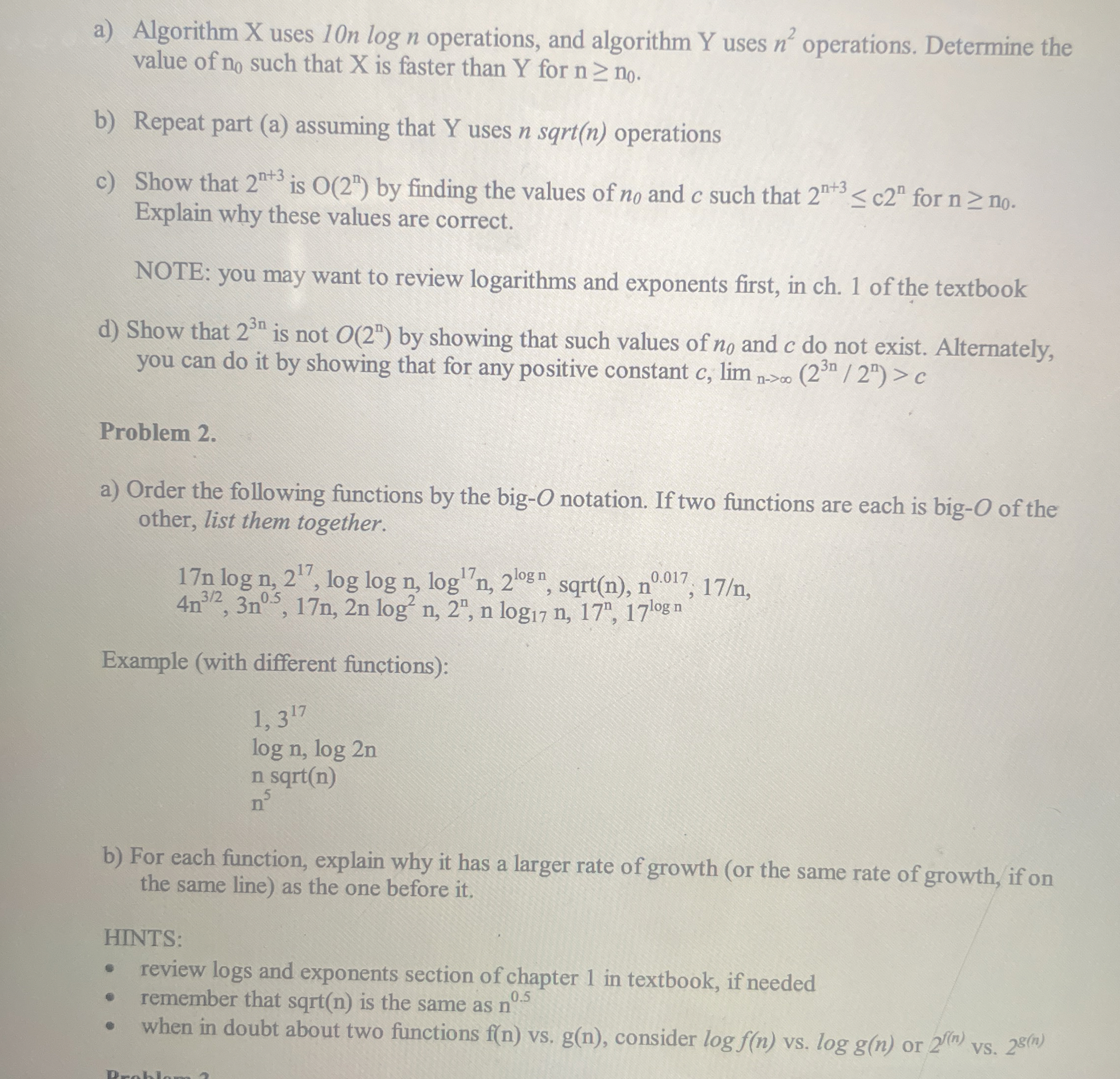
Question: Problem 1 . a ) Algorithm X uses 1 0 n l o g n operations, and algorithm Y uses n 2 operations. Determine the
Problem
a Algorithm X uses operations, and algorithm Y uses operations. Determine the value of such that is faster than for
b Repeat part a assuming that Y uses sqrt operations
c Show that is by finding the values of and such that for Explain why these values are correct.
NOTE: you may want to review logarithms and exponents first, in ch of the textbook
d Show that is not by showing that such values of and do not exist. Alternately, you can do it by showing that for any positive constant
Problem
a Order the following functions by the big notation. If two functions are each is big of the other, list them together.
Example with different functions:
b For each function, explain why it has a larger rate of growth or the same rate of growth, if on the same line as the one before it
HINTS:
review logs and exponents section of chapter in textbook, if needed
remember that is the same as
when in doubt about two functions vs consider vs or vs
a Algorithm X uses operations, and algorithm Y uses operations. Determine the value of such that is faster than for
b Repeat part a assuming that Y uses operations
c Show that is by finding the values of and such that for Explain why these values are correct.
NOTE: you may want to review logarithms and exponents first, in ch of the textbook
d Show that is not by showing that such values of and do not exist. Alternately, you can do it by showing that for any positive constant
Problem
a Order the following functions by the big notation. If two functions are each is big of the other, list them together.
Example with different functions:
b For each function, explain why it has a larger rate of growth or the same rate of growth, if on the same line as the one before it
HINTS:
review logs and exponents section of chapter in textbook, if needed
remember that sqrtn is the same as
when in doubt about two functions vs consider vs or vs
Step by Step Solution
There are 3 Steps involved in it
1 Expert Approved Answer
Step: 1 Unlock

Question Has Been Solved by an Expert!
Get step-by-step solutions from verified subject matter experts
Step: 2 Unlock
Step: 3 Unlock
 Study Help