







Question: PROBLEM 1 A ping-pong ball (m = 2.7 g. D = 3.8 cm) travels through stationary air (p = 1.2 kg/m?, v = 1.4x 10⁷
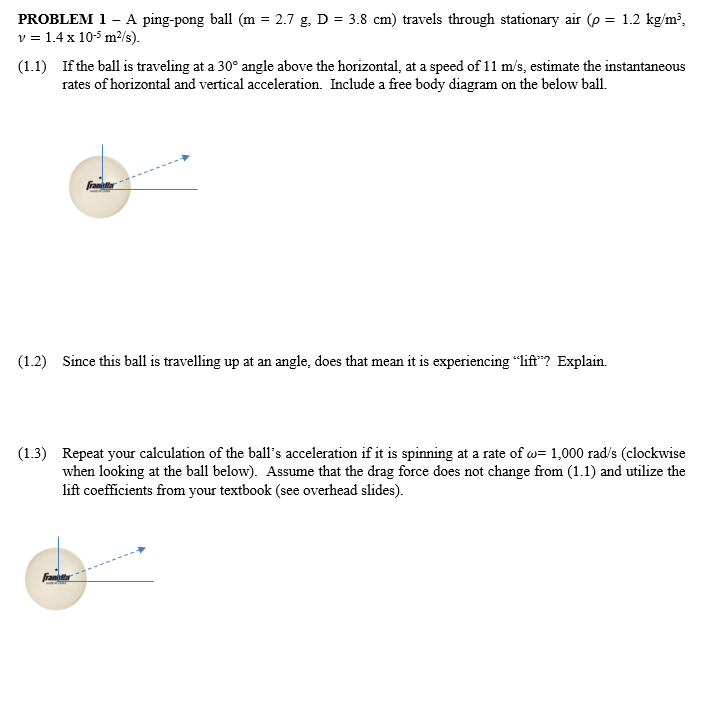
PROBLEM 1 A ping-pong ball (m = 2.7 g. D = 3.8 cm) travels through stationary air (p = 1.2 kg/m?, v = 1.4x 10⁷ ms). (1.1) If the ball is traveling at a 30 angle above the horizontal, at a speed of 11 m/s, estimate the instantaneous rates of horizontal and vertical acceleration. Include a free body diagram on the below ball. (1.2) Since this ball 1s travelling up at an angle, does that mean it 1s experiencing \"1ift\"? Explain. (1.3) Repeat your calculation of the ball's acceleration 1f 1t 15 spinning at a rate of w= 1,000 rad's (clockwise when looking at the ball below). Assume that the drag force does not change from (1.1) and utilize the lift coefficients from vour textbook (see overhead slides). (1.4) Estimate the terminal velocity of the ping pong ball if dropped in air. (1.5) Perform a spreadsheet-based solution to estimate the time and distance it takes the ball to reach 95% of the terminal velocity, if it is dropped from rest in still air. Be sure to account for the variation of Cp as the ball accelerates. Provide a graph of the ball speed vs. time and list all equations used so that another student could replicate your work
Step by Step Solution
There are 3 Steps involved in it

Get step-by-step solutions from verified subject matter experts
 Study Help