







Question: PROBLEM #1 : Assume three teams assigned to generate an embedded software project. Team 1 includes 9 engineers (average engineer salary $100,000 per annum); team
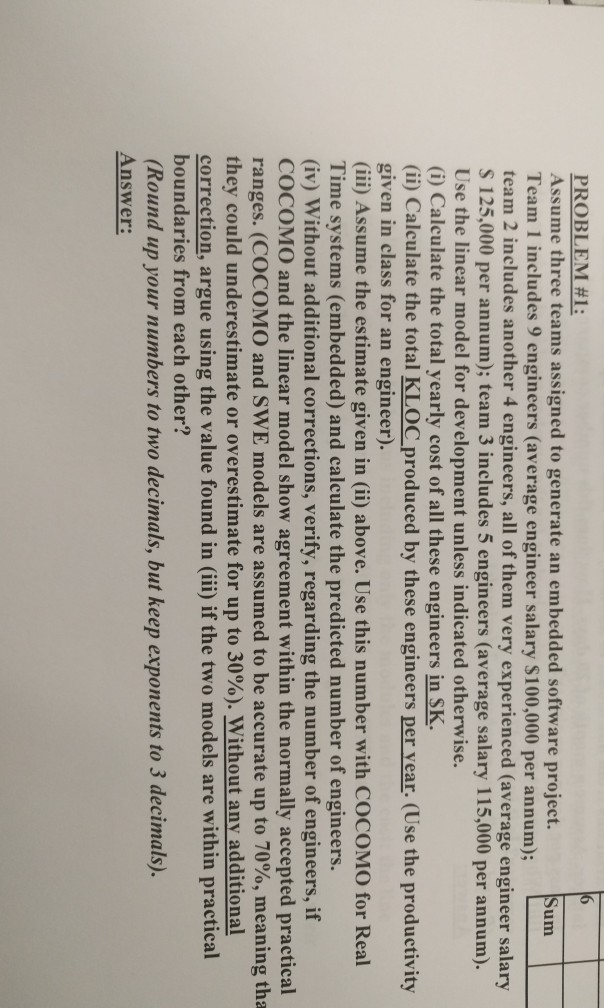
PROBLEM #1 : Assume three teams assigned to generate an embedded software project. Team 1 includes 9 engineers (average engineer salary $100,000 per annum); team 2 includes another 4 engineers, all of them very experienced (average engineer salary S 125,000 per annum); team 3 includes 5 engineers (average salary 115,000 per annum). Use the linear model for development unless indicated otherwise. (i) Calculate the total yearly cost of all these engineers in SK. (ii) Calculate the total KLOC produced by these engineers per year. (Use the productivity given in class for an engineer). (iii) Assume the estimate given in (ii) above. Use this number with COCOMO for Real Time systems (embedded) and calculate the predicted number of engineers. (iv) Without additional corrections, verify, regarding the number of engineers, if COCOM0 and the linear model show agreement within the normally accepted practical ranges. (COCOMO and SWE models are assumed to be accurate up to 70%, meaning tha they could underestimate or overestimate for up to 30%), without any additional correction, argue using the value found in (ii) if the two models are within practical boundaries from each other? (Round up your numbers to two decimals, but keep exponents to 3 decimals). Sum Answer: PROBLEM #1 : Assume three teams assigned to generate an embedded software project. Team 1 includes 9 engineers (average engineer salary $100,000 per annum); team 2 includes another 4 engineers, all of them very experienced (average engineer salary S 125,000 per annum); team 3 includes 5 engineers (average salary 115,000 per annum). Use the linear model for development unless indicated otherwise. (i) Calculate the total yearly cost of all these engineers in SK. (ii) Calculate the total KLOC produced by these engineers per year. (Use the productivity given in class for an engineer). (iii) Assume the estimate given in (ii) above. Use this number with COCOMO for Real Time systems (embedded) and calculate the predicted number of engineers. (iv) Without additional corrections, verify, regarding the number of engineers, if COCOM0 and the linear model show agreement within the normally accepted practical ranges. (COCOMO and SWE models are assumed to be accurate up to 70%, meaning tha they could underestimate or overestimate for up to 30%), without any additional correction, argue using the value found in (ii) if the two models are within practical boundaries from each other? (Round up your numbers to two decimals, but keep exponents to 3 decimals). Sum
Step by Step Solution
There are 3 Steps involved in it

Get step-by-step solutions from verified subject matter experts
 Study Help