







Question: Problem 1 Consider a consumer with the following utility function for consumption and leisure: U(R, C) = 160 In R + C where R is
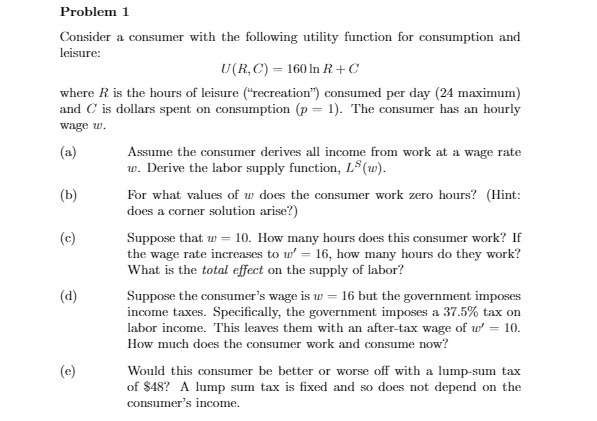
Problem 1 Consider a consumer with the following utility function for consumption and leisure: U(R, C) = 160 In R + C where R is the hours of leisure ("recreation") consumed per day (24 maximum) and C is dollars spent on consumption (p = 1). The consumer has an hourly wage w. (a) Assume the consumer derives all income from work at a wage rate w. Derive the labor supply function, 15(w). (b) For what values of w does the consumer work zero hours? (Hint: does a corner solution arise?) (c) Suppose that w = 10. How many hours does this consumer work? If the wage rate increases to w' = 16, how many hours do they work? What is the total effect on the supply of labor? (d) Suppose the consumer's wage is w = 16 but the government imposes income taxes. Specifically, the government imposes a 37.5% tax on labor income. This leaves them with an after-tax wage of w = 10. How much does the consumer work and consume now? (e) Would this consumer be better or worse off with a lump-sum tax of $48? A lump sum tax is fixed and so does not depend on the consumer's income
Step by Step Solution
There are 3 Steps involved in it

Get step-by-step solutions from verified subject matter experts
 Study Help