







Question: Problem 1 Consider the following elementary gas-phase reactions, ?, + D? - ?D + ?? Rxn a D, + ?? - ?D + D? Rxn
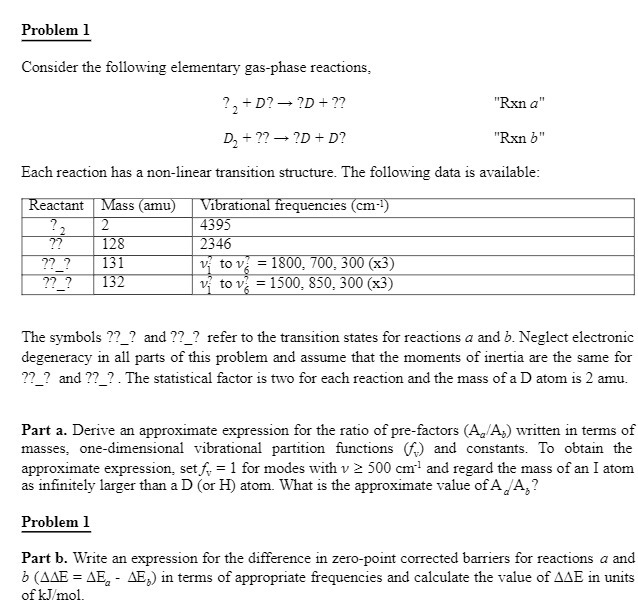
Problem 1 Consider the following elementary gas-phase reactions, ?, + D? - ?D + ?? "Rxn a" D, + ?? - ?D + D? "Rxn b" Each reaction has a non-linear transition structure. The following data is available: Reactant Mass (amu) Vibrational frequencies (cm-!) ! 2 2 1395 77 128 2346 ??_? 131 v. to v. = 1800, 700, 300 (x3) ?? ? 132 V. to v. = 1500, 850, 300 (x3) The symbols ??_? and ??_? refer to the transition states for reactions a and b. Neglect electronic degeneracy in all parts of this problem and assume that the moments of inertia are the same for ??_? and ??_? . The statistical factor is two for each reaction and the mass of a D atom is 2 amu. Part a. Derive an approximate expression for the ratio of pre-factors (A,/A) written in terms of masses, one-dimensional vibrational partition functions (f,) and constants. To obtain the approximate expression, set f, = 1 for modes with v 2 500 curl and regard the mass of an I atom as infinitely larger than a D (or H) atom. What is the approximate value of A /A,? Problem 1 Part b. Write an expression for the difference in zero-point corrected barriers for reactions a and b (AAE = AE, - AE,) in terms of appropriate frequencies and calculate the value of AAE in units of kJ/mol
Step by Step Solution
There are 3 Steps involved in it

Get step-by-step solutions from verified subject matter experts
 Study Help