







Question: PROBLEM 1: Consider the following situation. Nature determines whether the payoffs are as in Game 1, with probability p, or as in Game 2, with
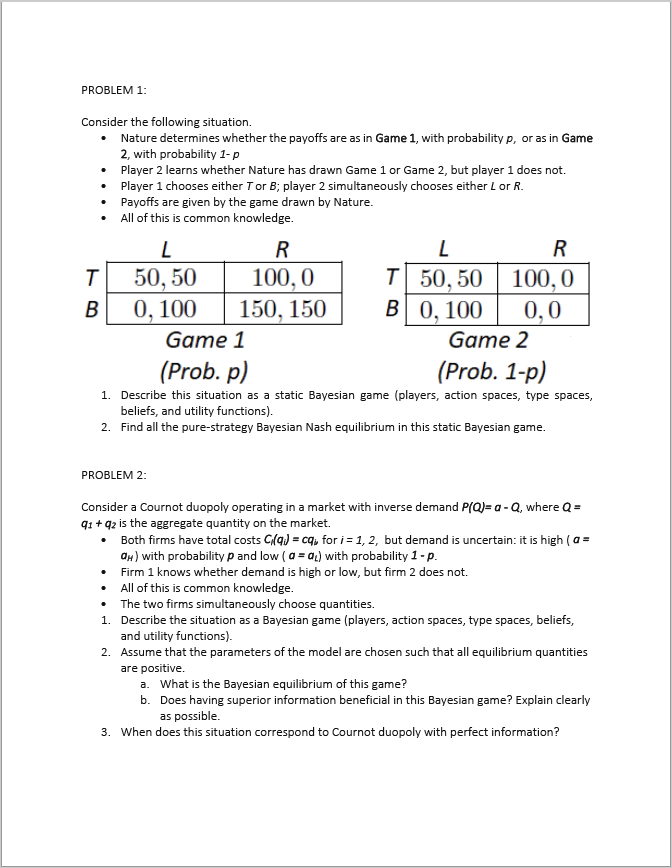
PROBLEM 1: Consider the following situation. Nature determines whether the payoffs are as in Game 1, with probability p, or as in Game 2, with probability 1- p Player 2 learns whether Nature has drawn Game 1 or Game 2, but player 1 does not. Player 1 chooses either T or B; player 2 simultaneously chooses either [ or R. Payoffs are given by the game drawn by Nature. All of this is common knowledge. L R L R 50, 50 100, 0 50, 50 100, 0 B 0, 100 150, 150 B 0, 100 0,0 Game 1 Game 2 (Prob. p) (Prob. 1-p) 1. Describe this situation as a static Bayesian game (players, action spaces, type spaces, beliefs, and utility functions). 2. Find all the pure-strategy Bayesian Nash equilibrium in this static Bayesian game. PROBLEM 2: Consider a Cournot duopoly operating in a market with inverse demand P(Q)= a - Q, where Q = q1 + q2 is the aggregate quantity on the market. Both firms have total costs C(q:) = cq) for / =1, 2, but demand is uncertain: it is high ( a = aw ) with probability p and low ( a = a ) with probability 1 - p. Firm 1 knows whether demand is high or low, but firm 2 does not. All of this is common knowledge The two firms simultaneously choose quantities. 1. Describe the situation as a Bayesian game (players, action spaces, type spaces, beliefs, and utility functions). 2. Assume that the parameters of the model are chosen such that all equilibrium quantities are positive. a. What is the Bayesian equilibrium of this game? b. Does having superior information beneficial in this Bayesian game? Explain clearly as possible. 3. When does this situation correspond to Cournot duopoly with perfect information
Step by Step Solution
There are 3 Steps involved in it

Get step-by-step solutions from verified subject matter experts
 Study Help