







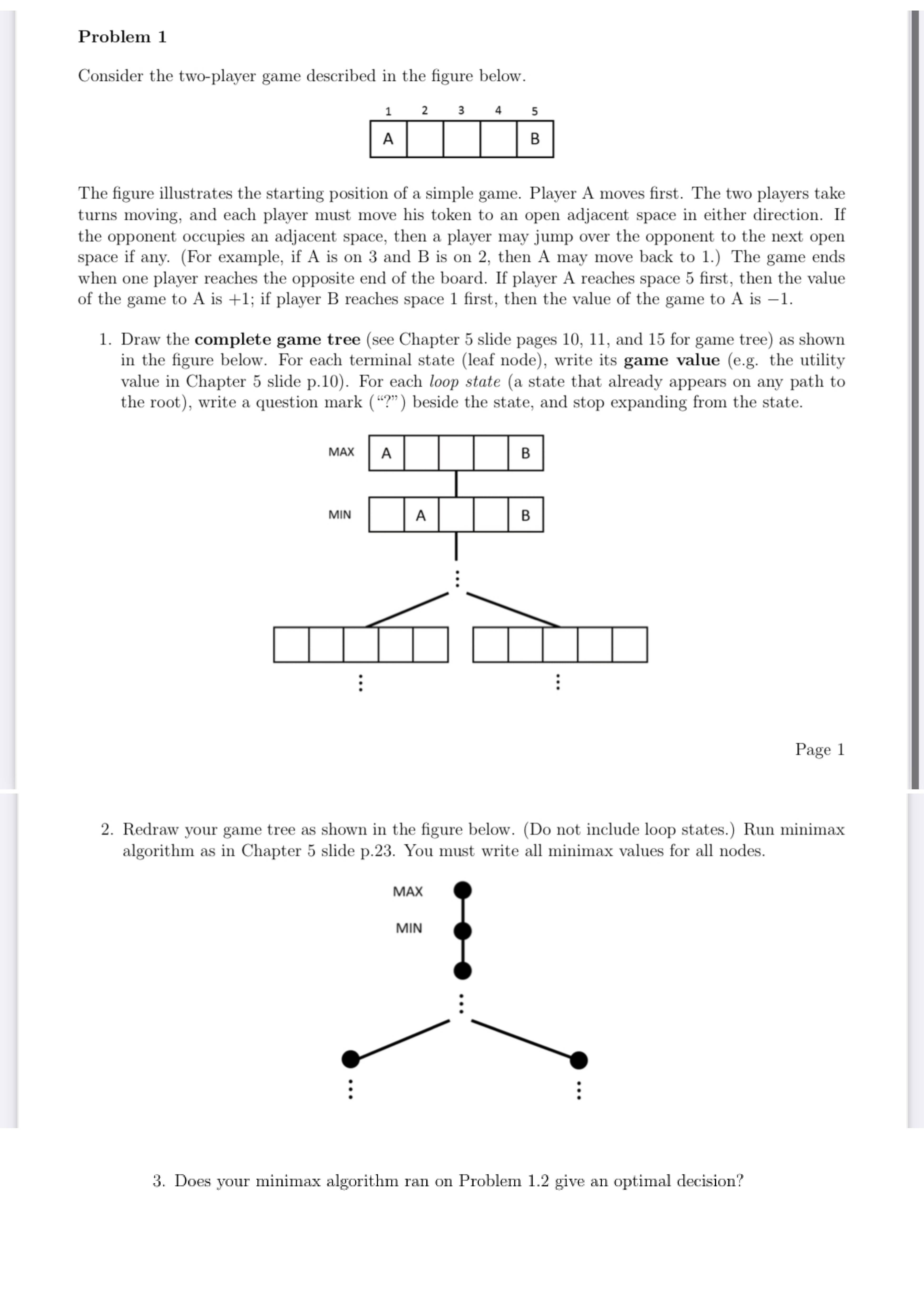
Question: Problem 1 Consider the two - player game described in the figure below. The figure illustrates the starting position of a simple game. Player A
Problem
Consider the twoplayer game described in the figure below.
The figure illustrates the starting position of a simple game. Player A moves first. The two players take turns moving, and each player must move his token to an open adjacent space in either direction. If the opponent occupies an adjacent space, then a player may jump over the opponent to the next open space if any. For example, if is on and is on then A may move back to The game ends when one player reaches the opposite end of the board. If player A reaches space first, then the value of the game to is ; if player reaches space first, then the value of the game to is
Draw the complete game tree see Chapter slide pages and for game tree as shown in the figure below. For each terminal state leaf node write its game value eg the utility value in Chapter slide p For each loop state a state that already appears on any path to the root write a question mark beside the state, and stop expanding from the state.
Page
Redraw your game tree as shown in the figure below. Do not include loop states. Run minimax algorithm as in Chapter slide p You must write all minimax values for all nodes.
Does your minimax algorithm ran on Problem give an optimal decision?
Step by Step Solution
There are 3 Steps involved in it
1 Expert Approved Answer
Step: 1 Unlock

Question Has Been Solved by an Expert!
Get step-by-step solutions from verified subject matter experts
Step: 2 Unlock
Step: 3 Unlock
 Study Help