







Question: Problem 1 Consumer consumes only two goods. Her preference over these two goods is given by 1 u(a:1, 2:2) = $1323 . Her income is
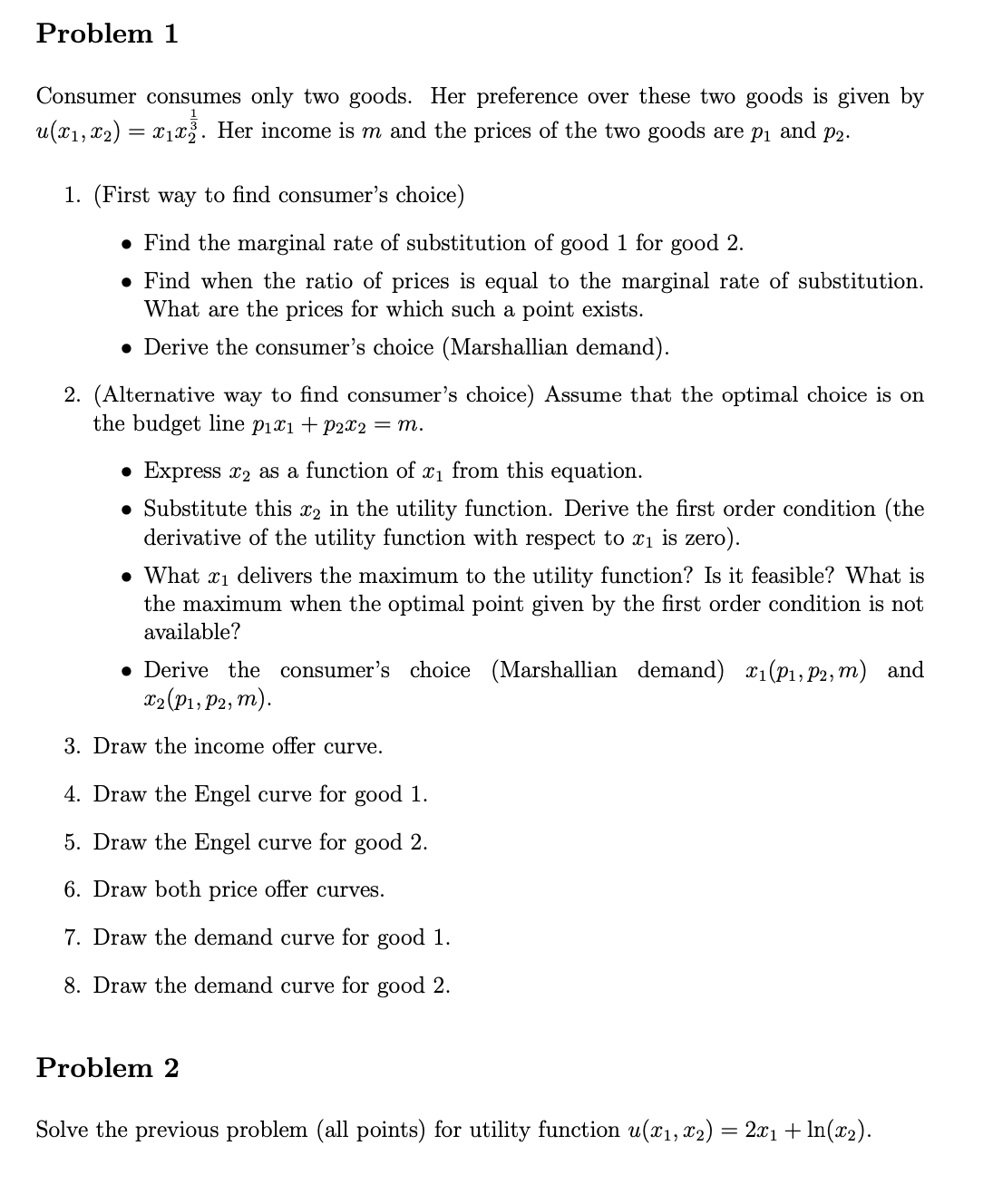
Problem 1 Consumer consumes only two goods. Her preference over these two goods is given by 1 u(a:1, 2:2) = $1323 . Her income is m and the prices of the two goods are 331 and pg. 1. (First way to nd consumer's choice) 0 Find the marginal rate of substitution of good 1 for good 2. 0 Find when the ratio of prices is equal to the marginal rate of substitution. What are the prices for which such a point exists. 0 Derive the consumer's choice (Marshallian demand). 2. (Alternative way to nd consumer's choice) Assume that the optimal choice is on the budget line mm + 1?ng = m. 0 Express 592 as a function of 3:1 from this equation. 0 Substitute this 3:2 in the utility function. Derive the rst order condition (the derivative of the utility function with respect to 1:1 is zero). 0 What 5121 delivers the maximum to the utility function? Is it feasible? What is the maximum when the optimal point given by the rst order condition is not available? 0 Derive the consumer's choice (Marshallian demand) 3:1(p1, p2, m.) and 332601, P2, m). 3. Draw the income o'er curve. 4. Draw the Engel curve for good 1. 5. Draw the Engel curve for good 2. 6. Draw both price offer curves. 7. Draw the demand curve for good 1. 8. Draw the demand curve for good 2. Problem 2 Solve the previous problem (all points) for utility function 1L($1,.'E2) = 23:1 + ln(:c2)
Step by Step Solution
There are 3 Steps involved in it

Get step-by-step solutions from verified subject matter experts
 Study Help