







Question: PROBLEM 1 Develop a well - documented function called convertTorque that can convert a torque from one set of units to another. For example, the
PROBLEM
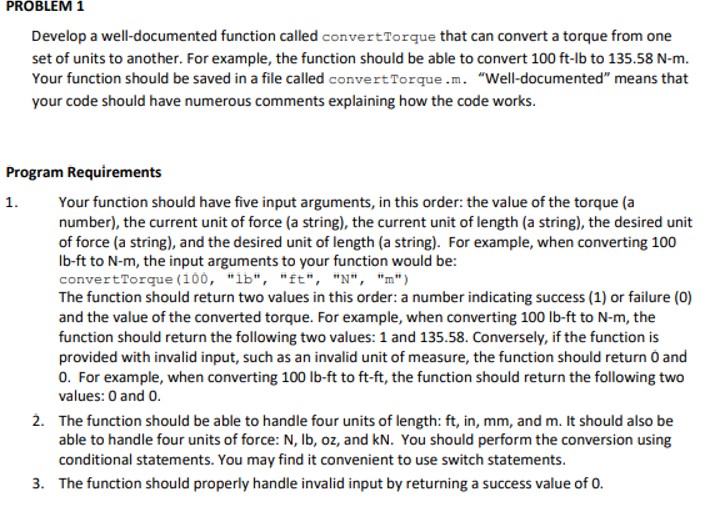
Develop a welldocumented function called convertTorque that can convert a torque from one set of units to another. For example, the function should be able to convert ftlb to NmYour function should be saved in a file called convertTorque.mWelldocumented means that your code should have numerous comments explaining how the code works.
Program Requirements
Your function should have five input arguments, in this order: the value of the torque a number the current unit of force a string the current unit of length a string the desired unit of force a string and the desired unit of length a string For example, when converting lbft to Nm the input arguments to your function would be: convertTorquelbftNm
The function should return two values in this order: a number indicating success or failure and the value of the converted torque. For example, when converting lbft to Nm the function should return the following two values: and Conversely, if the function is provided with invalid input, such as an invalid unit of measure, the function should return and For example, when converting lbft to ftft the function should return the following two values: and
The function should be able to handle four units of length: ft in mm and m It should also be able to handle four units of force: N lb oz and kN You should perform the conversion usingconditional statements. You may find it convenient to use switch statements.
The function should properly handle invalid input by returning a success value ofPROBLEM
Develop a welldocumented function called convert Torque that can convert a torque from one
set of units to another. For example, the function should be able to convert to
Your function should be saved in a file called convertTorque.m "Welldocumented" means that
your code should have numerous comments explaining how the code works.
Program Requirements
Your function should have five input arguments, in this order: the value of the torque a number the current unit of force a string the current unit of length a string the desired unit of force a string and the desired unit of length a string For example, when converting to the input arguments to your function would be: convertTorque bftNm The function should return two values in this order: a number indicating success or failure and the value of the converted torque. For example, when converting to the function should return the following two values: and Conversely, if the function is
provided with invalid input, such as an invalid unit of measure, the function should return and For example, when converting to the function should return the following two
values: and The function should be able to handle four units of length: in and It should also beable to handle four units of force: and You should perform the conversion using
con ditional statements. You may find it convenient to use switch statements. The function should properly handle invalid input by returning a success value of
Step by Step Solution
There are 3 Steps involved in it
1 Expert Approved Answer
Step: 1 Unlock

Question Has Been Solved by an Expert!
Get step-by-step solutions from verified subject matter experts
Step: 2 Unlock
Step: 3 Unlock
 Study Help