







Question: Problem 1: Draw a straight line on a plot that does NOT pass through the origin. Call the length of the perpendicular segment between the
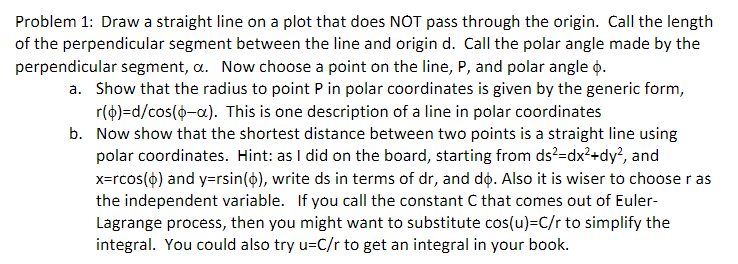
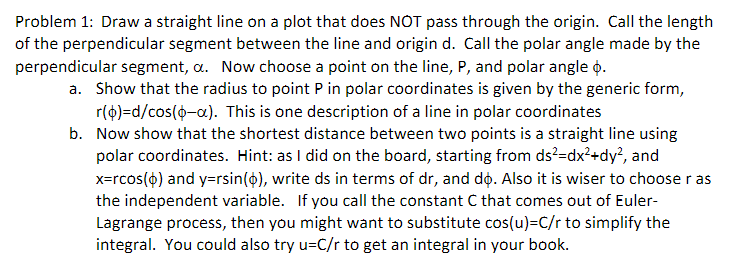
Problem 1: Draw a straight line on a plot that does NOT pass through the origin. Call the length of the perpendicular segment between the line and origin d. Call the polar angle made by the perpendicular segment, o. Now choose a point on the line, P, and polar angle o. a. Show that the radius to point P in polar coordinates is given by the generic form, r()=d/cos(0-a). This is one description of a line in polar coordinates b. Now show that the shortest distance between two points is a straight line using polar coordinates. Hint: as I did on the board, starting from ds'=dx2+dy, and x=rcos($) and y=rsin($), write ds in terms of dr, and do. Also it is wiser to choose r as the independent variable. If you call the constant C that comes out of Euler- Lagrange process, then you might want to substitute cos(u)=C/r to simplify the integral. You could also try u=C/r to get an integral in your book
Step by Step Solution
There are 3 Steps involved in it

Get step-by-step solutions from verified subject matter experts
 Study Help