







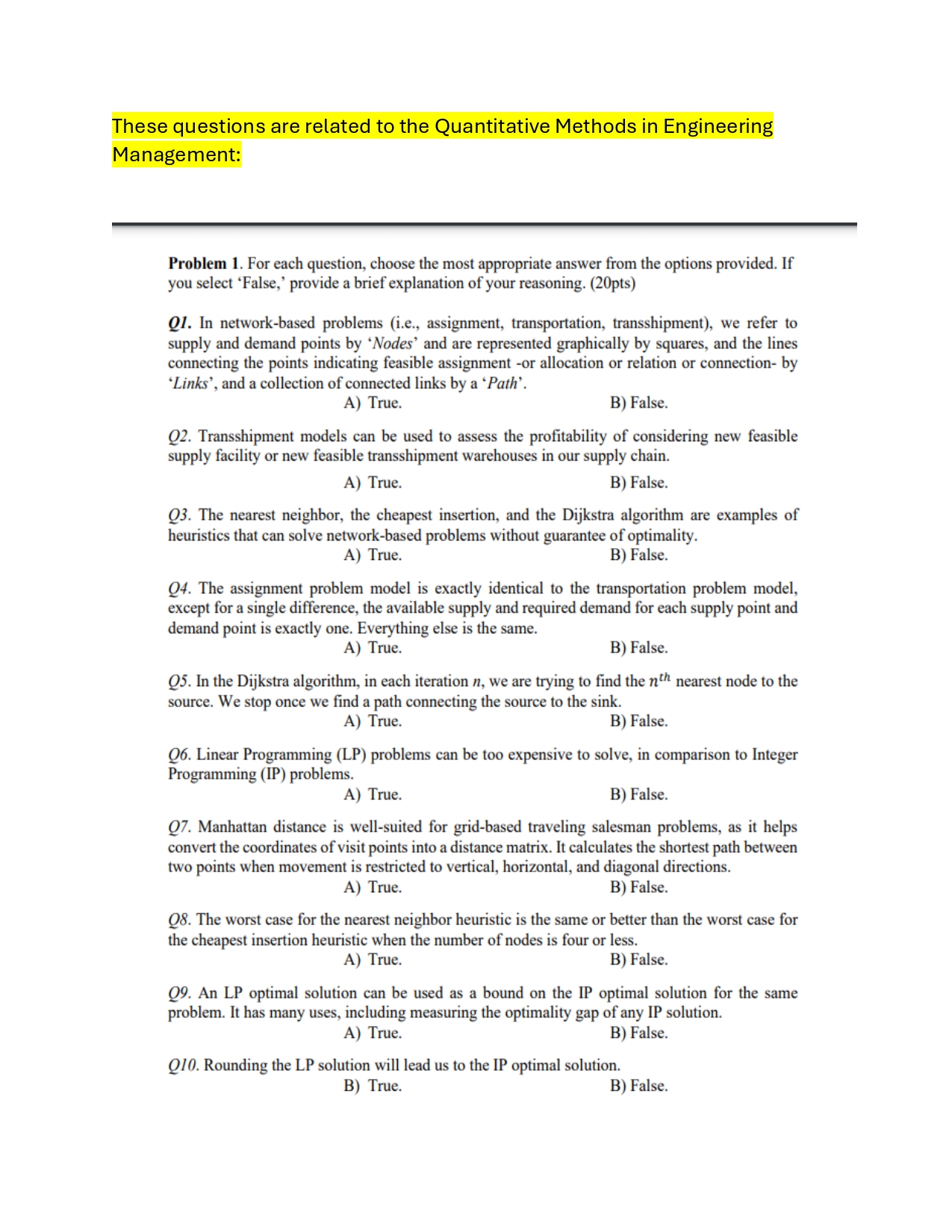
Question: Problem 1 . For each question, choose the most appropriate answer from the options provided. If you select 'False, ' provide a brief explanation of
Problem For each question, choose the most appropriate answer from the options provided. If you select 'False, provide a brief explanation of your reasoning. pts
Q In networkbased problems ie assignment, transportation, transshipment we refer to supply and demand points by 'Nodes' and are represented graphically by squares, and the lines connecting the points indicating feasible assignment or allocation or relation or connection by 'Links', and a collection of connected links by a 'Path'.
A True.
B False
Q Transshipment models can be used to assess the profitability of considering new feasible supply facility or new feasible transshipment warehouses in our supply chain.
A True.
B False.
Q The nearest neighbor, the cheapest insertion, and the Dijkstra algorithm are examples of heuristics that can solve networkbased problems without guarantee of optimality.
A True.
B False.
Q The assignment problem model is exactly identical to the transportation problem model, except for a single difference, the available supply and required demand for each supply point and demand point is exactly one. Everything else is the same.
A True.
B False.
Q In the Dijkstra algorithm, in each iteration n we are trying to find the ntext th nearest node to the source. We stop once we find a path connecting the source to the sink.
A True.
B False.
Q Linear Programming LP problems can be too expensive to solve, in comparison to Integer Programming IP problems.
A True.
B False
Q Manhattan distance is wellsuited for gridbased traveling salesman problems, as it helps convert the coordinates of visit points into a distance matrix. It calculates the shortest path between two points when movement is restricted to vertical, horizontal, and diagonal directions.
A True.
B False
Q The worst case for the nearest neighbor heuristic is the same or better than the worst case for the cheapest insertion heuristic when the number of nodes is four or less.
A True.
B False.
Q An LP optimal solution can be used as a bound on the IP optimal solution for the same problem. It has many uses, including measuring the optimality gap of any IP solution.
A True.
B False.
Q Rounding the LP solution will lead us to the IP optimal solution.
B True.
B False.
Step by Step Solution
There are 3 Steps involved in it
1 Expert Approved Answer
Step: 1 Unlock

Question Has Been Solved by an Expert!
Get step-by-step solutions from verified subject matter experts
Step: 2 Unlock
Step: 3 Unlock
 Study Help