







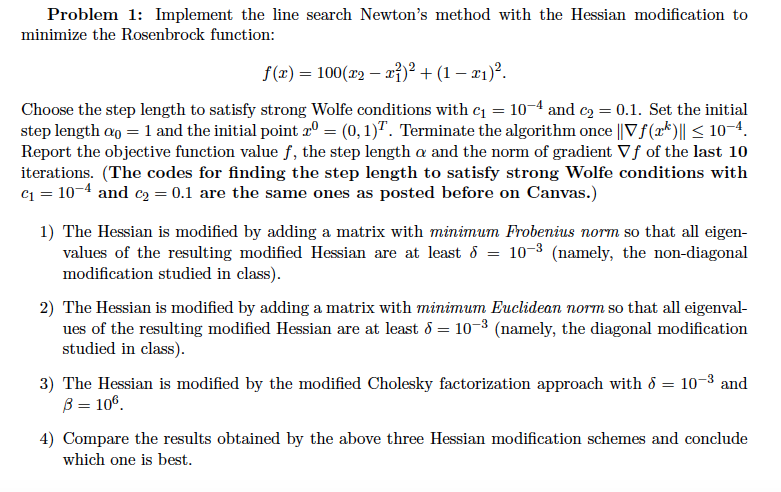
Question: Problem 1: Implement the line search Newton's method with the Hessian modication to minimize the Rosenbrock function: f(x) = 100(x2 x21 )2 + (1 x1)2:
Problem 1: Implement the line search Newton's method with the Hessian modication to
minimize the Rosenbrock function:
f(x) = 100(x2 x21
)2 + (1 x1)2:
Choose the step length to satisfy strong Wolfe conditions with c1 = 104 and c2 = 0:1. Set the initial
step length 0 = 1 and the initial point x0 = (0; 1)T . Terminate the algorithm once krf(xk)k 104.
Report the objective function value f, the step length and the norm of gradient rf of the last 10
iterations. (The codes for nding the step length to satisfy strong Wolfe conditions with
c1 = 104 and c2 = 0:1 are the same ones as posted before on Canvas.)
1) The Hessian is modied by adding a matrix with minimum Frobenius norm so that all eigen-
values of the resulting modied Hessian are at least = 103 (namely, the non-diagonal
modication studied in class).
2) The Hessian is modied by adding a matrix with minimum Euclidean norm so that all eigenval-
ues of the resulting modied Hessian are at least = 103 (namely, the diagonal modication
studied in class).
3) The Hessian is modied by the modied Cholesky factorization approach with = 103 and
= 106.
4) Compare the results obtained by the above three Hessian modication schemes and conclude
which one is best.
plz show the matlab works!!
1
Problem 1: Implement the line search Newton's method with the Hessian modification to minimize the Rosenbrock function f(z) = 100(T2- 2 + (1-X1)2. Choose the step length to satisfy strong Wolfe conditions with c1 10-4 and c2 0.1. Set the initial step length = 1 and the initial point zo (0, 1)T, Terminate the algorithm once llVf(rk) l 10-4. Report the objective function value f, the step length and the norm of gradient f of the last 10 iterations. (The codes for finding the step length to satisfy strong Wolfe conditions with c1 = 10-4 and c2 = 0.1 are the same ones as posted before on Canvas.) 1) The Hessian is modified by adding a matrix with minimum Frobenius norm so that all eigen values of the resulting modified Hessian are at least -10-3 (namely, the non-diagonal modification studied in class) 2) The Hessian is modified by adding a matrix with minimum Euclidean norm so that all eigenval ues of the resulting modified Hessian are at least -10-3 (namely, the diagonal modification studied in class) 3) The Hessian is modified by the modified Cholesky factorization approach with = 10-3 and 4) Compare the results obtained by the above three Hessian modification schemes and conclude which one is best Problem 1: Implement the line search Newton's method with the Hessian modification to minimize the Rosenbrock function f(z) = 100(T2- 2 + (1-X1)2. Choose the step length to satisfy strong Wolfe conditions with c1 10-4 and c2 0.1. Set the initial step length = 1 and the initial point zo (0, 1)T, Terminate the algorithm once llVf(rk) l 10-4. Report the objective function value f, the step length and the norm of gradient f of the last 10 iterations. (The codes for finding the step length to satisfy strong Wolfe conditions with c1 = 10-4 and c2 = 0.1 are the same ones as posted before on Canvas.) 1) The Hessian is modified by adding a matrix with minimum Frobenius norm so that all eigen values of the resulting modified Hessian are at least -10-3 (namely, the non-diagonal modification studied in class) 2) The Hessian is modified by adding a matrix with minimum Euclidean norm so that all eigenval ues of the resulting modified Hessian are at least -10-3 (namely, the diagonal modification studied in class) 3) The Hessian is modified by the modified Cholesky factorization approach with = 10-3 and 4) Compare the results obtained by the above three Hessian modification schemes and conclude which one is best
Step by Step Solution
There are 3 Steps involved in it

Get step-by-step solutions from verified subject matter experts
 Study Help