







Question: Problem 1: Implement the Various CPU Scheduling Algorithms Objective: To implement the following CPU scheduling algorithm using any programming language a) First Come First Serve,
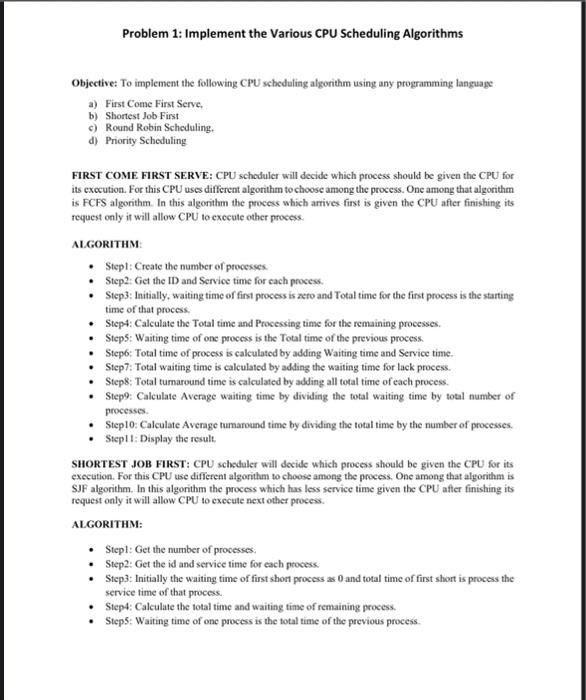
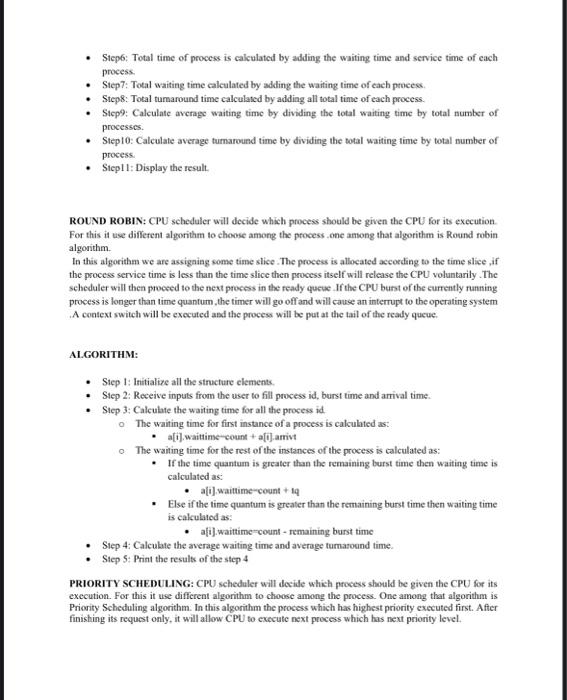
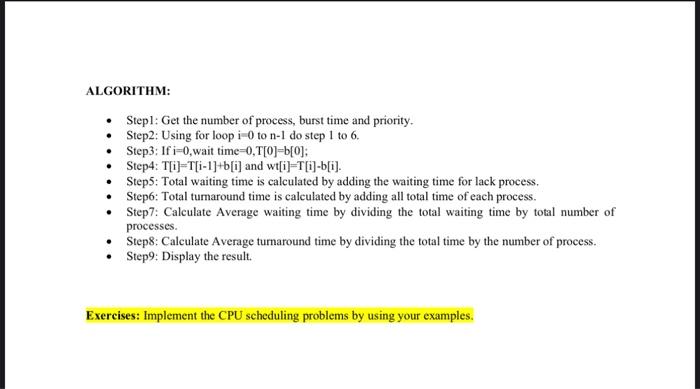
Problem 1: Implement the Various CPU Scheduling Algorithms Objective: To implement the following CPU scheduling algorithm using any programming language a) First Come First Serve, b) Shortest Job First c) Round Robin Scheduling. d) Priority Scheduling FIRST COME FIRST SERVE: CPU schoduler will decide which process should be given the CPU for its execution. For this CPU uses different algorithm to choose among the process. One among that algonithm is FCFS algorithm. In this algorithm the process which arrives first is given the CPU after finishing its request only it will allow CPU to execute other process. ALGORITHM: - Stepl: Create the number of processes. - Step2: Get the ID and Service time for each process. - Step3: Initially, waiting time of first process is zeto and Total time for the first process is the starting time of that process. - Step4: Calculate the Total time and Processing time for the remaining processes. - Step5: Waiting time of one process is the Total time of the previous process. - Step6: Total time of process is calculated by adding Waiting time and Service time. - Step7: Total waiting time is calculated by adding the waiting time for lack process. - Step8: Total tumaround time is calculated by adding all total time of each process. - Step9: Calculate Average waiting time by dividing the total waiting time by total number of processes. - Step 10: Calculate Average tumaround time by dividing the total time by the number of processes. - Step11: Display the result. SHORTEST JOB FIRST: CPU scheduler will decide which process should be given the CPU for its execution. For this CPU use different algorithm to choose among the process. One among that algorithm is SJF algorithm. In this algorithm the process which has less service time given the CPU after finishing its request only it will allow CPU to execute next other proces. ALGORITHM: - Stepl: Get the number of processes. - Step2: Get the id and service time for each process. - Step3: Initially the waiting time of first short process as 0 and total time of first short is process the service time of that process. - Step4: Calculate the total time and waiting time of remaining process. - Step5: Waiting time of one process is the total time of the previous process. - Sicp6: Total time of process is calculated by adding the waiting time and service time of each process. - Step7: Total waiting time calculated by adding the waiting time of cach process. - Step8: Total tumaround time calculated by adding all total time of each process. - Stcp9: Calculate average waiting time by dividing the total waiting time by total number of processes. - Step 10: Calculate average turnaround time by dividing the total waiting time by total number of process: - Stepl 1: Display the result. ROUND ROBIN: CPU scheduler will decide which process should be given the CPU for its execution. For this it use different algonithm to choose among the process .one among that algorithm is Round robin algonithm. In this algorithm we are assigaing some time slice. The process is allocated according to the time slice , if the process service time is less than the time slice then process itself will release the CPU voluntarily. The seheduler will then proced to the next process in the ready queue .If the CPU burst of the currently running process is longer than time quantum , the timer will go off and will cause an interrupt to the operating system A context switch will be executed and the process will be put at the tail of the ready queue. ALGORITHM: - Step 1: Initialize all the structure clements. - Sicp 2: Receive inputs from the user to fill process id, burst time and amival time. - Siep 3; Calculate the waiting time for all the process id. The waiting time for first instance of a process is calculated as: - a[i].waittime-count + a[i].arrivt The waiting time for the rest of the instances of the process is calculated as: - If the time quantum is greater than the remaining burst time then waiting time is calculated as: - a[i],waittime-count + iq - Else if the lime quantum is greater than the remaining burst time then waiting time is calculared as: - afi]. waittime-count - remaining burst time - Siep 4: Calculate the average waiting time and averoge tumaround time. - Step 5: Priat the results of the step 4 PRIORITY SCHEDUIIING: CPU scheduler will docide which process should be given the CPU for its execution. For this it use different algonithm to choose among the process. One among that algorithm is Priority Scheduling algorithm. In this algorithm the process which has highest priority executed first. After finishing its request only, it will allow CPU to execute next process which has next priority level. - Step 1: Get the number of process, burst time and priority. - Step2; Using for loop i=0 to n1 do step 1 to 6. - Step3; If i=0, wait time =0,T[0]=b[0]; - Step5: Total waiting time is calculated by adding the waiting time for lack process. - Step6: Total tumaround time is calculated by adding all total time of each process. - Step7: Calculate Average waiting time by dividing the total waiting time by total number of processes. - Step8: Calculate Average turnaround time by dividing the total time by the number of process. - Step9: Display the result. Exercises: Implement the CPU scheduling problems by using your examples
Step by Step Solution
There are 3 Steps involved in it

Get step-by-step solutions from verified subject matter experts
 Study Help