







Question: Problem 1. Let G(V,E) be a connected, undirected graph and let sV be a source node (you may assume that the graph is given in
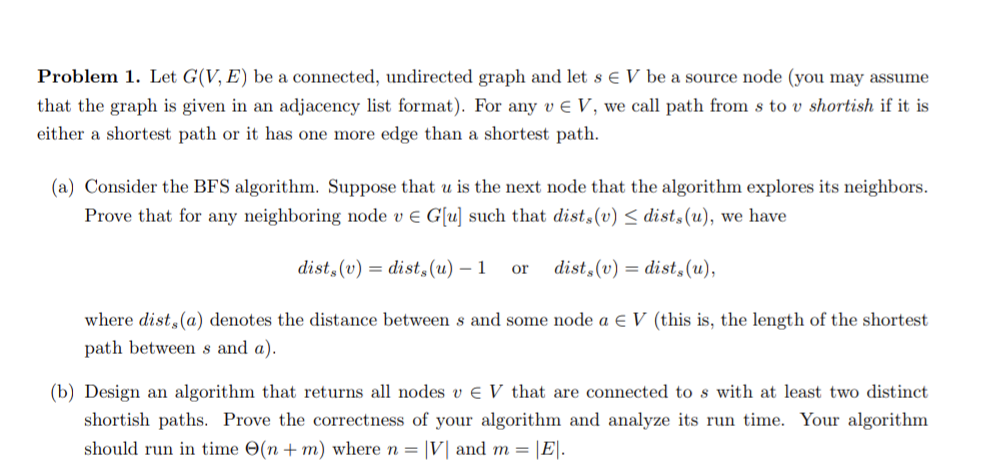
Problem 1. Let G(V,E) be a connected, undirected graph and let sV be a source node (you may assume that the graph is given in an adjacency list format). For any vV, we call path from s to v shortish if it is either a shortest path or it has one more edge than a shortest path. (a) Consider the BFS algorithm. Suppose that u is the next node that the algorithm explores its neighbors. Prove that for any neighboring node vG[u] such that dists(v)dists(u), we have dists(v)=dists(u)1ordists(v)=dists(u), where dists(a) denotes the distance between s and some node aV (this is, the length of the shortest path between s and a ). (b) Design an algorithm that returns all nodes vV that are connected to s with at least two distinct shortish paths. Prove the correctness of your algorithm and analyze its run time. Your algorithm should run in time (n+m) where n=V and m=E
Step by Step Solution
There are 3 Steps involved in it

Get step-by-step solutions from verified subject matter experts
 Study Help