







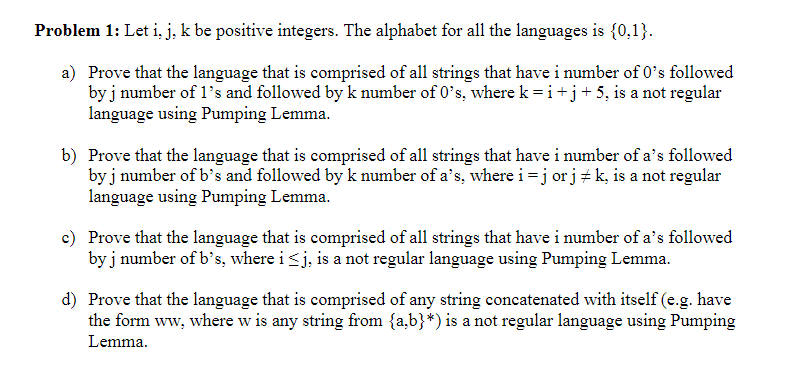
Question: Problem 1 : Let ( mathrm { i } , mathrm { j } , mathrm { k } )
Problem : Let mathrmimathrmjmathrmk be positive integers. The alphabet for all the languages is
a Prove that the language that is comprised of all strings that have i number of s followed by j number of s and followed by k number of s where kij is a not regular language using Pumping Lemma.
b Prove that the language that is comprised of all strings that have i number of as followed by j number of bs and followed by k number of as where ij or j
eq k is a not regular language using Pumping Lemma.
c Prove that the language that is comprised of all strings that have i number of as followed by j number of bs where i leq j is a not regular language using Pumping Lemma.
d Prove that the language that is comprised of any string concatenated with itself eg have the form ww where w is any string from leftmathrmamathrmbright is a not regular language using Pumping Lemma.
Step by Step Solution
There are 3 Steps involved in it
1 Expert Approved Answer
Step: 1 Unlock

Question Has Been Solved by an Expert!
Get step-by-step solutions from verified subject matter experts
Step: 2 Unlock
Step: 3 Unlock
 Study Help