







Question: Problem 1 Let X = Y V Z be the one point union of spaces Y and Z, where the base points of Y and
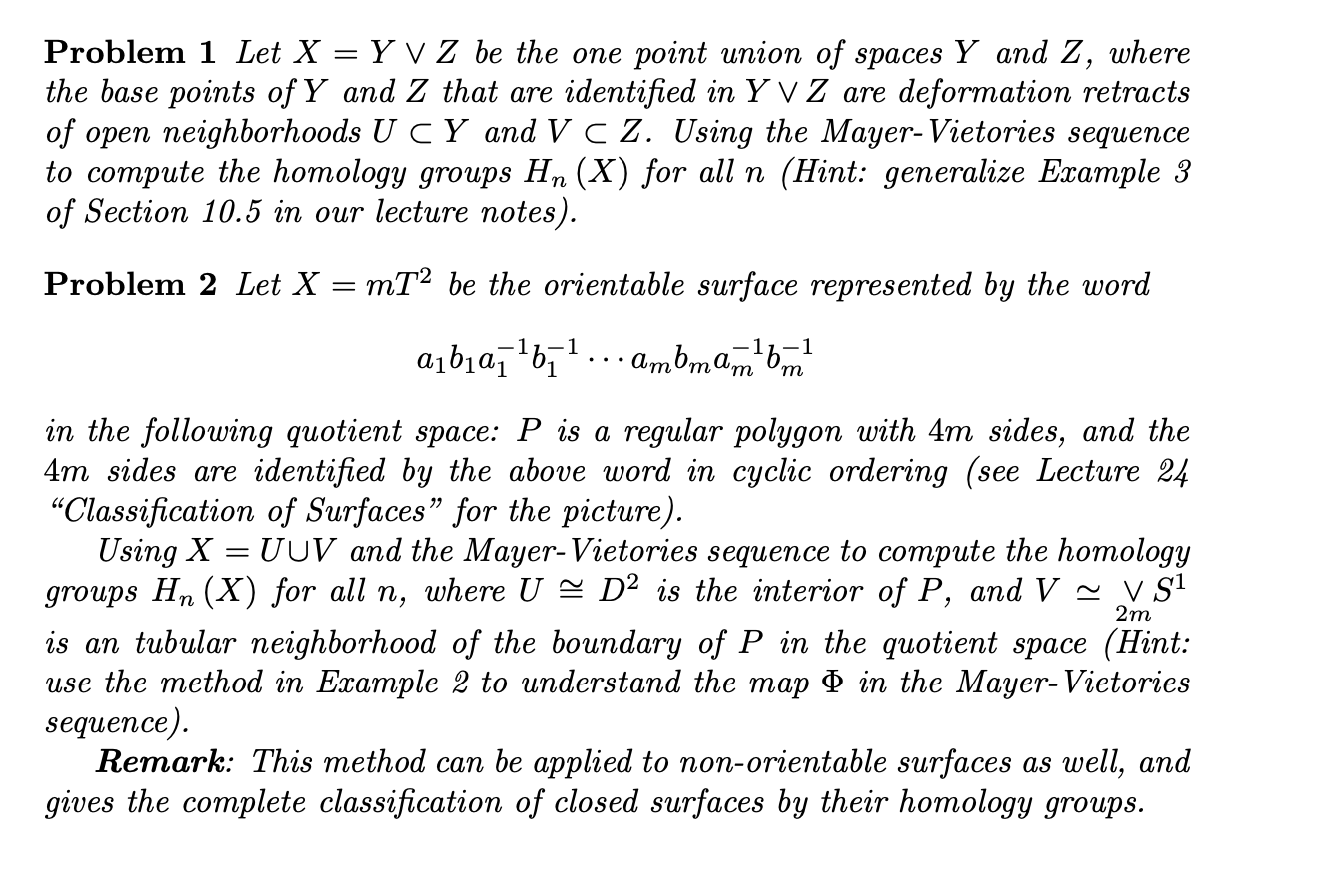
Problem 1 Let X = Y V Z be the one point union of spaces Y and Z, where the base points of Y and Z that are identified in Y V Z are deformation retracts of open neighborhoods U CY and V CZ. Using the Mayer-Vietories sequence to compute the homology groups Hn (X) for all n (Hint: generalize Example 3 of Section 10.5 in our lecture notes). Problem 2 Let X EmT2 be the orientable surface represented by the word 1 ajbialbi?...ambmam'bm in the following quotient space: P is a regular polygon with 4m sides, and the 4m sides are identified by the above word in cyclic ordering (see Lecture 24 "Classification of Surfaces for the picture). Using X UUV and the Mayer-Vietories sequence to compute the homology groups Hn (X) for all n, where U = D2 is the interior of P, and V ~ v si is an tubular neighborhood of the boundary of P in the quotient space (Hint: use the method in Example 2 to understand the map in the Mayer-Victories sequence) Remark: This method can be applied to non-orientable surfaces as well, and gives the complete classification of closed surfaces by their homology groups. 2 m Problem 1 Let X = Y V Z be the one point union of spaces Y and Z, where the base points of Y and Z that are identified in Y V Z are deformation retracts of open neighborhoods U CY and V CZ. Using the Mayer-Vietories sequence to compute the homology groups Hn (X) for all n (Hint: generalize Example 3 of Section 10.5 in our lecture notes). Problem 2 Let X EmT2 be the orientable surface represented by the word 1 ajbialbi?...ambmam'bm in the following quotient space: P is a regular polygon with 4m sides, and the 4m sides are identified by the above word in cyclic ordering (see Lecture 24 "Classification of Surfaces for the picture). Using X UUV and the Mayer-Vietories sequence to compute the homology groups Hn (X) for all n, where U = D2 is the interior of P, and V ~ v si is an tubular neighborhood of the boundary of P in the quotient space (Hint: use the method in Example 2 to understand the map in the Mayer-Victories sequence) Remark: This method can be applied to non-orientable surfaces as well, and gives the complete classification of closed surfaces by their homology groups. 2 m
Step by Step Solution
There are 3 Steps involved in it

Get step-by-step solutions from verified subject matter experts
 Study Help