



Question: Problem 1. (Locating Snack Bars) You have been hired as a consultant for a new theme park to help choose locations for the park's snack
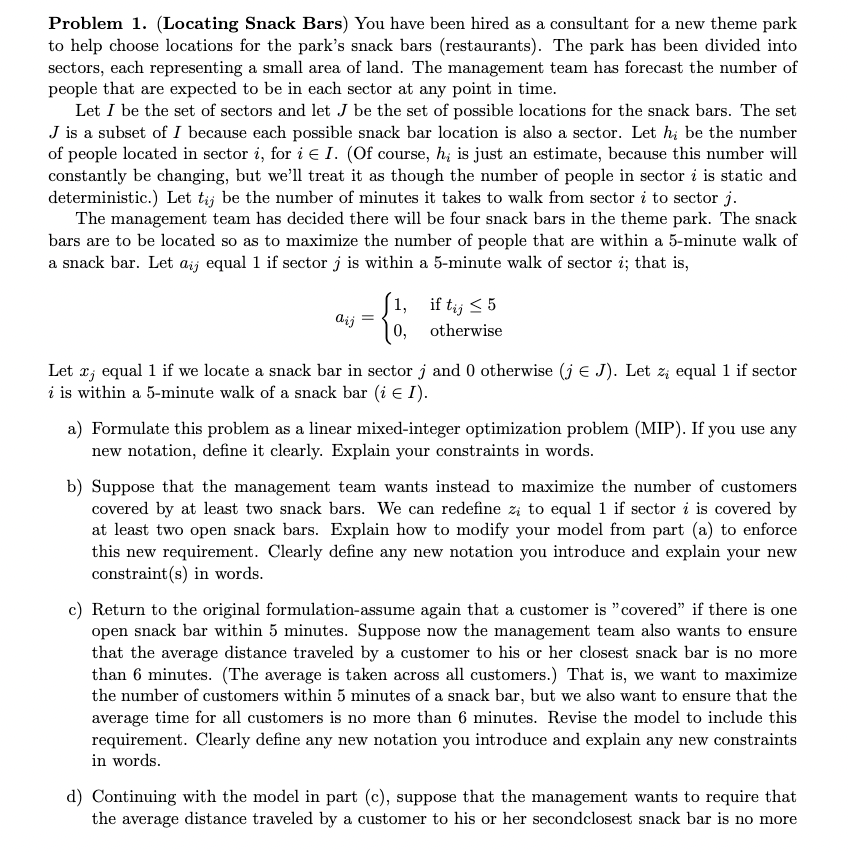

Problem 1. (Locating Snack Bars) You have been hired as a consultant for a new theme park to help choose locations for the park's snack bars (restaurants). The park has been divided into sectors, each representing a small area of land. The management team has forecast the number of people that are expected to be in each sector at any point in time. Let I be the set of sectors and let J be the set of possible locations for the snack bars. The set J is a subset of I because each possible snack bar location is also a sector. Let hi be the number of people located in sector i, for iI. (Of course, hi is just an estimate, because this number will constantly be changing, but we'll treat it as though the number of people in sector i is static and deterministic.) Let tij be the number of minutes it takes to walk from sector i to sector j. The management team has decided there will be four snack bars in the theme park. The snack bars are to be located so as to maximize the number of people that are within a 5-minute walk of a snack bar. Let aij equal 1 if sector j is within a 5 -minute walk of sector i; that is, aij={1,0,iftij5otherwise Let xj equal 1 if we locate a snack bar in sector j and 0 otherwise (jJ). Let zi equal 1 if sector i is within a 5-minute walk of a snack bar (iI). a) Formulate this problem as a linear mixed-integer optimization problem (MIP). If you use any new notation, define it clearly. Explain your constraints in words. b) Suppose that the management team wants instead to maximize the number of customers covered by at least two snack bars. We can redefine zi to equal 1 if sector i is covered by at least two open snack bars. Explain how to modify your model from part (a) to enforce this new requirement. Clearly define any new notation you introduce and explain your new constraint(s) in words. c) Return to the original formulation-assume again that a customer is "covered" if there is one open snack bar within 5 minutes. Suppose now the management team also wants to ensure that the average distance traveled by a customer to his or her closest snack bar is no more than 6 minutes. (The average is taken across all customers.) That is, we want to maximize the number of customers within 5 minutes of a snack bar, but we also want to ensure that the average time for all customers is no more than 6 minutes. Revise the model to include this requirement. Clearly define any new notation you introduce and explain any new constraints in words. d) Continuing with the model in part (c), suppose that the management wants to require that the average distance traveled by a customer to his or her secondclosest snack bar is no more than 6 minutes. Explain how to modify your model from part (c) to include this requirement. Clearly define any new notation you introduce and explain any new constraints in words
Step by Step Solution
There are 3 Steps involved in it

Get step-by-step solutions from verified subject matter experts