







Question: Problem 1 : Note: The test described in the following is a part of Problem 1 on Page 1 8 4 of the 3 r
Problem :
Note: The test described in the following is a part of Problem on Page of the edition of Soil Mechanics in Engineering Practice Terzaghi Peck, and Mesri,
In a conventional tiraxial test, the specimen was first consolidated by subjecting it to an equal allaround pressure of kPa and a back pressure of kPa. After the sample reached equilibrium in this consolidation stage, the drainage lines were turned off, and the axial stress was increased until failure occurred. At failure, total pore pressure measured was kPa, and the increase in axial stress was kPa.
Establish the stress tensors for the total stress, pore pressure, and the effective stress at the end of consolidation stage. Clearly describe your choice of the frame of reference and the reasons behind it What are the principal stresses and directions of the effective stress tensor?
In the remainder of this problem, effective stresses are meant whenever the term stress is used.
Establish the stress tensor at failure.
Compute mean stress and the deviatoric stress tensor at failure. What are the principal values and principal directions of deviatoric stress tensor, and how do these compare with principal values and directions of the stress tensor at failure? Try to answer these questions without computing principal values and or directions.
Assuming no cohesion intercept, compute friction angle for this sample. By using Mohr stress circle or any other method that you prefer determine the orientation of the slip surfaces that may develop during failure. Compute the magnitude of normal and shear stresses acting on this plane refer to this plane as P
Compute principal shear stresses, and determine the orientation of the maximum shear stress plane refer to this plane as P Do planes Pfrom previous part and P have the same orientation? If no how do you explain the fact that slippage occurs along P while the maximum shear stress acts on P
Assume that the axial strain at failure is measured from the beginning of shear loading Also, assume that the end platens are frictionless. Establish the strain tensor in any coordinate system that you prefer, and explain your choice of this reference system. Compute the principal shear strains.
Assume that this was a plane strain shear test instead of a triaxial shear test Solve Part
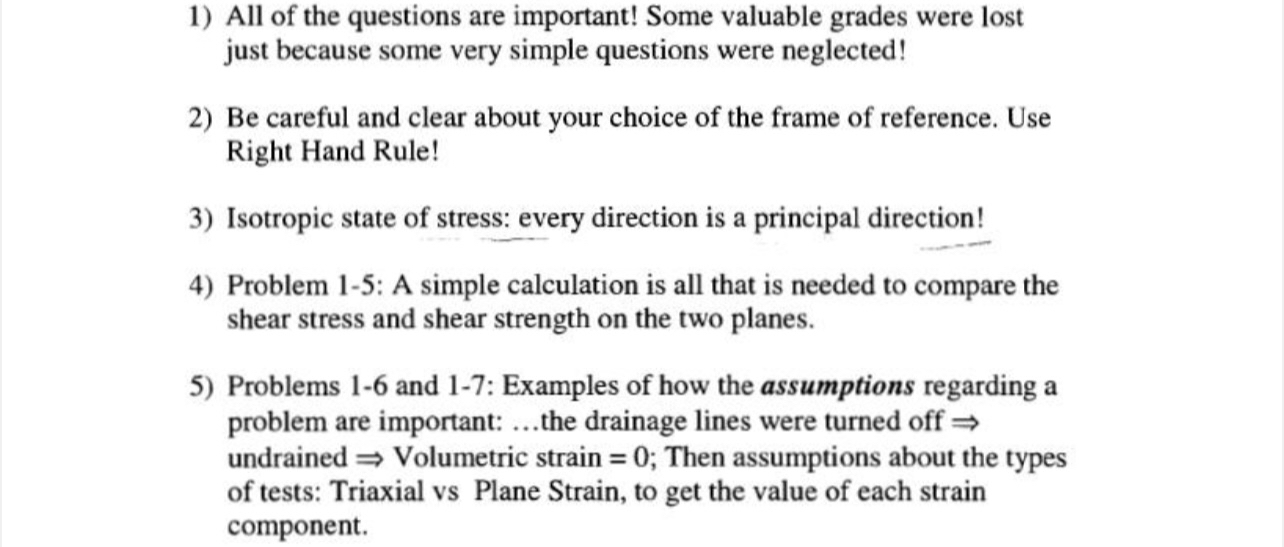
All of the questions are important! Some valuable grades were lost just because some very simple questions were neglected!
Be careful and clear about your choice of the frame of reference. Use Right Hand Rule!
Isotropic state of stress: every direction is a principal direction!
Problem : A simple calculation is all that is needed to compare the shear stress and shear strength on the two planes.
Problems and : Examples of how the assumptions regarding a problem are important: the drainage lines were turned off undrained Volumetric strain ; Then assumptions about the types of tests: Triaxial vs Plane Strain, to get the value of each strain component.
Step by Step Solution
There are 3 Steps involved in it
1 Expert Approved Answer
Step: 1 Unlock

Question Has Been Solved by an Expert!
Get step-by-step solutions from verified subject matter experts
Step: 2 Unlock
Step: 3 Unlock
 Study Help