







Question: PROBLEM 1: PROBLEM 2: (11-14) Replacement Analysis DeYoung Entertainment Enterprises is considering replacing the latex molding machine it uses to fabricate rubber chickens with a
PROBLEM 1:
PROBLEM 2:
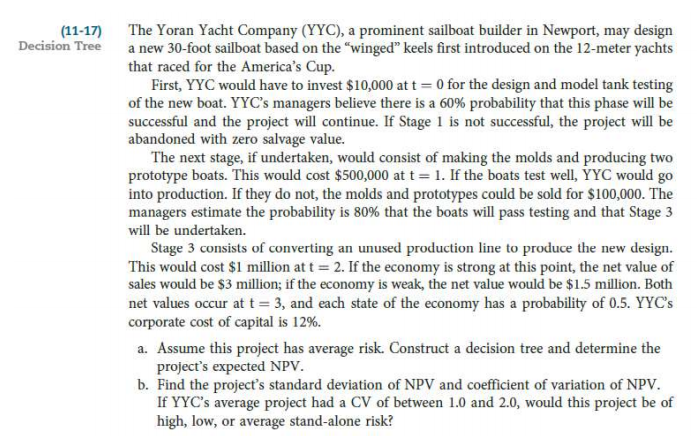
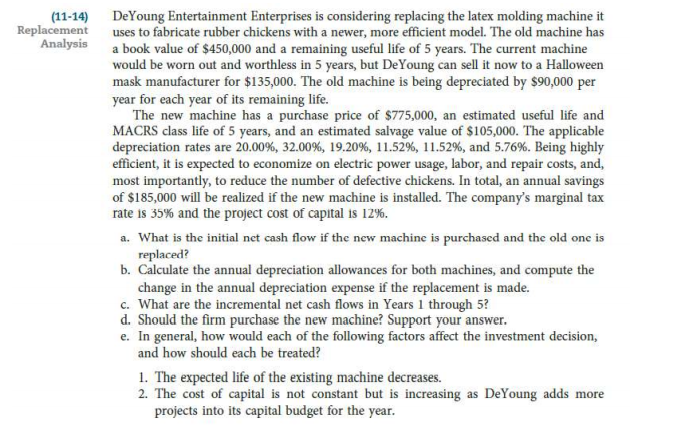
(11-14) Replacement Analysis DeYoung Entertainment Enterprises is considering replacing the latex molding machine it uses to fabricate rubber chickens with a newer, more efficient model. The old machine has a book value of $450,000 and a remaining useful life of 5 years. The current machine would be worn out and worthless in 5 years, but De Young can sell it now to a Halloween mask manufacturer for $135,000. The old machine is being depreciated by $90,000 per year for each year of its remaining life. The new machine has a purchase price of $775,000, an estimated useful life and MACRS class life of 5 years, and an estimated salvage value of $105,000. The applicable depreciation rates are 20.00%, 32.00%, 19.20%, 11.52%, 11.52%, and 5.76%. Being highly efficient, it is expected to economize on electric power usage, labor, and repair costs, and, most importantly, to reduce the number of defective chickens. In total, an annual savings of $185,000 will be realized if the new machine is installed. The company's marginal tax rate is 35% and the project cost of capital is 12%. a. What is the initial net cash flow if the new machine is purchased and the old one is replaced? b. Calculate the annual depreciation allowances for both machines, and compute the change in the annual depreciation expense if the replacement is made. c. What are the incremental net cash flows in Years 1 through 5? d. Should the firm purchase the new machine? Support your answer. e. In general, how would each of the following factors affect the investment decision, and how should each be treated? 1. The expected life of the existing machine decreases. 2. The cost of capital is not constant but is increasing as De Young adds more projects into its capital budget for the year. (11-17) The Yoran Yacht Company (YYC), a prominent sailboat builder in Newport, may design Decision Tree a new 30-foot sailboat based on the "winged" keels first introduced on the 12-meter yachts that raced for the America's Cup. First, YYC would have to invest $10,000 at t=0 for the design and model tank testing of the new boat. YYC's managers believe there is a 60% probability that this phase will be successful and the project will continue. If Stage 1 is not successful, the project will be abandoned with zero salvage value. The next stage, if undertaken, would consist of making the molds and producing two prototype boats. This would cost $500,000 at t = 1. If the boats test well, YYC would go into production. If they do not, the molds and prototypes could be sold for $100,000. The managers estimate the probability is 80% that the boats will pass testing and that Stage 3 will be undertaken. Stage 3 consists of converting an unused production line to produce the new design. This would cost $1 million at t = 2. If the economy is strong at this point, the net value of sales would be $3 million; if the economy is weak, the net value would be $1.5 million. Both net values occur at t = 3, and each state of the economy has a probability of 0.5. YYC's corporate cost of capital is 12%. a. Assume this project has average risk. Construct a decision tree and determine the project's expected NPV. b. Find the project's standard deviation of NPV and coefficient of variation of NPV. If YYC's average project had a CV of between 1.0 and 2.0, would this project be of high, low, or average stand-alone risk
Step by Step Solution
There are 3 Steps involved in it

Get step-by-step solutions from verified subject matter experts
 Study Help