







Question: Problem 1 (See Appendix for numerical inputs De and CR) Real Great Foods (RGF) is a distributor of frozen food products. They source large quantities
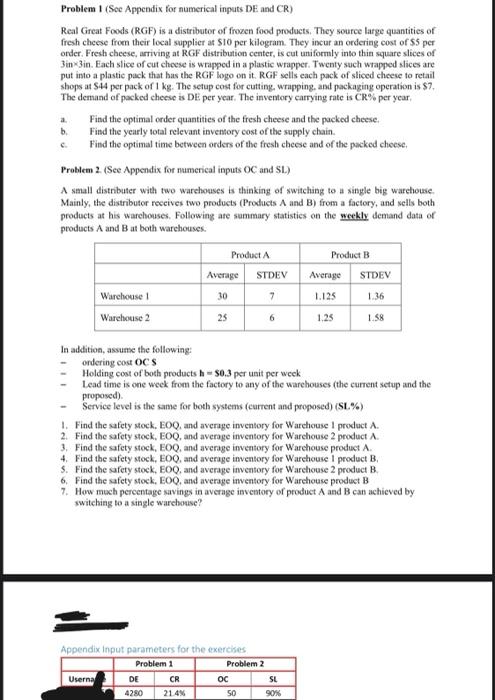
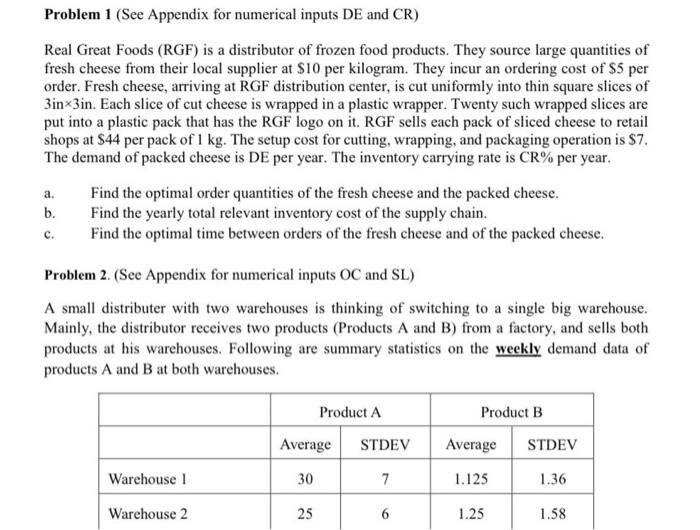
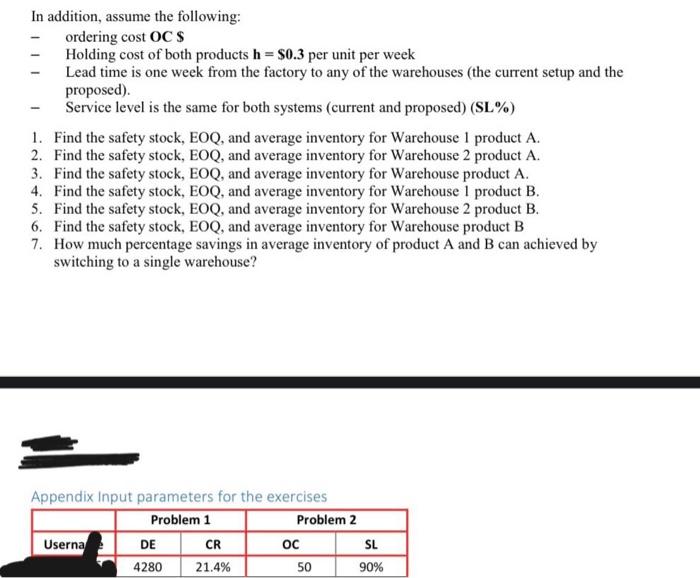
Problem 1 (See Appendix for numerical inputs De and CR) Real Great Foods (RGF) is a distributor of frozen food products. They source large quantities of fresh cheese from their local supplier at SIO per kilogram. They incur an ordering cost of $5 per order. Fresh cheese, arriving at RGF distribution center, is cut uniformly into thin square slices of 3in 3in. Each slice of cut cheese is wrapped in a plastic wrapper. Twenty such wrapped slices are put into a plastic pack that has the RGF logo on it. RGF sells each pack of sliced cheese to retail shops at S44 per pack of 1 kg. The setup cost for cutting, wrapping and packaging operation is $7. The demand of packed cheese s DE per year. The inventory carrying rate is CR% per year, Find the optimal order quantities of the fresh cheese and the packed cheese b Find the yearly total relevant inventory cost of the supply chain. Find the optimal time between orders of the fresh cheese and of the packed cheese Problem 2. (See Appendix for numerical inputs OC and SL.) A small distributer with two warehouses is thinking of switching to a single big warchouse. Mainly, the distributor receives two products (Products A and B) from a factory, and sells both products at his warchouses. Following ate summary statistics on the weekly demand data of products A and B at both warehouses. Product A Average STDEV Product B Average STDEV 1.125 1.36 30 7 Warehouse Warehouse 2 25 6 1.25 1.58 In addition, assume the following: ordering cost OCS Holding cost of both products h - 50.3 per unit per week Lead time is one week from the factory to any of the warehouses (the current setup and the proposed) Service level is the same for both systems (current and proposed) (SL%) 1. Find the safety stock. EOQ, and average inventory for Warchouse product A. 2. Find the safety stock, EOQ, and average inventory for Warehouse 2 product A 3. Find the safety stock, EOQ, and average inventory for Warehouse product A. 4. Find the safety stock, E00, and average inventory for Warehouse 1 product B $. Find the safety stock, EOQ, and average inventory for Warehouse 2 product B 6. Find the safety stock, EOQ, and average inventory for Warchouse product B 7. How much percentage savings in average inventory of product A and B can achieved by switching to a single warehouse? Appendix input parameters for the exercises Problem 1 Problem 2 Userna DE CR OC SL 4280 21.4% 50 90% Problem 1 (See Appendix for numerical inputs De and CR) Real Great Foods (RGF) is a distributor of frozen food products. They source large quantities of fresh cheese from their local supplier at $10 per kilogram. They incur an ordering cost of $5 per order. Fresh cheese, arriving at RGF distribution center, is cut uniformly into thin square slices of 3in3in. Each slice of cut cheese is wrapped in a plastic wrapper. Twenty such wrapped slices are put into a plastic pack that has the RGF logo on it. RGF sells each pack of sliced cheese to retail shops at $44 per pack of 1 kg. The setup cost for cutting, wrapping, and packaging operation is $7. The demand of packed cheese is DE per year. The inventory carrying rate is CR% per year. Find the optimal order quantities of the fresh cheese and the packed cheese. b. Find the yearly total relevant inventory cost of the supply chain. Find the optimal time between orders of the fresh cheese and of the packed cheese. a. c. Problem 2. (See Appendix for numerical inputs OC and SL) A small distributer with two warehouses is thinking of switching to a single big warehouse. Mainly, the distributor receives two products (Products A and B) from a factory, and sells both products at his warehouses. Following are summary statistics on the weekly demand data of products A and B at both warehouses. Product A Product B Average STDEV Average STDEV Warehouse 1 30 7 1.125 1.36 Warehouse 2 25 6 1.25 1.58 In addition, assume the following: ordering cost OCS Holding cost of both products h = $0.3 per unit per week Lead time is one week from the factory to any of the warehouses (the current setup and the proposed). Service level is the same for both systems (current and proposed) (SL%) 1. Find the safety stock, EOQ, and average inventory for Warehouse 1 product A. 2. Find the safety stock, EOQ, and average inventory for Warehouse 2 product A. 3. Find the safety stock, EOQ, and average inventory for Warehouse product A. 4. Find the safety stock, EOQ, and average inventory for Warehouse 1 product B. 5. Find the safety stock, EOQ, and average inventory for Warehouse 2 product B. 6. Find the safety stock, EOQ, and average inventory for Warehouse product B 7. How much percentage savings in average inventory of product A and B can achieved by switching to a single warehouse? Appendix Input parameters for the exercises Problem 1 Problem 2 Userna DE SL 4280 21.4% 50 90% CR Problem 1 (See Appendix for numerical inputs De and CR) Real Great Foods (RGF) is a distributor of frozen food products. They source large quantities of fresh cheese from their local supplier at SIO per kilogram. They incur an ordering cost of $5 per order. Fresh cheese, arriving at RGF distribution center, is cut uniformly into thin square slices of 3in 3in. Each slice of cut cheese is wrapped in a plastic wrapper. Twenty such wrapped slices are put into a plastic pack that has the RGF logo on it. RGF sells each pack of sliced cheese to retail shops at S44 per pack of 1 kg. The setup cost for cutting, wrapping and packaging operation is $7. The demand of packed cheese s DE per year. The inventory carrying rate is CR% per year, Find the optimal order quantities of the fresh cheese and the packed cheese b Find the yearly total relevant inventory cost of the supply chain. Find the optimal time between orders of the fresh cheese and of the packed cheese Problem 2. (See Appendix for numerical inputs OC and SL.) A small distributer with two warehouses is thinking of switching to a single big warchouse. Mainly, the distributor receives two products (Products A and B) from a factory, and sells both products at his warchouses. Following ate summary statistics on the weekly demand data of products A and B at both warehouses. Product A Average STDEV Product B Average STDEV 1.125 1.36 30 7 Warehouse Warehouse 2 25 6 1.25 1.58 In addition, assume the following: ordering cost OCS Holding cost of both products h - 50.3 per unit per week Lead time is one week from the factory to any of the warehouses (the current setup and the proposed) Service level is the same for both systems (current and proposed) (SL%) 1. Find the safety stock. EOQ, and average inventory for Warchouse product A. 2. Find the safety stock, EOQ, and average inventory for Warehouse 2 product A 3. Find the safety stock, EOQ, and average inventory for Warehouse product A. 4. Find the safety stock, E00, and average inventory for Warehouse 1 product B $. Find the safety stock, EOQ, and average inventory for Warehouse 2 product B 6. Find the safety stock, EOQ, and average inventory for Warchouse product B 7. How much percentage savings in average inventory of product A and B can achieved by switching to a single warehouse? Appendix input parameters for the exercises Problem 1 Problem 2 Userna DE CR OC SL 4280 21.4% 50 90% Problem 1 (See Appendix for numerical inputs De and CR) Real Great Foods (RGF) is a distributor of frozen food products. They source large quantities of fresh cheese from their local supplier at $10 per kilogram. They incur an ordering cost of $5 per order. Fresh cheese, arriving at RGF distribution center, is cut uniformly into thin square slices of 3in3in. Each slice of cut cheese is wrapped in a plastic wrapper. Twenty such wrapped slices are put into a plastic pack that has the RGF logo on it. RGF sells each pack of sliced cheese to retail shops at $44 per pack of 1 kg. The setup cost for cutting, wrapping, and packaging operation is $7. The demand of packed cheese is DE per year. The inventory carrying rate is CR% per year. Find the optimal order quantities of the fresh cheese and the packed cheese. b. Find the yearly total relevant inventory cost of the supply chain. Find the optimal time between orders of the fresh cheese and of the packed cheese. a. c. Problem 2. (See Appendix for numerical inputs OC and SL) A small distributer with two warehouses is thinking of switching to a single big warehouse. Mainly, the distributor receives two products (Products A and B) from a factory, and sells both products at his warehouses. Following are summary statistics on the weekly demand data of products A and B at both warehouses. Product A Product B Average STDEV Average STDEV Warehouse 1 30 7 1.125 1.36 Warehouse 2 25 6 1.25 1.58 In addition, assume the following: ordering cost OCS Holding cost of both products h = $0.3 per unit per week Lead time is one week from the factory to any of the warehouses (the current setup and the proposed). Service level is the same for both systems (current and proposed) (SL%) 1. Find the safety stock, EOQ, and average inventory for Warehouse 1 product A. 2. Find the safety stock, EOQ, and average inventory for Warehouse 2 product A. 3. Find the safety stock, EOQ, and average inventory for Warehouse product A. 4. Find the safety stock, EOQ, and average inventory for Warehouse 1 product B. 5. Find the safety stock, EOQ, and average inventory for Warehouse 2 product B. 6. Find the safety stock, EOQ, and average inventory for Warehouse product B 7. How much percentage savings in average inventory of product A and B can achieved by switching to a single warehouse? Appendix Input parameters for the exercises Problem 1 Problem 2 Userna DE SL 4280 21.4% 50 90% CR
Step by Step Solution
There are 3 Steps involved in it

Get step-by-step solutions from verified subject matter experts
 Study Help