







Question: Problem 1: Short-Run Prot Maximization [10 points] Consider a rm that uses both capital {K} and labour [L] to produce a nal product [C1] that
![Problem 1: Short-Run Prot Maximization [10 points] Consider a rm that](https://s3.amazonaws.com/si.experts.images/answers/2024/06/667536412f928_633667536410c602.jpg)
![uses both capital {K} and labour [L] to produce a nal product](https://s3.amazonaws.com/si.experts.images/answers/2024/06/66753641a5973_633667536417b1a1.jpg)
![[C1] that it sells at the market price 55. The rm buys](https://s3.amazonaws.com/si.experts.images/answers/2024/06/6675364211f28_63366753641dfa12.jpg)
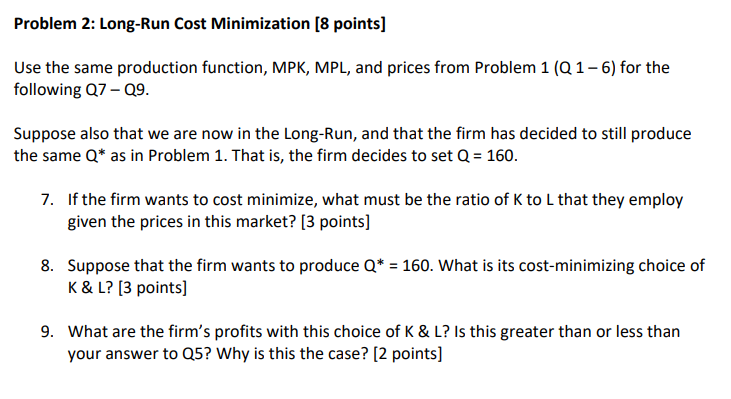
Problem 1: Short-Run Prot Maximization [10 points] Consider a rm that uses both capital {K} and labour [L] to produce a nal product [C1] that it sells at the market price 55. The rm buys Labour at a cost of $4 per unit and capital at a cost of $10 per unit. The rm is a pricetaker for all prices with the following production function: .9 = 4K1f2L1f2 This production function implies the following: Llfz MPK = 2 Kll'z Kifz MPL = Luz Suppose also that the firm currently has 16 units of capital [K = 15] in the ShortRun. For 0.1 (16, assume that we are operating in the ShortRun: 1. Given the above production function, write down an expression for Labour employed as a function of the quantity produced (Le. L = film]. [1 point] 2. Use the MPL and the wage rate to write down an expression for the Firm's Marginal Cost per unit of output ({1} produced as a function of (1. [3 points] 3. Show that the rm's protmaximizing quantity {431*} is equal to 160 in the shortru n. [1 point] 4. What are the firm's variable costs {VC} and xed costs {FC} at 0.\"? [2 points] 5. What are this rm's shortrun prots in this example? [1 point] 5. What would be the rm's ShortRun prots if it chooses to shut down? Should the rm keep producing in the shortrun? How do you know? [2 points] Problem 2: Long-Run Cost Minimization [8 points] Use the same production function, MPK, MPL, and prices from Problem 1 [C1 1- 6] for the following [1? C19. Suppose also that we are now in the LongRun, and that the rm has decided to still produce the same {1* as in Problem 1. That is, the rm decides to set C1 = 160. 7. If the firm wants to cost minimize, what must he the ratio of K to L that the~.,t employ given the prices in this market? [3 points] 3. Suppose that the rm wants to produce {1* = 160. What is its cost-minimizing choice of K El. L? [3 points] 9. What are the firm's prots with this choice of K 84. L? Is this greater than or less than your answer to C15? Whyf is this the case? [2 points]
Step by Step Solution
There are 3 Steps involved in it

Get step-by-step solutions from verified subject matter experts
 Study Help