







Question: Second picture shows everything you need for Problem 2 Problem 2: Long-Run Cost Minimization [8 points] Use the same production function, MPK, MPL, and prices
![Long-Run Cost Minimization [8 points] Use the same production function, MPK, MPL,](https://dsd5zvtm8ll6.cloudfront.net/si.experts.images/questions/2024/10/66fb87634372d_22666fb8762bcf19.jpg)
Second picture shows everything you need for Problem 2
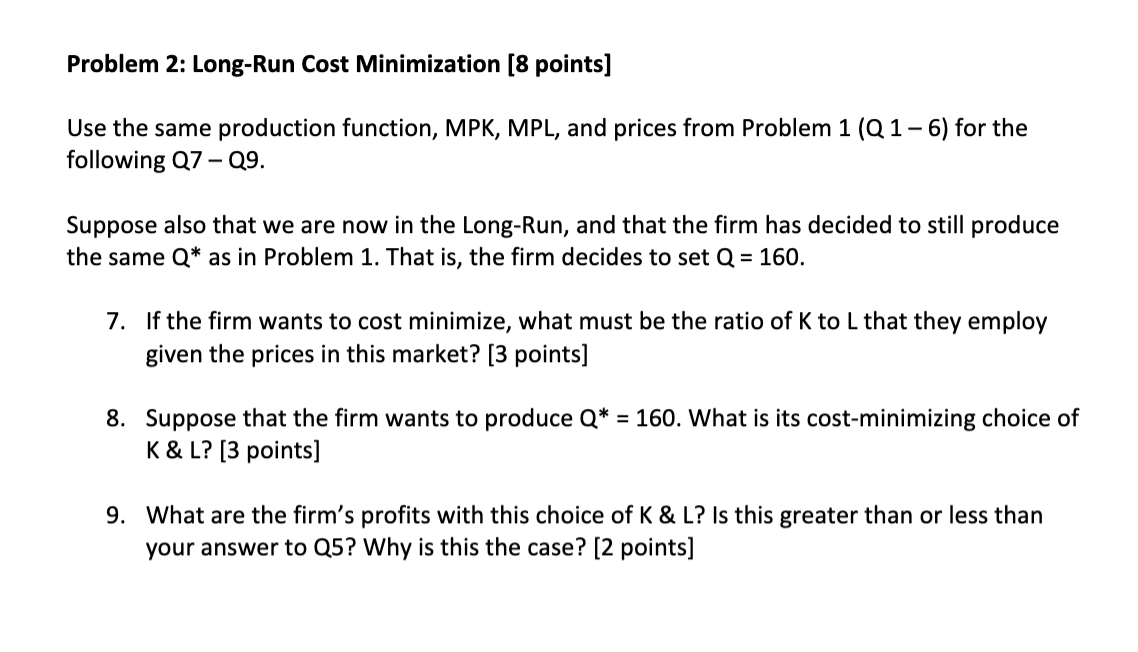
Problem 2: Long-Run Cost Minimization [8 points] Use the same production function, MPK, MPL, and prices from Problem 1(Q16) for the following Q7-Q9. Suppose also that we are now in the Long-Run, and that the firm has decided to still produce the same Q as in Problem 1 . That is, the firm decides to set Q=160. 7. If the firm wants to cost minimize, what must be the ratio of K to L that they employ given the prices in this market? [3 points] 8. Suppose that the firm wants to produce Q=160. What is its cost-minimizing choice of K&L ? [3 points] 9. What are the firm's profits with this choice of K \& L ? Is this greater than or less than your answer to Q5? Why is this the case? [2 points] Consider a firm that uses both capital (K) and labour (L) to produce a final product (Q) that it sells at the market price $5. The firm buys Labour at a cost of $4 per unit and capital at a cost of $10 per unit. The firm is a price-taker for all prices with the following production function: Q=4K1/2L1/2 This production function implies the following: MPK=2K1/2L1/2MPL=2L1/2K1/2 Problem 2: Long-Run Cost Minimization [8 points] Use the same production function, MPK, MPL, and prices from Problem 1(Q16) for the following Q7-Q9. Suppose also that we are now in the Long-Run, and that the firm has decided to still produce the same Q as in Problem 1 . That is, the firm decides to set Q=160. 7. If the firm wants to cost minimize, what must be the ratio of K to L that they employ given the prices in this market? [3 points] 8. Suppose that the firm wants to produce Q=160. What is its cost-minimizing choice of K&L ? [3 points] 9. What are the firm's profits with this choice of K \& L ? Is this greater than or less than your answer to Q5? Why is this the case? [2 points] Consider a firm that uses both capital (K) and labour (L) to produce a final product (Q) that it sells at the market price $5. The firm buys Labour at a cost of $4 per unit and capital at a cost of $10 per unit. The firm is a price-taker for all prices with the following production function: Q=4K1/2L1/2 This production function implies the following: MPK=2K1/2L1/2MPL=2L1/2K1/2
Step by Step Solution
There are 3 Steps involved in it

Get step-by-step solutions from verified subject matter experts
 Study Help