



Question: Problem 1. The first part of the implementation is to write some preliminaries useful later. a) We're often going to need to use some form
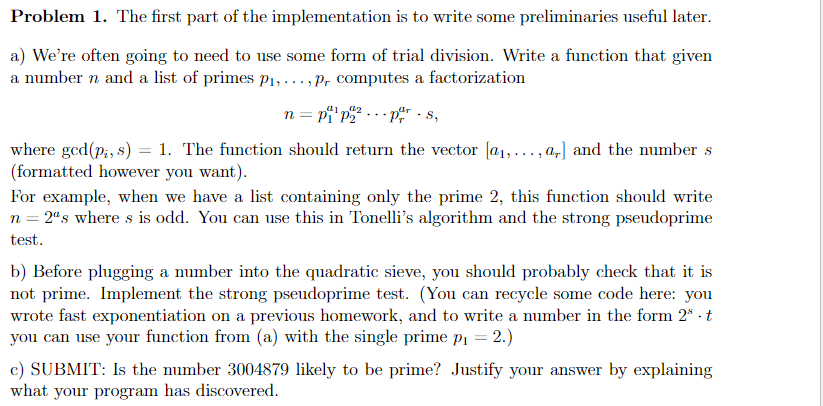
Problem 1. The first part of the implementation is to write some preliminaries useful later. a) We're often going to need to use some form of trial division. Write a function that given a number n and a list of primes p1, . . ., p, computes a factorization 1 2 . . . Pr n = PI P2 ar . S. where god(p;, s) = 1. The function should return the vector Jaj, ...,a, and the number s (formatted however you want.). For example, when we have a list containing only the prime 2, this function should write n = 2''s where s is odd. You can use this in Tonelli's algorithm and the strong pseudoprime test. b) Before plugging a number into the quadratic sieve, you should probably check that it is not prime. Implement the strong pseudoprime test. (You can recycle some code here: you wrote fast exponentiatron on a previous homework, and to write a number in the form 2" . t you can use your function from (a) with the single prime p, = 2.) c) SUBMIT: Is the number 3004879 likely to be prime? Justify your answer by explaining what your program has discovered
Step by Step Solution
There are 3 Steps involved in it

Get step-by-step solutions from verified subject matter experts